CAAS Urges PM to Deploy AI in Tax Administration to Eliminate Corruption and Protect Taxpayer Data:
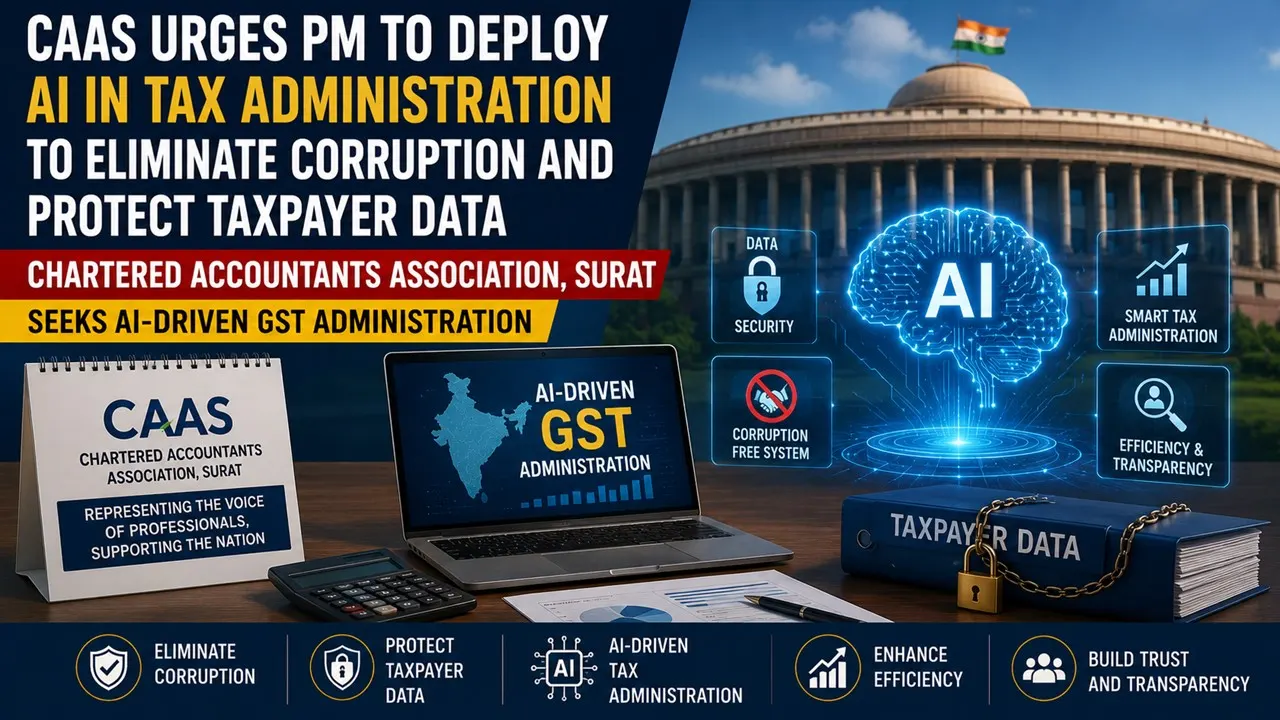
The Chartered Accountants Association, Surat (CAAS) has submitted a detailed representation to the Prime Minister of India advocating large-scale deployment of Artificial Intelligence in tax administration.
Chartered Accountants Association, Surat seeks AI-driven GST administration
 Saima
Saima Jun 15, 2026
CAAS Urges PM to Deploy AI in Tax Administration to Eliminate Corruption and Protect Taxpayer Data
The Chartered Accountants Association, Surat, has addressed a representation dated 11 June 2026 to the Prime Minister of India after claiming that earlier representations made before the Commissioner of State Tax, Gujarat and the Finance Ministry had not yielded any meaningful action. The Chartered Accountants Association, Surat, has proposed that structural reforms through Artificial Intelligence would eliminate opportunities for corruption and enhance transparency in tax administration.
According to the Association, several functions under the GST regime, such as registration, refunds, assessments and cancellation of registrations, continue to be affected by delays and alleged corrupt practices. The Association stated that such discretionary powers have created what it termed an "Alms economy", wherein taxpayers are compelled to make unofficial payments to secure routine approvals.
CAAS claimed that confidential GST information, including GSTR-1 details, e-way bills and e-invoices, is allegedly available through data brokers operating in the open market. It stated that they brought the issue to the notice of the Finance Ministry in 2025 but the problem still exists, and taxpayers and professionals continue to receive calls offering access to competitors' data. The Association also referred to earlier surveys conducted across Gujarat that allegedly indicated region-wise rates for obtaining registrations, assessments and refunds.
The Association suggested that repetitive and objective functions should be handled by Artificial Intelligence, while adverse actions should continue to require intervention by human officers with recorded reasons. The Association referred to the Supreme Court's Draft Regulations for Use of Artificial Intelligence in Courts, 2026 and observed that the judiciary has already adopted a framework favouring responsible use of AI and argued for the same in the taxation industry.
The Association proposed certain solutions to integrate AI in Tax administration such as:
- AI-based processing of GST registrations, refunds and cancellations
- Encryption and audit trails for taxpayer data on GSTN
- Machine-readable reasoning logs for AI-assisted decisions
- AI-assisted scrutiny of departmental appeals
- A one-time amnesty for time-barred first appeals under Section 107 of the CGST Act
- Mandatory service of notices upon authorised representatives
- Annual independent audits of algorithms and publication of transparency reports.

About Author


Saima
Content Writer
Saima is a Law graduate with a passion for research and content writing. She writes for Finance, Taxation and Legal Updates at Studycafe.in, simplifying complex legal decisions by the ITAT, High Court, AAR and GSTAT into uncomplicated and clear explanations.
Saima is a Law graduate with a passion for research and content writing. She writes for Finance, Taxation and Legal Updates at Studycafe.in, simplifying complex legal decisions by the ITAT, High Court, AAR and GSTAT into uncomplicated and clear explanations.
 StudyCafe
 Delhi, Delhi, India
 555
555My Recent Articles
- High Court Quashes GST Demand Against Amul Over Non-Cross-Charging of Common Expenses
- High Court Quashes Income Tax Demand Against Contractual Worker Over Misuse of PAN
- ITAT Deletes Rs 2.06 Crore Addition Under Section 68 for Unsecured Loans
- ITAT Holds Section 263 Revision Invalid on Taxability of Interest Under Section 28 of Land Acquisition Act
- ITAT Upholds Section 68 Addition for Bogus Loans But Restricts Estimated Profit to 2% of Sales
Up Next
Loading suggestions…


Recent Posts


All Posts
Tags
Recent Posts
All Posts