Delhi High Court Declines to Entertain GST Writ Petition Due to The Availability of Appeal Remedy:
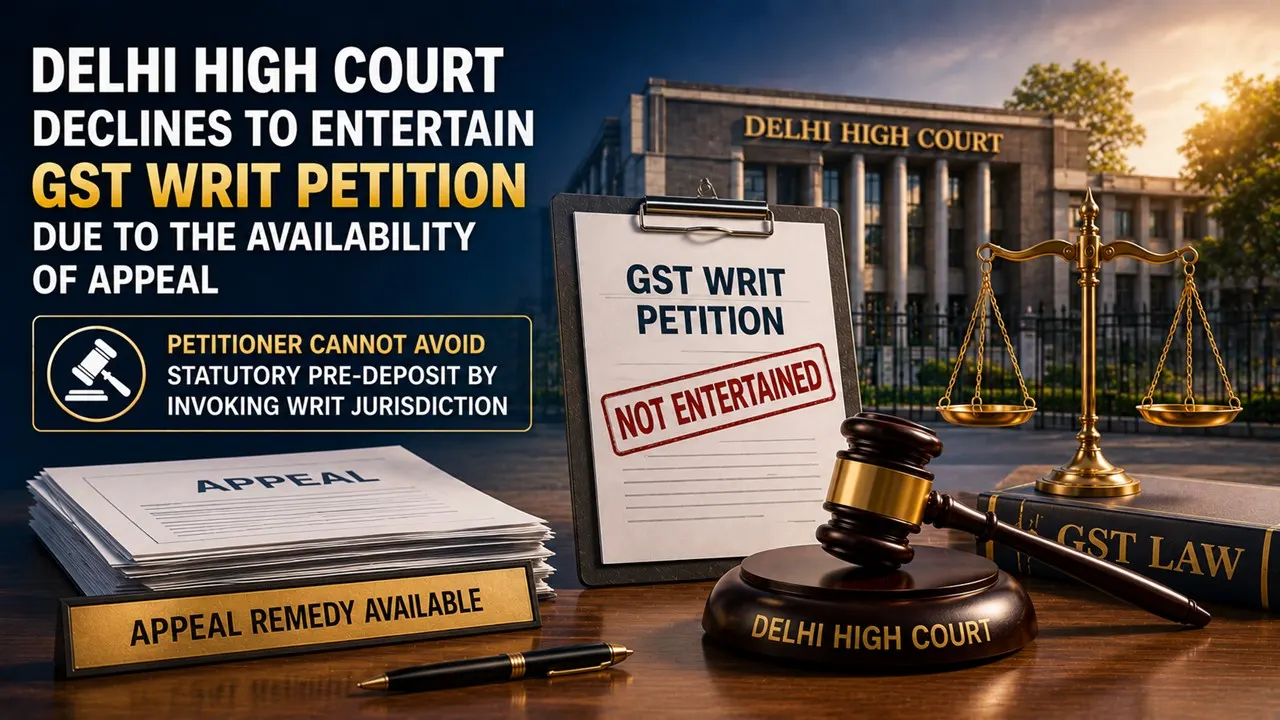
The Delhi High Court has dismissed a writ petition challenging an Order-in-Original passed under Section 74 of the CGST Act, holding that the existence of an effective alternative statutory remedy bars interference under Article 226 of the Constitution.
Petitioner Cannot Avoid Statutory Pre-Deposit by Invoking Writ Jurisdiction
 Saima
Saima Jun 7, 2026
Delhi High Court Declines to Entertain GST Writ Petition Due to The Availability of Appeal Remedy
The Delhi High Court held that proceedings under Sections 73 and 74 of the CGST Act are independent in nature and availability of Appeal remedy bars the Writ jurisdiction.
The petitioners challenged the Order-in-Original dated March 30, 2026, challenging the proceedings initiated by the Central GST Authorities under Section 74 of the Central Goods and Services Tax Act, contending that they were barred by Section 6(2)(b) of the Act. The petitioners argued that the State authorities had already concluded proceedings initiated under Section 73 of the CGST Act on the basis of the same set of documents and evidence and the Central GST Authorities proceeded to pass an adverse order despite the production of identical documents.
The petitioners further alleged that adequate opportunity of hearing had not been granted and the impugned order suffered from arbitrary and discriminatory treatment in violation of Article 14 of the Constitution.
The respondents objected to the maintainability of the writ petition, submitting that the statute provides an alternative remedy of appeal, which is equally effective. The respondents also contended that questions concerning appreciation of evidence fall within the domain of the concerned appellate authority and cannot be re-examined by the High Court in exercise of its writ jurisdiction.
A Division Bench of the Delhi High Court held that Sections 73 and 74 of the CGST Act operate independently in different arenas and merely because the petitioners had been exonerated by the State GST Authorities in proceedings under Section 73, it could not automatically prevent the Central GST Authorities from initiating proceedings under Section 74.
The Court further reiterated that where an effective statutory remedy of appeal is available, disputes relating to appreciation of evidence and procedural grievances must ordinarily be examined by the appellate authority and not in writ proceedings under Article 226 of the Constitution. Finding no exceptional circumstance warranting interference, the High Court declined to exercise its jurisdiction under Article 226 and dismissed the writ petition.

About Author


Saima
Content Writer
Saima is a Law graduate with a passion for research and content writing. She writes for Finance, Taxation and Legal Updates at Studycafe.in, simplifying complex legal decisions by the ITAT, High Court, AAR and GSTAT into uncomplicated and clear explanations.
Saima is a Law graduate with a passion for research and content writing. She writes for Finance, Taxation and Legal Updates at Studycafe.in, simplifying complex legal decisions by the ITAT, High Court, AAR and GSTAT into uncomplicated and clear explanations.
 StudyCafe
 Delhi, Delhi, India
 555
555My Recent Articles
- High Court Quashes GST Demand Against Amul Over Non-Cross-Charging of Common Expenses
- High Court Quashes Income Tax Demand Against Contractual Worker Over Misuse of PAN
- ITAT Deletes Rs 2.06 Crore Addition Under Section 68 for Unsecured Loans
- ITAT Holds Section 263 Revision Invalid on Taxability of Interest Under Section 28 of Land Acquisition Act
- ITAT Upholds Section 68 Addition for Bogus Loans But Restricts Estimated Profit to 2% of Sales
Up Next
Loading suggestions…


Recent Posts

All Posts
Recent Posts
All Posts