GST: Input tax credit on Closing stock as on 30.06.2017
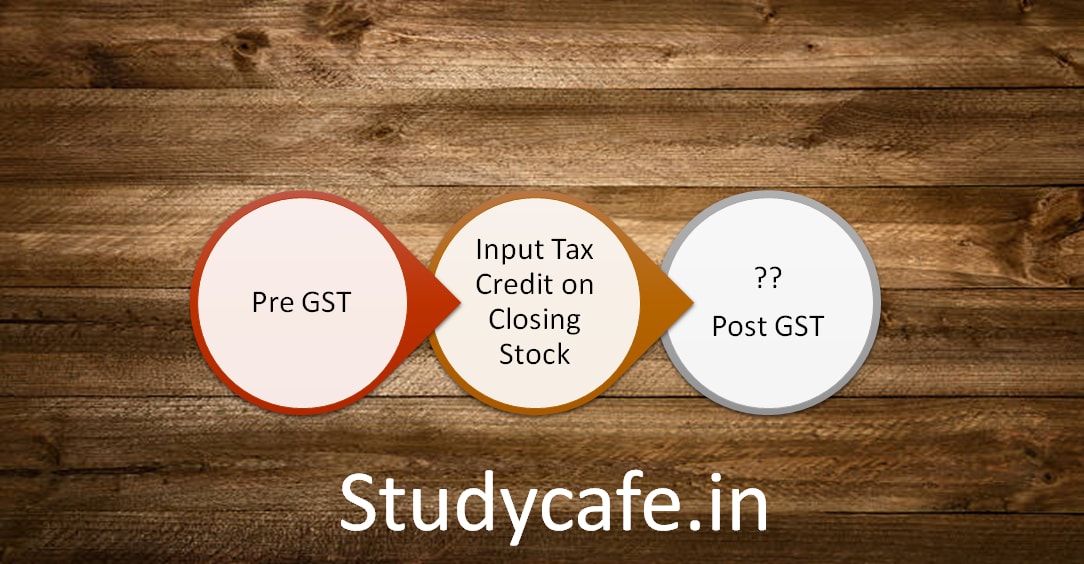
GST: Input tax credit on Closing stock as on 30.06.2017: GST has been implemented from 01.07.2017, Now every businessman/ trader/dealer/ man
 Ankita Khetan
 Jul 7, 2017
GST: Input tax credit on Closing stock as on 30.06.2017:
GST has been implemented from 01.07.2017, Now every businessman/ trader/dealer/ manufacturer/service provider have one big confusion and question in mind. What will happen of the unsold stock as on 30.06.2017 who all are eligible for input tax credit How the VAT credit will be treated How much percentage credit will be allowed as input credit What all documents are needed to avail the input credit How should the accounting be done for closing stock, Input tax credit on closing stock under GST, GST impact on old inventory, Input tax credit on closing stock under GST, GST Impact on closing stock, Moving to GST: Can I Avail Input Credit on Closing Stock etc..- The Central Board of Excise Board and Revenue Department said: "The law allows you to carry forward your inputs tax credit and ensures that no input tax credit will be lost while migrating/transitioning to the new regime."
- The CBEC has come out with clarifications on what details will be required to avail input tax credit available to manufacturers, traders and service providers under GST.
On the date of transitioning to GST Businesses which fall under any of the following categories subject to certain conditions will be eligible to claim input tax credit:
- The person who is registered either as a first stage dealer, second stage dealer or a registered importer.
- First stage dealer and second dealer are liable for registration under Central Excise if they deal/trade in excisable goods.
- They are not eligible to take credit of excise duty paid, but they are permitted to pass on this credit of the duty paid to registered manufacturer. (As this increases the final cost of the product as first stage or second stage dealer adds the excise duty paid to the price of the product.)
- This excise duty which is paid by first stage & second stage dealer is allowed as a input credit to the registered manufacturer of dutiable goods.
- Similarly, one needs to get registered as an importer under Central Excise if deals in import of goods, and discharge the applicable import duty.
- Businesses which are not required/liable to be registered under any of the current laws but needs a registration under GST.
- As per VAT, businesses are required to be registered only when turnover during the financial year crosses the threshold limit. The threshold limit is different from state to state.
- As per the Central Excise Act and Rules, businesses which are involved in manufacturing are required to be registered only when the aggregate clearance value crosses Rs 1.5 crores (threshold limit), and the liability to discharge the duty arises.
- But after the implementation of GST, same businesses may require to be registered as threshold limit are not the same as current laws (VAT, Central Excise Act and Rules) .
- As per GST, businesses will require registration, if the aggregate turnover exceeds Rs 10 lakhs for Special Category States (Arunachal Pradesh, Assam, Jammu and Kashmir, Manipur, Meghalaya, Mizoram, Nagaland, Sikkim, Tripura, Himachal Pradesh and Uttarakhand) and Rs 20 Lakhs for the rest of India.
- Businesses which deals in either the manufacture or sale of exempted goods under current laws but the same goods become taxable under GST.
- As per the current laws, manufacture or sale of certain goods may be exempted, but if these become taxable after transition to GST.
- Businesses which provide works contract services or other services but avails the benefit of exemption notification for such services.
- As per the current laws, works contract services or other services you are providing may be exempted, but if these become taxable after transition to GST.
You May Also Like:
- How to File GSTR-1 Online
- How to File GSTR-1 Offline
Eligibility conditions to avail Input Tax credit for stock held as on 30.06.17
- The supplier of services is not eligible for any abatement under the act.
- Only if the closing stock is held either in the form of raw materials, semi-finished goods or finished goods, and it must be further used or intended to be used for taxable supplies. If it is further used or intended to be used for non taxable/exempt supplies then there will be no input tax credit.

- Only if one is a regular tax payer. That means if a taxable person opts for composition levy scheme under GST then claim of input tax credit will not be allowed.

- Only if the date of invoices or any other prescribed duty / tax paying documents(tax invoice/debit note/credit note/ supplementary invoice) should be within 12 months from the date of transition to GST.
- Only if one has invoices or any other prescribed duty/tax paying documents in respect of the closing stock. (i.e. raw material, semi-finished goods and finished goods).
- Only if the benefit of such input credit is passed on to the recipient by way of reduced prices. In current tax structure, for certain duty/tax which are not allowed as input credit are added to the cost of product. On transition to GST, if the input tax credit for such duty/tax is allowed, then this should naturally be passed on to the customer by way of reduction in the final price.
- You have invoices or any other prescribed duty/tax paying documents in respect of the closing stock of inputs (including semi-finished goods and finished goods). 100 % input tax credit will be allowed if you have invoice or any other document evidencing tax payment. In the absence of such document, the credit will allowed 60% / 40%
 GST: Input tax credit on closing stock as on 30.06.2017
As per Chapter XIV of Transitional Provisions of CGST Rules released on 01.06.2017, A registered person who was not registered under the existing law shall, in accordance with the proviso to sub-section (3) of section 140, be allowed to avail of input tax credit on goods (on which the duty of central excise or, as the case may be, additional duties of customs under sub-section (1) of section 3 of the Customs Tariff Act, 1975, is leviable) held in stock on the appointed day in respect of which he is not in possession of any document evidencing payment of central excise duty.
(ii) The input tax credit referred to in sub-clause (i) shall be allowed at the rate of sixty per cent. on such goods which attract central tax at the rate of nine per cent. or more and forty per cent. for other goods of the central tax applicable on supply of such goods after the appointed date and shall be credited after the central tax payable on such supply has been paid:
Provided that where integrated tax is paid on such goods, the amount of credit shall be allowed at the rate of thirty per cent. and twenty per cent. respectively of the said tax;
(iii) The scheme shall be available for six tax periods from the appointed date.
The above rule has been explained in below table:
Now Let us understand this with an example. Rajiv Automobiles is a registered excise dealer in cars and car spare parts. On 1st June, 2017, Rajiv Automobiles purchased spare parts, and the details of transaction are given below:
| Date | Stock Item | Qty | Rate Per Unit | Unit | Base Value | Excise Duty @ 12.5% | VAT Amount @ 14.5% |
| 1-Mar-17 | Spares | 50 | 1,500 | Nos | 75,000 | 9,375 | 10,875 |
| Closing Stock as on 30-6-2017 | 30 Nos |
| Duty Per Unit ( Total Excise Duty 9,375 / Quantity 50 Nos ) | 187.5 / Unit |
| Balance Duty on closing Stock (Duty per unit 187.5 * Closing Stock 30 Nos ) | 5,625 |
- The closing stock held must be used or intended to be used for taxable supplies. Yes, the closing stock of 30 nos will be used for taxable supplies.
- The benefit of such credit must be passed on, by way of reduced prices, to the recipient. Since Input Tax credit is available, Rajiv Automobiles will no longer add this to the product cost. As a result the base cost will reduce, and subsequently result in reduction of price.
- They are eligible for Input Tax credit under GST.
- They should have invoices or any other prescribed duty/tax paying documents in respect of closing stock of inputs (including semi-finished goods and finished goods). Rajiv Automobiles has the Rule 11 invoice issued by their supplier (Manufacturer) in respect the closing stock of 30 nos.
- The date of invoices or any other prescribed duty/tax paying documents must be within 12 months from the date of transitioning to GST.
About Author


Ankita Khetan
Author
 765
765My Recent Articles
- ICAI announcement for CA Final Students issued on 7th May 2018
- Intra State E way bill to be roll out in Assam from May 16, 2018
- Press release for incentive for digital payments & change in GST Rate
- Changes in shareholding pattern of GSTN - Press release dated 4th May 2018
- Press Release issued by CBIC for Simplified GST Return System in 27th GST Council meeting
Up Next
Loading suggestions…


Recent Posts

All Posts


Tags
No tags yet.
Recent Posts
All Posts
Tags
No tags yet.