GSTAT Quashes Rs 1.96 Lakh Penalty on G P Motors for Stock Transfer Without E-Way Bill:
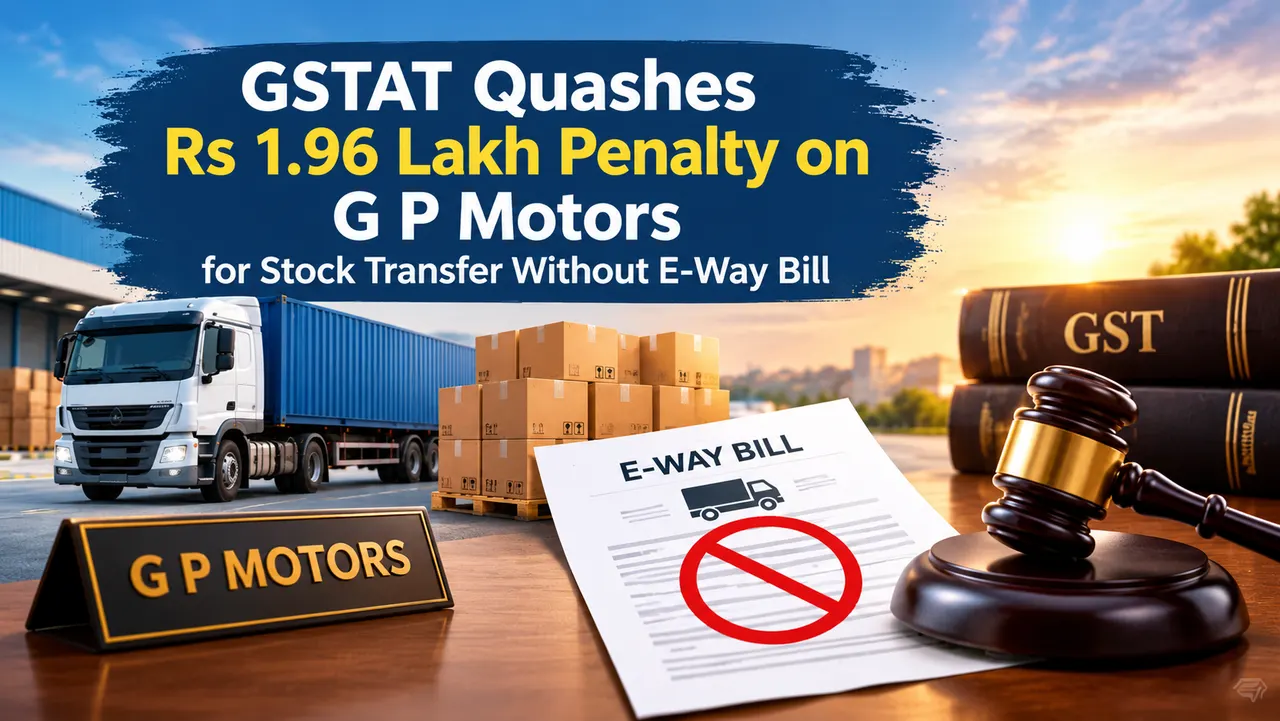
The GSTAT holds that absence of an E-Way bill does not, by Itself, establish tax evasion in a Bona Fide Stock Transfer.
GSTAT Held Penalty Unsustainable
 Saima
 Oct 27, 2026

G P Motors Private Limited, an authorised dealer of Honda Motorcycle & Scooter India Pvt. Ltd., regularly transfers two-wheelers from its godown at Naini to its showroom at Civil Lines, Prayagraj, approximately 14 km away. On 30 April 2025, the State Tax Mobile Squad intercepted the company's self-owned loader carrying five two-wheelers. The vehicles were valued at Rs 3.50 lakh and were being moved as an internal stock transfer. The Tribunal noted that Delivery Challan No. 718 dated 30 April 2025 was on record and that the vehicle details were reconciled with the challan through their engine and chassis numbers.
The tax authorities detained the goods and imposed a penalty of Rs 1,96,000 under Section 129(1) read with Section 129(3) of the Central Goods and Services Tax Act, 2017 and the Uttar Pradesh Goods and Services Tax Act, 2017, on the ground that the goods were transported without an e-way bill. The first appellate authority upheld the penalty by an order dated 24 July 2035.

The Tribunal clarified that Rule 138(1) of the CGST or UPGST Rules, 2017, requires an e-way bill for the movement of goods where the consignment value exceeds Rs 50,000, including movements for reasons other than supply. Rule 138(2) requires the registered person transporting goods in its own conveyance to generate the e-way bill, while Rule 138A(1) requires the person in charge of the conveyance to carry the prescribed documents.
The Tribunal observed that the five two-wheelers had been purchased from the manufacturer against valid tax invoices on which GST had already been paid. The subsequent movement was merely an internal transfer between the appellant's own godown and showroom, with no sale to a third party or consideration involved. Interpreting Section 7(1) of the CGST or UPGST Act, 2017, the Tribunal held that the transaction did not constitute a supply attracting tax under Section 9 of the Act in the facts of the case. Consequently, no tax was payable on the stock transfer at that stage.

The Tribunal also considered the appellant's explanation that it had acted under a bona fide misunderstanding of the distance-related provisions under Rule 138. It clarified that Rule 138(14)(n) provides a limited exemption for movement to and from a weighbridge within 20 km, while the relevant provisos to Rules 138(3) and 138(5) concern the updating of Part B details within specified conditions and do not dispense with the requirement to generate an e-way bill. Nevertheless, the Tribunal found that the documentation lapse did not establish a deliberate attempt to evade tax, particularly when the movement involved tax-paid goods and no fresh tax liability arose.
The Tribunal concluded that, on the facts of the case, the absence of an e-way bill constituted a procedural breach but did not establish the deliberate intent to evade tax necessary to sustain the penalty. The GSTAT allowed the appeal filed by G P Motors Private Limited and set aside the Order-in-Original dated 5 May 2025 and the Order-in-Appeal dated 24 July 2025. The penalty of Rs 1,96,000 imposed under Section 129 of the CGST or UPGST Act, 2017, was quashed.
About Author


Saima
Content Writer
 StudyCafe
 Delhi, Delhi, India
 583
My Recent Articles
- GSTAT Upholds Rs 12.55 Lakh Penalty on Undeclared Goods
- GSTAT Upholds GST Demand After Rejecting Manual Invoices Produced Three Months After Inspection
- GSTAT Holds GST Portal Glitches Cannot Defeat Statutory Remedy
- GSTAT Allows ITC of Previous Financial Year to Be Claimed in April 2019
- GSTAT Quashes Rs 1.77 Lakh Penalty on Saraswati Motors for Missing E-Way Bill
Loading suggestions…


Recent Posts

All Posts

Recent Posts
All Posts