HC Quashes Orders Passed Under Section 129(3) Where E-Way Bill Had Expired Due to Vehicle Breakdown:
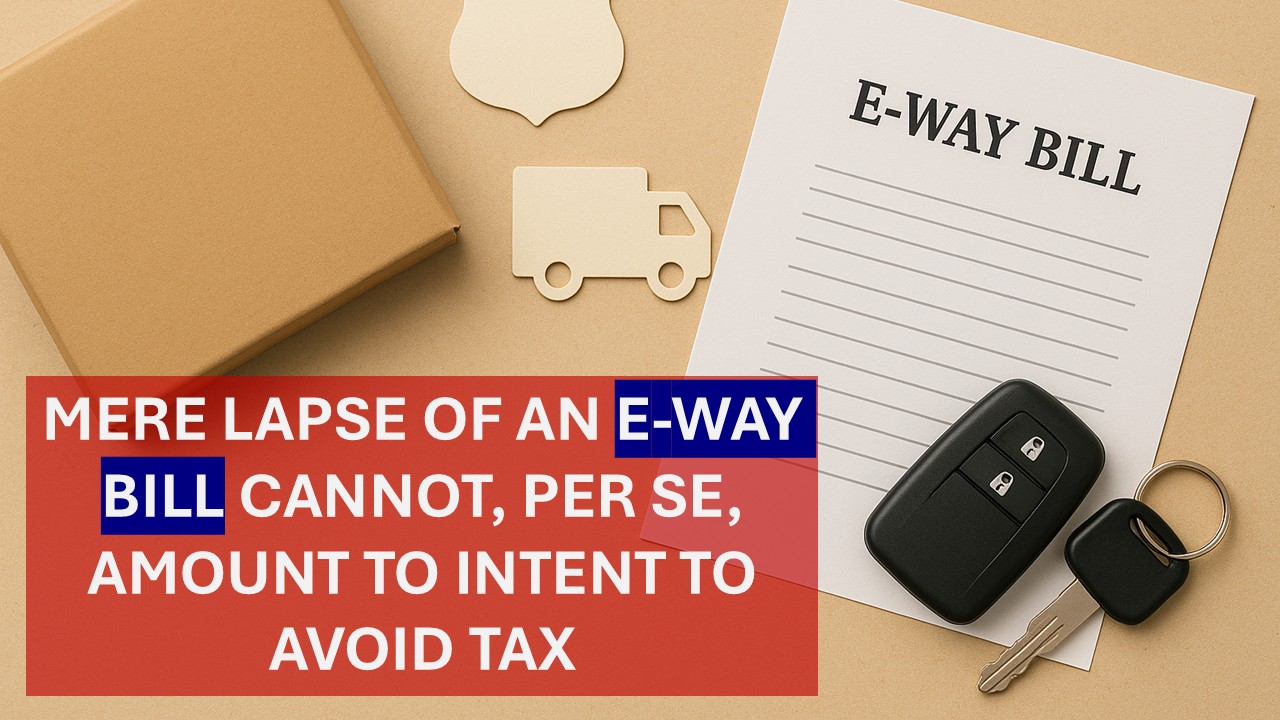
HC quashes orders under Section 129(3) of GST Act, holding that expiry of e-way bill due to vehicle breakdown and reissuance before seizure does not establish intent to evade tax
Expiry of e-way bill caused by vehicle breakdown and subsequent generation of new e-way bill before seizure held not indicative of tax evasion.
 Meetu Kumari
 Oct 27, 2025
HC Quashes Orders Passed Under Section 129(3) Where E-Way Bill Had Expired Due to Vehicle Breakdown
The petitioner, being a registered dealer who deals in providing vehicle-tracking services throughout India, instituted the current writ petition against the orders dated 27/12/2022 and 17/06/2023 issued by the authorities under Section 129(3) of the GST Act. The petitioner was engaged in the supply of GPS devices pursuant to a contract with the Surveyor General of India, National Geo-Spatial Data Centre. The goods were accompanied by proper tax invoices and a valid e-way bill having a validity of twelve days.
During the course of transit, the vehicle carrying the goods developed a mechanical breakdown. Without informing the petitioner, the driver attempted repairs but failed, and transferred the goods to another vehicle. Due to this the transport was delayed, and the e-way bill expired on 20/12/2022. Before the issuance of any order of seizure, the petitioner created new e-way bills on 22 December 2022 at 11:30 a.m. Still the goods were seized on the grounds of the expiry of the e-way bill, and penalty proceedings were launched under Section 129(3). The appellate authority thereafter upheld the levy.
Issue Raised: Whether failure of an e-way bill due to vehicle breakdown, followed by new e-way bill generation before seizure, would constitute intent to avoid payment of tax under Section 129(3) of the GST Act.
High Court Held: The Court ruled that the goods were under valid invoices and a valid e-way bill during dispatch, and the fact that a vehicle breakdown occurred or not was not at all disputed by the respondents. It was also noted that the petitioner had created a new e-way bill before the passing of the order under Section 129(3).
Dependent on the earlier judgments, such as Assistant Commissioner (ST) v. Satyam Shivam Papers Pvt. Ltd. and Ashoka P.U. Foam (India)Pvt. Ltd. v. State of U.P., the Court upheld once again that mere lapse of an e-way bill cannot, per se, amount to intent to avoid tax. As no mala fide intention was found from the facts and mechanically, the authorities had acted, the impugned orders were declared to be unsustainable in law. As a result, the orders dated 17/06/2023 and 27/12/2022 were quashed, and the writ petition was allowed.
To Read Full Judgment, Download PDF Given Below
About Author


Meetu Kumari
Content Manager
Meetu Kumari is an Experienced Advocate and Content Writer with 4+ years of demonstrated history of working in the law practice industry. Skilled in Developing Content, Researching, and Drafting. Strong professional with a Bachelor of Science (B.Sc.) focused on Law from Gujarat National Law University.
Meetu Kumari is an Experienced Advocate and Content Writer with 4+ years of demonstrated history of working in the law practice industry. Skilled in Developing Content, Researching, and Drafting. Strong professional with a Bachelor of Science (B.Sc.) focused on Law from Gujarat National Law University.
 Studycafe
 Jodhpur, Rajasthan, India
 2264
2264My Recent Articles
- ITAT Condones 302-Day Delay, Restores Salary Assessment for Fresh VerificationPremium
- ITAT Condones Delay After Tax Consultant's Death, Restores Appeals for Fresh HearingPremium
- ITAT Remands Salary Addition, Says Taxability Depends on Salary Becoming Due, Not Mere ReceiptPremium
- ITAT Deletes TP Royalty Adjustment, Orders Fresh Review of Commission BenchmarkingPremium
- ITAT Quashes Reassessment Over Unsigned Section 148 Notice Issued to AssesseePremium
Up Next
Loading suggestions…


Recent Posts
All Posts
Recent Posts
All Posts