ITAT Deletes Rs 2.60 Crore Addition, Holds Genuine Business Liabilities Can't Be Disallowed Merely Due to Cash Transactions:
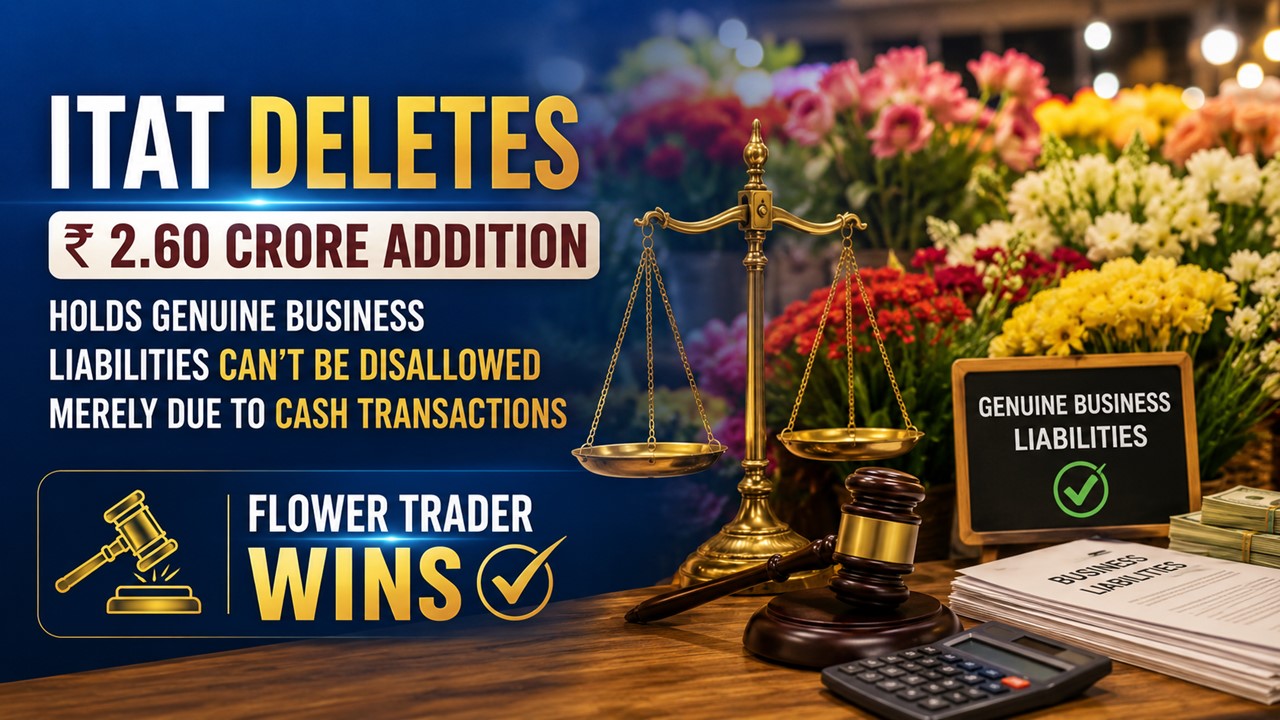
The ITAT upheld the deletion of an addition of Rs 2.60 crore, holding that the nature of the business itself cannot be a basis to conclude that outstanding creditor balances are non-genuine.
Flower Trader Wins as Rs 2.60 Crore Addition on Trade Creditors is Quashed
 Saloni Kumari
 Jun 26, 2026
ITAT Deletes Rs 2.60 Crore Addition, Holds Genuine Business Liabilities Can't Be Disallowed Merely Due to Cash Transactions
The Delhi Bench of the Income Tax Appellate Tribunal (ITAT) has dismissed the Income Tax Department’s appeal and upheld the deletion of an addition of Rs 2.60 crore made against taxpayer Arun Kumar Kanojia for Assessment Year 2014-15.
The assessee, Arun Kumar Kanojia, is an individual who runs a proprietorship firm named M/s Varun Decor and is involved in the business of supplying flowers, plants, stationery items, etc., and is also engaged in a wholesale business where he purchases flowers from farmers and other persons and thereafter sells them to retailers or customers in mandi (local market). The nature of this flower trade is primarily cash-driven, in relation to both purchases and sales. As per the assessee, he is generally able to generate a very small amount of profit from this flower trading.
During scrutiny assessment of the assessee's ITR for the AY 2014-15, the Assessing Officer (AO) treated the entire closing balance of sundry creditors amounting to Rs 2.60 crore as unexplained and non-genuine. The department claimed that the address provided was incorrect; hence the notices issued to creditors under Section 133(6) were returned unserved, and outstanding balances were not acceptable in a business largely conducted through cash transactions.
The aggrieved assessee filed an appeal before the lower appellate authority, i.e., the Commissioner of Income Tax (Appeals) [CIT(A)], which when analysed the case, deleted the addition after noting that the assessee had maintained audited books of account and had furnished ledger accounts, confirmations from creditors, purchase and sale details, and evidence of subsequent payments. The CIT(A) observed that no defects were found in the books and that the Assessing Officer had not disputed the purchases, sales, or gross profit disclosed by the assessee.
While hearing the department’s appeal, the ITAT noted that the assessee had produced confirmations/supporting documents from creditors and had also demonstrated that many outstanding balances were later settled through identifiable modes of payment. The Tribunal accepted the explanation that the flower trade is a cash-driven and seasonal business involving perishable goods, where delayed settlements with suppliers are common.
The ITAT held that the nature of the business itself cannot be a basis to conclude that outstanding creditor balances are non-genuine. Since the liabilities arose from genuine business purchases and were subsequently discharged, the addition was found to be unjustified. Accordingly, the Tribunal upheld the relief granted by the CIT(A) and dismissed the Revenue’s appeal.
About Author


Saloni Kumari
Content Writer
Saloni is a Content Writer with 2+ years of experience at studycafe.in. She writes legal, taxation, and finance related content including GST, Income Tax etc. Skilled in translating complex judicial pronouncements and regulatory developments into clear, and reader-friendly articles. Experienced in covering judgements of ITAT, High Court, GSTAT, and news related to Income Tax, GST, and corporate law. She can be reached at [email protected].
Saloni is a Content Writer with 2+ years of experience at studycafe.in. She writes legal, taxation, and finance related content including GST, Income Tax etc. Skilled in translating complex judicial pronouncements and regulatory developments into clear, and reader-friendly articles. Experienced in covering judgements of ITAT, High Court, GSTAT, and news related to Income Tax, GST, and corporate law. She can be reached at [email protected].
 StudyCafe
 Delhi, Delhi, India
 2891
2891My Recent Articles
- ITAT Rejects Trust’s Appeal Against Section 12A Registration Renewal Denial After Eight Hearing Opportunities
- GST Portal Opens GSTR-9 and GSTR-9C Filing for FY 2025-26: Check Due Date and Key Points
- ITAT Sets Aside Rejection of Charitable Trust’s Section 12AB Registration Application, Remands Case to CIT(E) for Fresh Consideration
- Can Same-Sex Partners Claim Tax Exemption on Gifts as Spouses? Karnataka High Court to Examine
- ITAT Remits Section 80G Renewal Application to CIT(E) for Fresh Consideration in Light of CBDT Circular
Up Next
Loading suggestions…


Recent Posts
All Posts
Recent Posts
All Posts