ITAT Grants Major Relief on Royalty, Warranty and Software Disallowances:
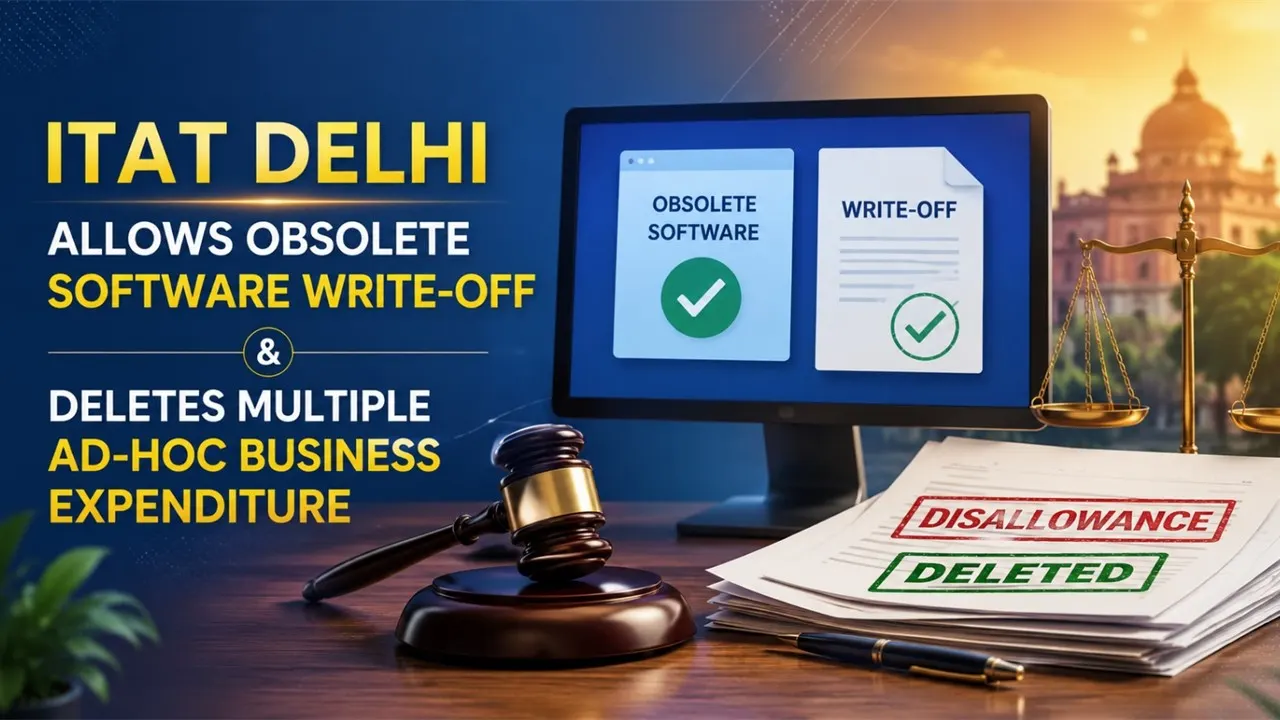
The ITAT Delhi allows obsolete software write-off and deletes multiple ad-hoc business expenditure disallowances.
Obsolete Software Licenses Allowed As Write-Off Despite Remaining Unused Throughout Assessment
 Meetu Kumari
 May 26, 2026
The Delhi Bench of the Income Tax Appellate Tribunal (ITAT) held that software licenses written off after becoming obsolete and unusable are allowable as business expenditure, even if the software was never put to use. A Bench comprising Judicial Member Anubhav Sharma and Accountant Member S. Rifaur Rahman allowed the appeal filed by Plasser India Pvt. Ltd. for AY 2017-18 and dismissed the Revenue’s appeal challenging various reliefs granted by the CIT(A). The tribunal pointed out that, “When an intangible asset becomes obsolete or is no more required for business operation there is no point to keep such an asset in the balance sheet and the fact that it was put to use or is of not any consequence and the same has been rightly written off by the assessee.”
The assessee, engaged in the business of manufacturing and supplying railway track maintenance machines and spare parts, had filed its return declaring income under the normal provisions as well as book profit under Section 115JB. During scrutiny assessment under Section 143(3), the Assessing Officer made multiple additions including disallowance of Section 80G deduction, ad-hoc disallowance of trade payables, disallowance of guarantee charges, royalty and technical service fees, warranty provision, bad debts, and software write-off expenses.

With respect to the software write-off, the Assessing Officer treated the expenditure as capital in nature and denied the deduction on the ground that the software licenses purchased from Sage Software Solutions Pvt. Ltd. were never put to use. The CIT(A) also upheld the disallowance, holding that only depreciation under Section 32 could be claimed on such intangible assets.
Before the Tribunal, the assessee contended that the software licenses had become obsolete and commercially unusable and therefore were rightly written off in the books. Reliance was placed on various High Court decisions to argue that once the asset ceases to be useful for business purposes, the write-off becomes allowable.

Accepting the contention, the Tribunal observed that the authorities below failed to appreciate that the assessee had merely written off software licenses that had lost business relevance. It held that once the intangible asset becomes obsolete, there is no justification to continue reflecting it in the balance sheet merely because it was not put to use.
The Tribunal also upheld the relief granted by the CIT(A) on other additions made by the Assessing Officer. It noted that the Section 80G disallowance was made only on technical defects despite payments being made through banking channels and duly acknowledged by the donee institutions. “The disallowance of 5% of the trade payables is arbitrary, unjustified, and based purely on surmises and conjectures.”
On the issue of ad-hoc disallowance of trade payables, the Tribunal observed that the assessee had furnished complete details of creditors along with ledger accounts and supporting documents. Since no adverse material was brought on record to establish that the liabilities were non-genuine, the ad-hoc addition was rightly deleted by the CIT(A).
The Bench further upheld deletion of disallowance relating to guarantee charges, royalty and technical service fees, observing that such payments were supported by documentary evidence and had been consistently accepted in earlier years, including under transfer pricing proceedings. The Tribunal also sustained the deletion of the warranty provision disallowance by relying on the Delhi High Court ruling in the assessee’s own case and the Supreme Court judgment in Rotork Controls India Pvt. Ltd.
However, on the issue of bad debts written off, the Tribunal restored the matter to the Assessing Officer for limited verification regarding compliance with Section 36(2) of the Income Tax Act.
Thus, the ITAT allowed the assessee’s appeal and dismissed the Revenue’s appeal.
To Read Full Order, Download PDF Given Below.
About Author


Meetu Kumari
Content Manager
 Studycafe
 Jodhpur, Rajasthan, India
 2264
2264My Recent Articles
- ITAT Condones 302-Day Delay, Restores Salary Assessment for Fresh VerificationPremium
- ITAT Condones Delay After Tax Consultant's Death, Restores Appeals for Fresh HearingPremium
- ITAT Remands Salary Addition, Says Taxability Depends on Salary Becoming Due, Not Mere ReceiptPremium
- ITAT Deletes TP Royalty Adjustment, Orders Fresh Review of Commission BenchmarkingPremium
- ITAT Quashes Reassessment Over Unsigned Section 148 Notice Issued to AssesseePremium
Loading suggestions…


Recent Posts


All Posts
Recent Posts
All Posts