ITAT Quashes Assessment Order As Section 148 Notice Was Not Issued Within Six Months' Time Limit:
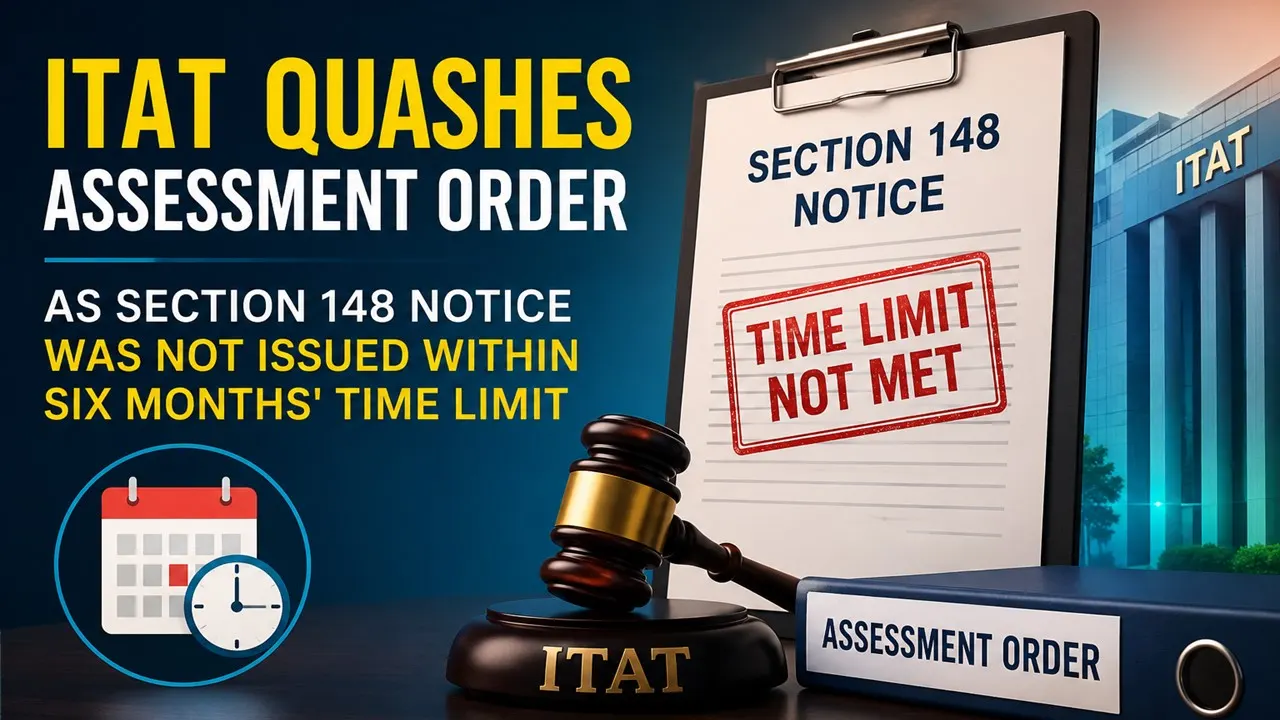
The ITAT held that a Section 148 notice is only to be considered valid when it is issued within the statutory time limit of six years from the end of the relevant assessment year.
ITAT Invalidates Entire Assessment Proceedings
 Saloni Kumari
 Jun 27, 2026
ITAT Quashes Assessment Order As Section 148 Notice Was Not Issued Within Six Months' Time Limit
The ITAT Delhi Bench held in favour of the taxpayer, Babli Devi, by sustaining the NFAC Delhi's ruling, holding that a Section 148 notice can only be considered valid when it is issued within the statutory time limit of six years from the end of the relevant assessment year.
The assessee, Babli Devi, had not filed her income tax return (ITR) for the assessment year 2015-16, as her income was below the basic exemption limit. The Assessing Officer (AO) noted that during the year in consideration, the assessee had made a substantial transaction using her bank account maintained with Axis Bank.
Based on this, the assessee's case was reopened under Section 147 of the Act, and notice under Section 148 was issued. In response to the notice, the assessee filed its ITR for the AY 2015-16, declaring a total income of Rs 1.09 lakh. Thereafter, several notices were issued to the assessee asking her to furnish all the relevant documents explaining the source of the transaction in question. However, she failed the same. Considering the same, the AO treated the same as unexplained money and made an addition amounting to Rs 60.55 lakh on her income under Section 69A of the Income Tax Act.
The aggrieved assessee filed an appeal before the National Faceless Appeal Centre (NFAC), Delhi, challenging the addition of Rs 60.55 lakh. Her appeal was allowed, and the impugned addition was set aside. The tax authorities, not satisfied with the NFAC's order, challenged the same before the Income Tax Appellate Tribunal (ITAT), Delhi, arguing that the lower appellate authority quashed the assessment order without considering the amendments introduced to sections 149 and 148 r. w. s. 148A of the Income Tax Act.
Further submitted that to announce the final decision, the NFAC has relied on the decision of the Honourable Supreme Court in the case of the Union of India v. Rajeev Bansal; however, the said ruling does not apply to the present case. Further claimed that the notice was issued within the prescribed time limit. However, the assessee claimed that the Section 148 notice was not issued within the statutory time limit of six years from the end of the relevant assessment year and hence was time-barred.
When the tribunal heard the arguments of both sides and examined the facts of the case, it noted that the Section 148 notice was indeed time-barred as it was issued after the allowed time limit of six years from the end of the relevant assessment year, i.e., AY 2015-16 in the present case; hence, it noted that the NFAC had rightly quashed the reassessment order by relying on the supreme court's ruling. Accordingly, the tax authorities' appeal is dismissed.
About Author


Saloni Kumari
Content Writer
Saloni is a Content Writer with 2+ years of experience at studycafe.in. She writes legal, taxation, and finance related content including GST, Income Tax etc. Skilled in translating complex judicial pronouncements and regulatory developments into clear, and reader-friendly articles. Experienced in covering judgements of ITAT, High Court, GSTAT, and news related to Income Tax, GST, and corporate law. She can be reached at [email protected].
Saloni is a Content Writer with 2+ years of experience at studycafe.in. She writes legal, taxation, and finance related content including GST, Income Tax etc. Skilled in translating complex judicial pronouncements and regulatory developments into clear, and reader-friendly articles. Experienced in covering judgements of ITAT, High Court, GSTAT, and news related to Income Tax, GST, and corporate law. She can be reached at [email protected].
 StudyCafe
 Delhi, Delhi, India
 2931
2931My Recent Articles
- Rs 843.97 Crore Bogus Political Party Donation Racket Unearthed in Gujarat, Income Tax Dept Files Complaint With CID (Crime)
- Retired Central GST Commissioner Kidnapped by Unknown Persons, Assailants Nabbed Within Hours
- Madhya Pradesh HC Quashes Section 74 GST Show Cause Notice Passed Against G R Infraprojects
- GSTAT Introduces SOP for Branch Officer-to-Branch Officer (BO-to-BO) Case Transfer Ensuring Seamless Reassignment of Cases
- GSTAT: E-Way Bills Cannot Be Invalidated Merely Because They Were Not Generated by Original Supplier
Up Next
Loading suggestions…


Recent Posts

All Posts
Recent Posts
All Posts