ITAT Remands TDS Default Appeals After Finding Notices Were Sent to Former Employee’s Email ID:
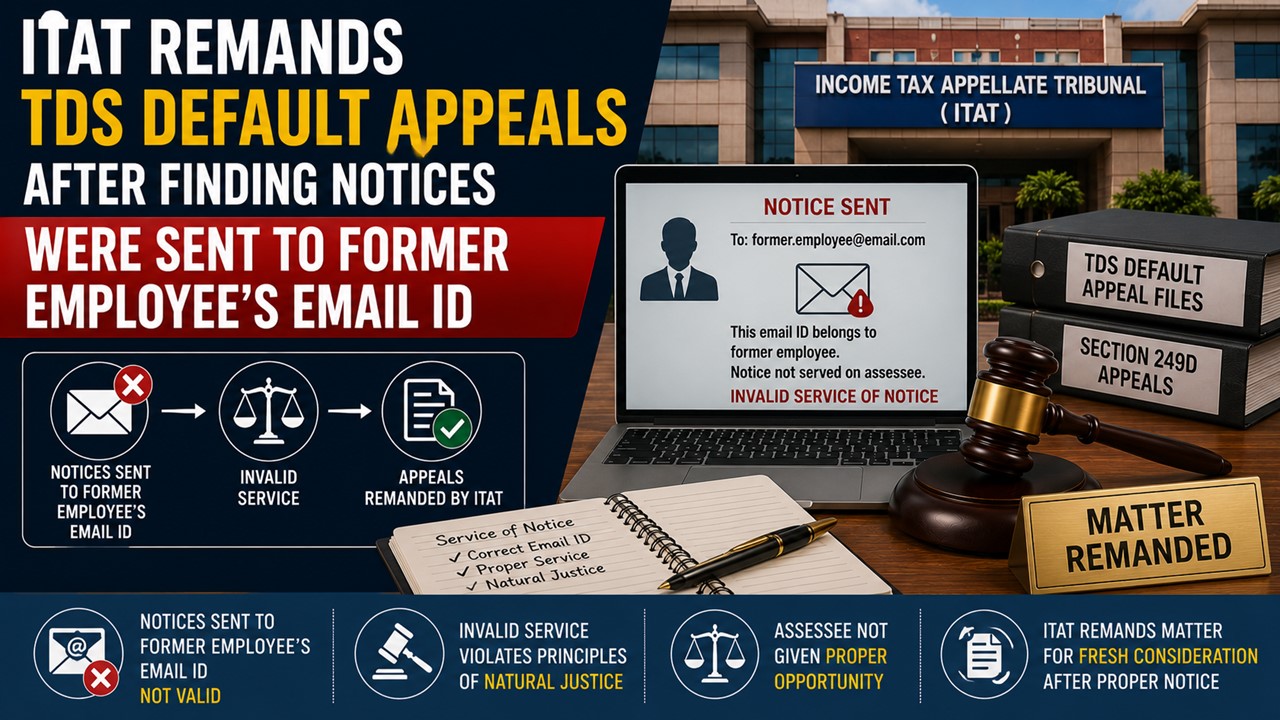
The Income Tax Appellate Tribunal (ITAT) Mumbai found that notices had been sent to an old email address belonging to a former employee and assessee was prevented by sufficient cause to comply with notice.
ITAT directs CIT(A) to adjudicate appeals afresh on merits
 Saima
Saima Jun 17, 2026
ITAT Remands TDS Default Appeals After Finding Notices Were Sent to Former Employee’s Email ID
The Income Tax Appellate Tribunal (ITAT) Mumbai held that the assessee was unable to comply with notices issued to it for default under Sections 201(1) and 201(1A) of the Income Tax Act because they were being communicated through an old email ID of a former employee.
The assessee is a partnership firm engaged in the business of construction and was subjected to proceedings under Sections 201(1) read with 201(1A) of the Income Tax Act, 1961, wherein the AO treated it as an “assessee in default” on account of alleged non-deduction and non-payment of tax at source. Aggrieved by the orders, the assessee preferred appeals before the CIT(A).
However, the CIT(A) dismissed the appeals on the grounds of delay in filing and non-compliance with notices issued during the appellate proceedings.
Before the Income Tax Appellate Tribunal, the assessee submitted that the notices issued by the appellate authority had been sent to an old email address belonging to a former employee who had already left the firm and contended that although a fresh email address had been furnished while filing the appeals, no notices were issued on that address, resulting in the assessee remaining unaware of the proceedings.
The Tribunal observed that the notices during the appellate proceedings had admittedly been issued to the earlier email address and not to the email address furnished by the assessee in its appeal documents, noting that the assessee had been prevented by sufficient cause from appearing before the CIT(A). The Bench deemed it appropriate to set aside the impugned orders and restore the matters to the file of the CIT(A). Accordingly, the appeals were allowed for statistical purposes, and the CIT(A) was directed to consider the reasons for delay wherever applicable and decide the appeals afresh on merits in accordance with law after providing a reasonable opportunity of hearing to the assessee.

About Author


Saima
Content Writer
Saima is a Law graduate with a passion for research and content writing. She writes for Finance, Taxation and Legal Updates at Studycafe.in, simplifying complex legal decisions by the ITAT, High Court, AAR and GSTAT into uncomplicated and clear explanations.
Saima is a Law graduate with a passion for research and content writing. She writes for Finance, Taxation and Legal Updates at Studycafe.in, simplifying complex legal decisions by the ITAT, High Court, AAR and GSTAT into uncomplicated and clear explanations.
 StudyCafe
 Delhi, Delhi, India
 518
518My Recent Articles
- High Court Holds GST Notices and Orders Valid Despite No Visible Digital Signature
- ITAT Remits Rs.49.55 Lakh Agricultural Income Addition to CIT(A)
- ITAT Remits Profit Estimation and Salary Disallowance Matter for Fresh Adjudication
- ITAT Deletes Additions Against Jaya Bachchan Over Alleged Noida Property Cash Receipt
- ITAT Deletes Section 271AAA Penalty on Diamond Stock Discrepancy for Failure to Establish Undisclosed Income
Up Next
Loading suggestions…


Recent Posts



All Posts



Recent Posts
All Posts