ITR Filing 2025: I-T Dept. Releases ITR Form 1, 2, 3, 4, and 5, Find Out Which Tax Form You Need to File:
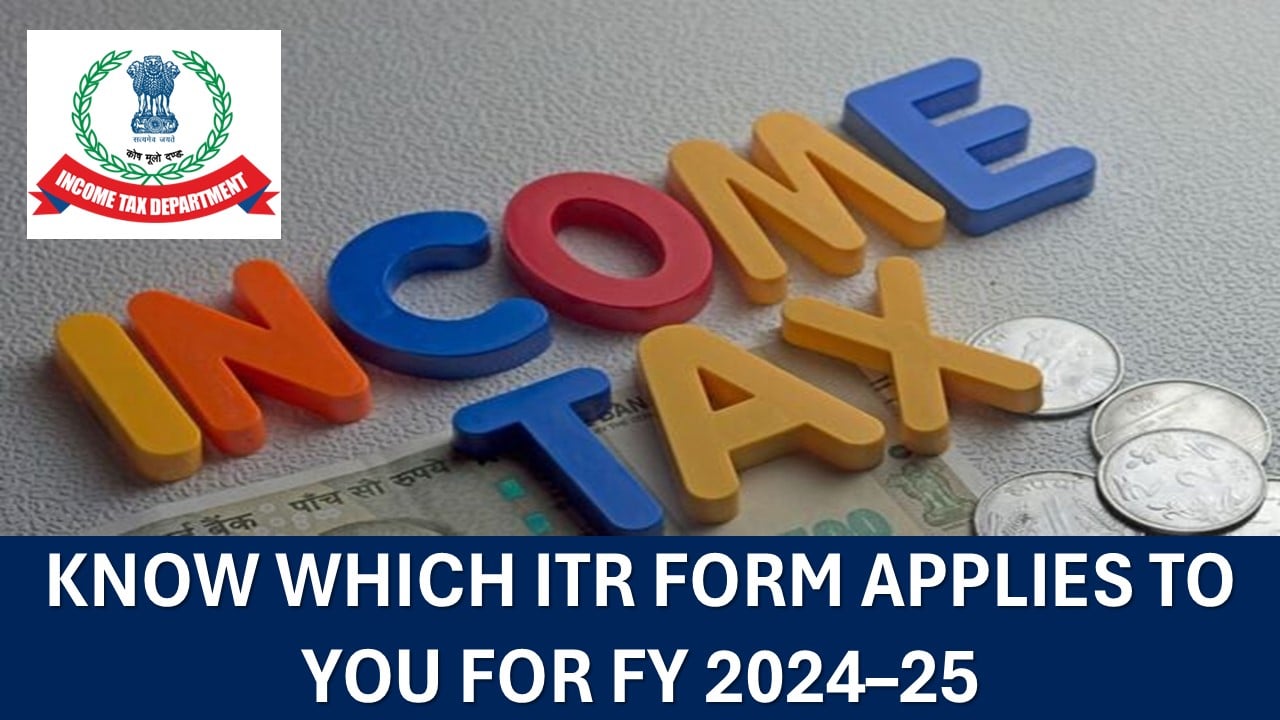
The I-T Department has released ITR Forms 1 to 5 for filing returns for FY 2024–25; here's a simple guide to help you choose the right form based on your income type and taxpayer category.
Know Which ITR Form Applies to You for FY 2024–25
 Saloni Kumari
 May 6, 2025
ITR Filing 2025: I-T Dept. Releases ITR Form 1, 2, 3, 4, and 5, Find Out Which Tax Form You Need to File
The Income Tax (I-T) Department has released the Income Tax Return (ITR) forms 1, 2, 3, 4 and 5. The department released ITR Form-1 (sahaj) and ITR Form-4 (sugam) on April 29, 2025. After these, ITR Form 3 were released on April 30, 2025. Later on, ITR Form 5 was released on May 2, 2025, and Form 2 on May 3, 2025. These forms are used for filing Income Tax Return (ITR) for the financial year 2024-25.
Let's discuss about which form type is applicable to you as per the category you fall into. Types of Income Tax Return (ITR) Forms: Income Tax Return (ITR) Form-1:Kind attention, taxpayers!
ITR-1 (SAHAJ) for AY 2025-26 has been notified via Notification No. 40/2025 dated 29.04.2025, effective from 1st April 2025. Wondering if you’re eligible to file ‘Sahaj’? Here is our explainer series on various aspects of ITR-1. pic.twitter.com/s7fBIgjYVj — Income Tax India (@IncomeTaxIndia) May 5, 2025
- This form is applicable to resident individuals who have their total income of more than Rs. 50 lakhs. This income includes sources such as salary or pension, income generated from one house property (Not including situations where you’re carrying forward a loss from previous years), income generated from other sources (like interest earned from savings accounts and fixed deposits) and agricultural income of more than Rs. 5000.
- You can’t use this form if, during the year, you were a company director, invested in unlisted shares, earned from business or profession, had foreign assets or income (if you're a resident), had high capital gains (including more than Rs. 1.25 lakh under section 112A), or had losses carried forward from earlier years.
- Individuals or those belonging from Hindu Undivided Families (HUFs) are eligible to file ITR Form-2 and these individuals are not eligible to file ITR-1 (Sahaj). Those who do not earn income from business or profession and also for those who don’t get income like interest, salary, bonus, or commission from a partnership firm are not eligible to file this form-1.
- This form is for individuals and HUFs who run a business or profession and keep detailed accounts, like doctors, lawyers, or chartered accountants, whose income is based on actual profits.
- This form is for resident individuals, HUFs, or firms (not LLPs) with income up to Rs. 50 lakh from business or profession using a simple calculation method (under sections 44AD, 44ADA, or 44AE), along with salary, one house property, small agricultural income (up to Rs. 5,000), and other sources.
- This form is for firms, LLPs, associations (AOP), groups of people (BOI), or certain legal entities (AJPs) to file their tax returns.
About Author


Saloni Kumari
Content Writer
Saloni is a Content Writer with 2+ years of experience at studycafe.in. She writes legal, taxation, and finance related content including GST, Income Tax etc. Skilled in translating complex judicial pronouncements and regulatory developments into clear, and reader-friendly articles. Experienced in covering judgements of ITAT, High Court, GSTAT, and news related to Income Tax, GST, and corporate law. She can be reached at [email protected].
Saloni is a Content Writer with 2+ years of experience at studycafe.in. She writes legal, taxation, and finance related content including GST, Income Tax etc. Skilled in translating complex judicial pronouncements and regulatory developments into clear, and reader-friendly articles. Experienced in covering judgements of ITAT, High Court, GSTAT, and news related to Income Tax, GST, and corporate law. She can be reached at [email protected].
 StudyCafe
 Delhi, Delhi, India
 2924
2924My Recent Articles
- Major Relief in Arbitration Case: MCIA Denies Rs 908 Crore Statement Claim Made by Allied Silica Against Tata Chemicals
- MCA and ICSI to Hold User Awareness Session on Form AOC-4 Filing Amid Glitches on MCA-21 Version-3 Portal
- GSTN Introduces New E-Invoicing Facility for Self-Invoices Under Reverse Charge Mechanism
- Flexi Cap vs Multi Cap Funds: What's the Real Difference?
- IBA Recommends Public Sector Banks to Reduce Ambit of Physical Branch Audits to 50% of Total Business
Up Next
Loading suggestions…


Recent Posts

All Posts


Tags
No tags yet.
Recent Posts
All Posts
Tags
No tags yet.