ITR Filing 2025: Taxpayers Should Carefully Match Their GST Details and Income Before Filing:
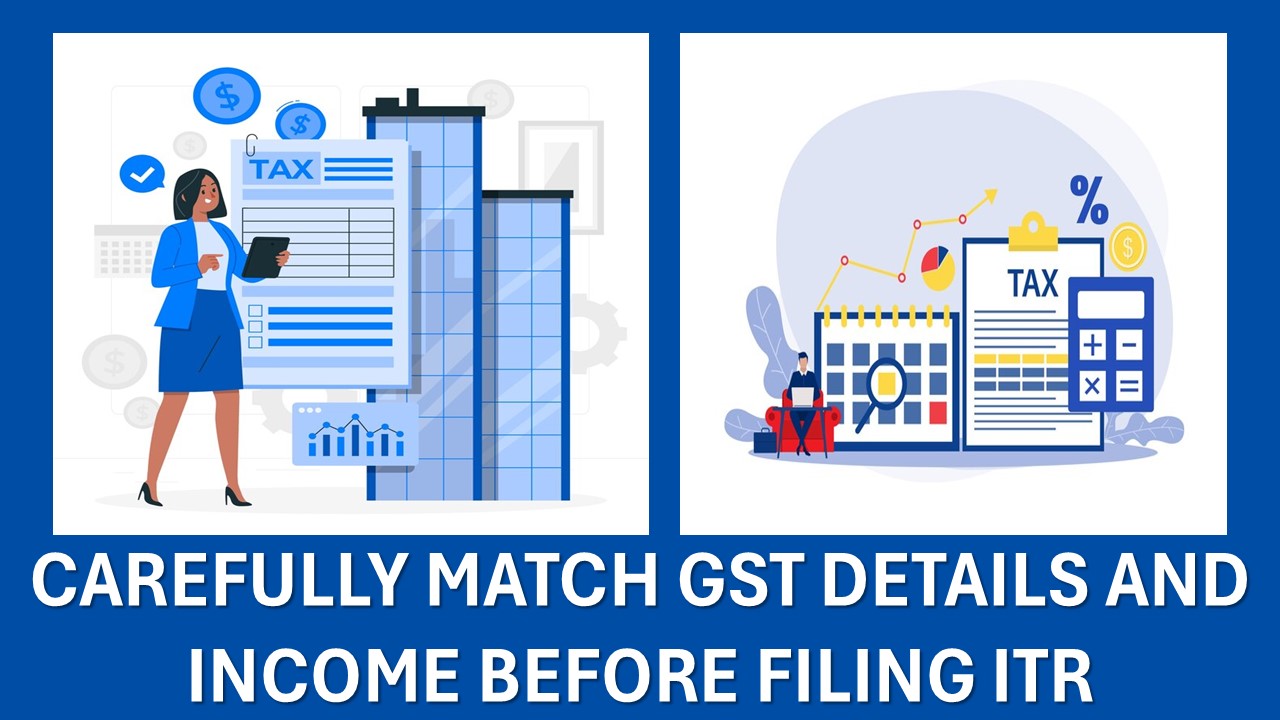
Learn why matching your GST returns with income tax filings is crucial in ITR Filing 2025 to avoid mismatches, scrutiny, and loss of tax credits.
Avoid Costly Mismatches by Aligning GST and Income Tax Data
 Saloni Kumari
 May 27, 2025
ITR Filing 2025: Taxpayers Should Carefully Match Their GST Details and Income Before Filing
As all ITR forms for the assessment year 2025–26 have now been released and filing is scheduled to begin soon in the upcoming days, taxpayers need to be extra careful while matching their GST data with income tax records. Tax experts warn that any mismatch between the two can lead to questions from the tax department and possibly higher costs to fix the issues.
If you're registered under GST, you usually file monthly returns such as GSTR-1, GSTR-2B, and GSTR-3B, plus yearly returns like GSTR-9 and GSTR-9C. These GST forms show details of your business transactions. On the other hand, income tax forms show your earnings. Since 2020, the income tax and GST departments have been regularly sharing data with each other, which means it’s easier for them to spot any mismatch. So, it’s now more important than ever to keep your records accurate and consistent.
GST Turnover reported in Annual Information Statement (AIS)
All your GST turnover is reported in your AIS, and therefore, any mismatch can invite an Income Tax Notice. All though sifferences can be due to timing mismatches, exempt income, or accounting treatment. Taxpayers should have valid reason for the difference, so as to avoid any kind of scrutiny.
TDS Deducted, but Income not shown in GST
Let’s say you give a professional service where 10% TDS may be deducted from that transaction, but the same has not been disclosed in GST. Even if the invoice wasn’t shown in GSTR-1, the GST department can still see it through TDS data. So, it’s important to match all records correctly to avoid Interest and Penalty at later stages.
It is crucial for them to follow extreme caution while filing ITR (Income Tax Return), especially while doing reconciliation of receipts from business/profession announced in ITR with GST returns and Form 26AS, as such differences will be caught while processing ITR in minutes. In case of variance, the tax authorities may raise queries or select the return of income for scrutiny assessment depending upon the risk parameters.
About Author


Saloni Kumari
Content Writer
Saloni is a Content Writer with 2+ years of experience at studycafe.in. She writes legal, taxation, and finance related content including GST, Income Tax etc. Skilled in translating complex judicial pronouncements and regulatory developments into clear, and reader-friendly articles. Experienced in covering judgements of ITAT, High Court, GSTAT, and news related to Income Tax, GST, and corporate law. She can be reached at [email protected].
Saloni is a Content Writer with 2+ years of experience at studycafe.in. She writes legal, taxation, and finance related content including GST, Income Tax etc. Skilled in translating complex judicial pronouncements and regulatory developments into clear, and reader-friendly articles. Experienced in covering judgements of ITAT, High Court, GSTAT, and news related to Income Tax, GST, and corporate law. She can be reached at [email protected].
 StudyCafe
 Delhi, Delhi, India
 2924
2924My Recent Articles
- Major Relief in Arbitration Case: MCIA Denies Rs 908 Crore Statement Claim Made by Allied Silica Against Tata Chemicals
- MCA and ICSI to Hold User Awareness Session on Form AOC-4 Filing Amid Glitches on MCA-21 Version-3 Portal
- GSTN Introduces New E-Invoicing Facility for Self-Invoices Under Reverse Charge Mechanism
- Flexi Cap vs Multi Cap Funds: What's the Real Difference?
- IBA Recommends Public Sector Banks to Reduce Ambit of Physical Branch Audits to 50% of Total Business
Up Next
Loading suggestions…


Recent Posts


All Posts


Tags
No tags yet.
Recent Posts
All Posts
Tags
No tags yet.