ITR Filing 2026: Key Conditions for Claiming HRA Exemption While Filing Income Tax Return:
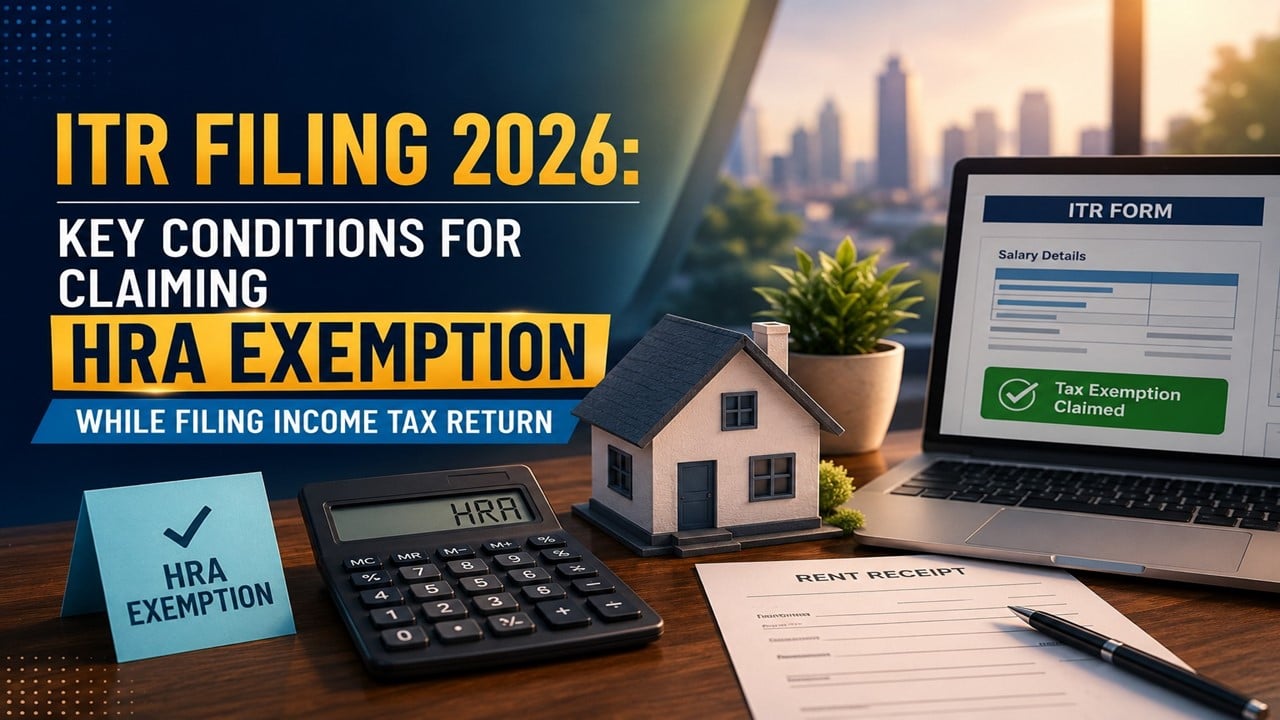
The Income Tax Department permits salaried employees receiving House Rent Allowance (HRA) to claim exemption under the Income-tax Act, subject to fulfilment of specified conditions.
Taxpayers Claiming House Rent Allowance Must Satisfy Prescribed Conditions
 Saima
Saima Jul 2, 2026
The Income Tax Return (ITR) filing process for Assessment Year (AY) 2026-27 is going on and salaried taxpayers who intend to claim exemption on House Rent Allowance (HRA) must ensure that they satisfy the statutory conditions required under Section 10(13A) of the Income-tax Act, 1961 read with Rule 2A of the Income-tax Rules, 1962. The exemption is available only to eligible employees who receive HRA as a part of their salary and do actual expenditure towards rent for the residential accommodation occupied by them.
The exemption can be claimed only if:

The employee receives HRA as part of the salary package.
Rent is actually paid for the residential accommodation occupied by the employee. Employees residing in their own house without paying rent are generally not entitled to claim HRA exemption.
The employee does not claim ineligible or unsupported rent payments.

Method of Computing HRA Exemption
The amount of exemption is not equal to the HRA received from the employer. Instead, the exempt amount is restricted to the least of the following three amounts:
Actual House Rent Allowance received during the financial year
Rent paid in excess of 10% of the employee's salary or
50% of salary where the employee resides in a metro city (Delhi, Mumbai, Kolkata or Chennai), or 40% of salary for employees residing in non-metro cities. For this purpose, salary generally includes basic salary and dearness allowance, forming part of retirement benefits where applicable.
Supporting Documents: Taxpayers should preserve documentary evidence, including:
Rent receipts
Rent agreement, wherever available
Proof of rent payment and
Permanent Account Number (PAN) of the landlord where the annual rent exceeds the prescribed limit under the Income-tax Rules.
Under the Income-tax Rules, quoting the landlord's PAN becomes necessary where the annual rent exceeds the prescribed threshold. These records may be called for during assessment or verification proceedings.
The availability of HRA exemption also depends upon the tax regime chosen by the taxpayer. Individuals opting for taxation under the new tax regime under Section 115BAC are generally not entitled to claim HRA exemption, whereas taxpayers opting for the old tax regime may continue to claim the benefit subject to fulfilment of the prescribed conditions. Therefore, taxpayers should carefully compare the tax liability under both regimes before exercising their option.
Before filing the Income Tax Return, taxpayers should verify that the HRA details furnished in the return correspond with the salary information reflected in Form 16 and other supporting documents. Any discrepancy between the information reported by the employer and the claim made in the return may lead to denial of the exemption. Proper documentation and accurate disclosure remain essential for successfully claiming the benefit.
About Author


Saima
Content Writer
 StudyCafe
 Delhi, Delhi, India
 518
518My Recent Articles
- High Court Holds GST Notices and Orders Valid Despite No Visible Digital Signature
- ITAT Remits Rs.49.55 Lakh Agricultural Income Addition to CIT(A)
- ITAT Remits Profit Estimation and Salary Disallowance Matter for Fresh Adjudication
- ITAT Deletes Additions Against Jaya Bachchan Over Alleged Noida Property Cash Receipt
- ITAT Deletes Section 271AAA Penalty on Diamond Stock Discrepancy for Failure to Establish Undisclosed Income
Loading suggestions…


Recent Posts

All Posts



Tags
Recent Posts
All Posts