MCA Introduces "Small Company" Status in Company Master Data:

MCA has updated Company Master Data to clearly display a company’s Small Company status, making compliance simpler and more transparent.
MCA Brings Clarity to Small Company Classification
 Vanshika verma
 Jan 12, 2026
MCA Introduces "Small Company" Status in Company Master Data
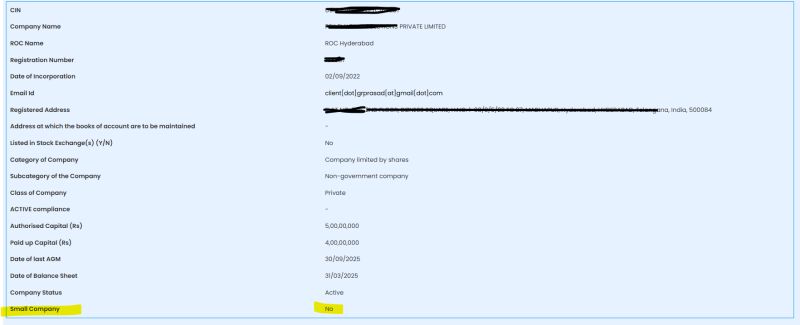
The Ministry of Corporate Affairs (MCA) has recently updated the Company Master Data to clearly indicate whether a company is classified as a Small Company or not, making it easier for everyone to understand a company’s status.
 Under Section 2(85) of the Companies Act, 2013, a Small Company means:
“small company’’ means a company, other than a public company,—
(i) paid-up share capital of which does not exceed fifty lakh rupees or such higher amount as may be prescribed which shall not be more than ten crore rupees; and
(ii) turnover of which as per profit and loss account for the immediately preceding financial year does not exceed two crore rupees or such higher amount as may be prescribed which shall not be more than one hundred crore rupees:
Provided that nothing in this clause shall apply to—
(A) a holding company or a subsidiary company;
(B) a company registered under section 8; or
(C) a company or body corporate governed by any special Act;
As per Rule (t) Chapter (2) (Definitions) of The Companies (Specification of Definitions Details) Rules, 2014:
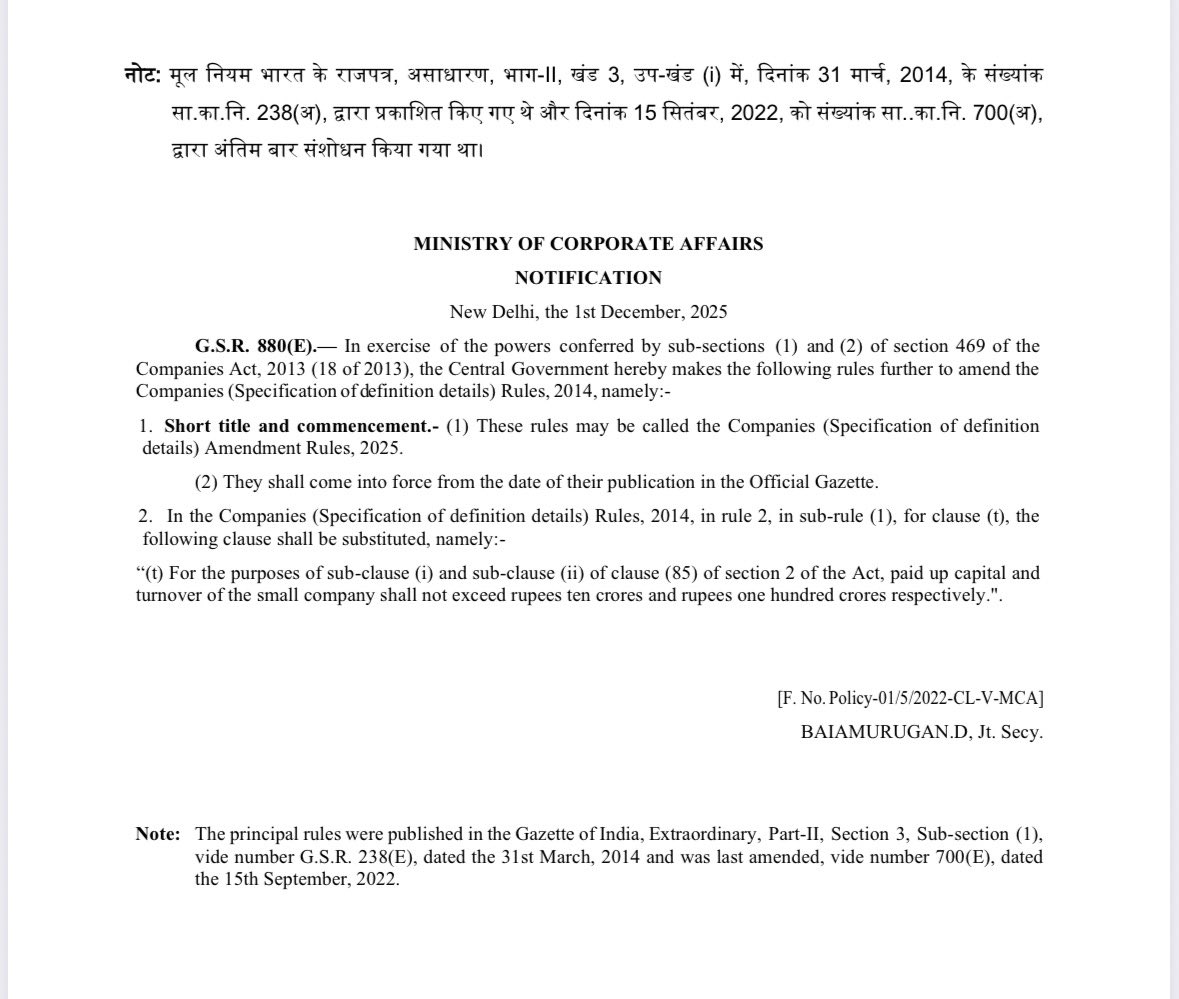
For the purposes of sub-clause (i) and sub-clause (ii) of clause (85) of section 2 of the Act, paid up capital and turnover of the small company shall not exceed rupees ten crores and rupees one hundred crores respectively.
Under Section 2(85) of the Companies Act, 2013, a Small Company means:
“small company’’ means a company, other than a public company,—
(i) paid-up share capital of which does not exceed fifty lakh rupees or such higher amount as may be prescribed which shall not be more than ten crore rupees; and
(ii) turnover of which as per profit and loss account for the immediately preceding financial year does not exceed two crore rupees or such higher amount as may be prescribed which shall not be more than one hundred crore rupees:
Provided that nothing in this clause shall apply to—
(A) a holding company or a subsidiary company;
(B) a company registered under section 8; or
(C) a company or body corporate governed by any special Act;
As per Rule (t) Chapter (2) (Definitions) of The Companies (Specification of Definitions Details) Rules, 2014:
For the purposes of sub-clause (i) and sub-clause (ii) of clause (85) of section 2 of the Act, paid up capital and turnover of the small company shall not exceed rupees ten crores and rupees one hundred crores respectively.
 Why Small Company Status is Important
The Small Company classification affects many day-to-day legal and compliance requirements of a company. Because of this, being classified as a Small Company can make compliance easier, cheaper, and less time-consuming for the business.
Many rules under the Companies Act and related regulations are either not applicable to small companies or are applied in a more relaxed way.
Small companies usually get the benefit of easier rules, fewer documents to file, share less detailed information, and follow simpler reporting formats.
Under several provisions of the law, small companies face lower financial penalties for non-compliance, and the personal liability of directors or officers is also reduced.
What has Changed?
The MCA has added a clear indicator in the Company Master Data showing whether a company is a "Small Company" or not. This new action has made it easier for companies as it brings:
Why Small Company Status is Important
The Small Company classification affects many day-to-day legal and compliance requirements of a company. Because of this, being classified as a Small Company can make compliance easier, cheaper, and less time-consuming for the business.
Many rules under the Companies Act and related regulations are either not applicable to small companies or are applied in a more relaxed way.
Small companies usually get the benefit of easier rules, fewer documents to file, share less detailed information, and follow simpler reporting formats.
Under several provisions of the law, small companies face lower financial penalties for non-compliance, and the personal liability of directors or officers is also reduced.
What has Changed?
The MCA has added a clear indicator in the Company Master Data showing whether a company is a "Small Company" or not. This new action has made it easier for companies as it brings:
Under Section 2(85) of the Companies Act, 2013, a Small Company means:
“small company’’ means a company, other than a public company,—
(i) paid-up share capital of which does not exceed fifty lakh rupees or such higher amount as may be prescribed which shall not be more than ten crore rupees; and
(ii) turnover of which as per profit and loss account for the immediately preceding financial year does not exceed two crore rupees or such higher amount as may be prescribed which shall not be more than one hundred crore rupees:
Provided that nothing in this clause shall apply to—
(A) a holding company or a subsidiary company;
(B) a company registered under section 8; or
(C) a company or body corporate governed by any special Act;
As per Rule (t) Chapter (2) (Definitions) of The Companies (Specification of Definitions Details) Rules, 2014:
For the purposes of sub-clause (i) and sub-clause (ii) of clause (85) of section 2 of the Act, paid up capital and turnover of the small company shall not exceed rupees ten crores and rupees one hundred crores respectively.
Why Small Company Status is Important
The Small Company classification affects many day-to-day legal and compliance requirements of a company. Because of this, being classified as a Small Company can make compliance easier, cheaper, and less time-consuming for the business.
Many rules under the Companies Act and related regulations are either not applicable to small companies or are applied in a more relaxed way.
Small companies usually get the benefit of easier rules, fewer documents to file, share less detailed information, and follow simpler reporting formats.
Under several provisions of the law, small companies face lower financial penalties for non-compliance, and the personal liability of directors or officers is also reduced.
What has Changed?
The MCA has added a clear indicator in the Company Master Data showing whether a company is a "Small Company" or not. This new action has made it easier for companies as it brings:
- Transparency
- Simplifies compliance for companies
- Faster and clearer decision-making
- Reduced dependence on manual determination
About Author


Vanshika verma
Content Writer
Vanshika Verma is a Content Writer with 1+ year of experience at Studycafe.in. A B.Com graduate from Delhi University, She writes articles on Finance, Tax, ICAI, GST, and the latest financial news, with a focus on making complex topics easy for readers and professionals.
Vanshika Verma is a Content Writer with 1+ year of experience at Studycafe.in. A B.Com graduate from Delhi University, She writes articles on Finance, Tax, ICAI, GST, and the latest financial news, with a focus on making complex topics easy for readers and professionals.
 Studycafe
 Delhi, Delhi, India
 2019
2019My Recent Articles
- ITAT Condones Over Two-Year Delay, Gives Taxpayer Fresh Opportunity to Contest Rs 1.30 Crore Property Sale Addition
- Snowman Logistics Receives Rs 2.06 Crore Income Tax Demand for FY24, Plans to Challenge Penalty Order
- Bharat Bijlee Receives Rs 58.3 Lakh Income Tax Demand Over Excess Refund and Interest Re-Computation
- Punjab National Bank Receives SEBI Administrative Warning Over Alleged Insider Trading Violations Involving Six Individuals
- Uttarakhand Tax Dept Recovers Rs 2.25 Crore From Eden Senior Living Over GST Irregularities
Up Next
Loading suggestions…


Recent Posts



All Posts

Recent Posts
All Posts