Property Sale of 1.18 Crore Led to Reassessment; ITAT Cancels Proceedings as Income Tax Notice Was Issued Beyond Time Limit:
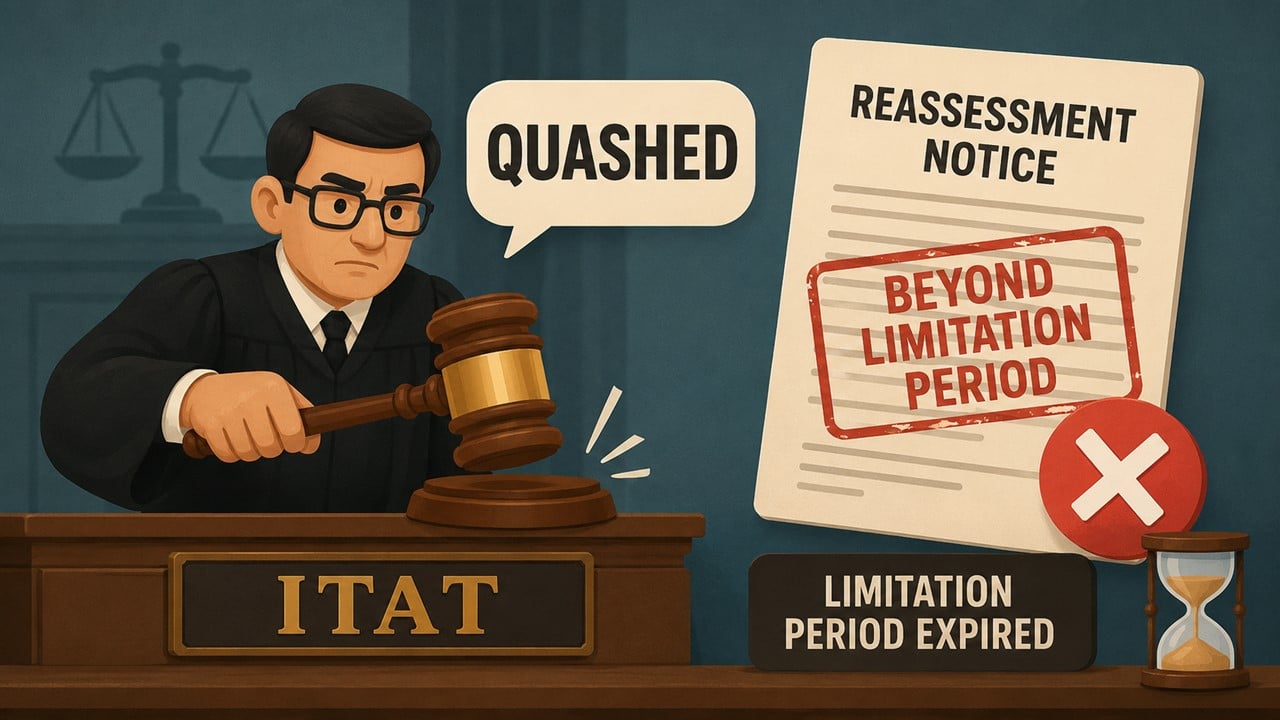
ITAT quashes reassessment after holding Section 148 notice was issued beyond permissible limitation.
Surviving limitation principle renders reassessment notice legally unsustainable.
 Meetu Kumari
 Jun 13, 2026
The Mumbai ITAT quashed reassessment proceedings against Popular Buffer Investments Pvt. Ltd. after holding that the notice issued under Section 148 for AY 2015-16 was time-barred and therefore without jurisdiction.
The assessee had not filed its return of income for AY 2015-16. Based on information that it had sold an immovable property on 16 July 2014 for ₹1.18 crore, the department initiated reassessment proceedings. A notice under Section 148A(b) was issued on 30 March 2022, followed by an order under Section 148A(d) and a notice under Section 148 on 13 April 2022. As the assessee did not respond, the Assessing Officer completed the assessment ex parte under Sections 147, 144 and 144B, estimating the cost of acquisition at 50% of the sale consideration and computing short-term capital gains of Rs.59 lakh.

The CIT(A) also dismissed the assessee’s appeal ex parte after recording non-compliance with hearing notices and confirmed the addition.
Before the Tribunal, the assessee challenged the very validity of the reassessment notice. It argued that for AY 2015-16, the six-year limitation period under the erstwhile Section 149 expired on 31 March 2022. Since the notice under Section 148 was issued only on 13 April 2022, it was barred by limitation in view of the first proviso to Section 149 inserted by the Finance Act, 2021.
The Tribunal noted that the issue was squarely covered by the Supreme Court’s ruling in Union of India v. Rajeev Bansal and subsequent Mumbai Bench decisions in ITO v. Pushpak Realities Pvt. Ltd. and STC Securities Pvt. Ltd. v. ITO. Those decisions held that reassessment notices for AY 2015-16 issued after 31 March 2022 fall outside the surviving limitation period and are invalid.

Applying the same principle, the Bench observed that while the Section 148A(b) notice was issued on 30 March 2022, the actual reassessment notice under Section 148 was issued only on 13 April 2022, after expiry of the permissible six-year period. Therefore, the notice was legally unsustainable.
Thus, the Tribunal held that the reassessment proceedings were void ab initio and quashed both the notice and the consequential assessment order. Since the reassessment itself was struck down on the legal ground of limitation, the Tribunal did not consider the grounds relating to the merits of the addition or the ex parte appellate order.
To Read Full Order, Download PDF Given Below.
About Author


Meetu Kumari
Content Manager
 Studycafe
 Jodhpur, Rajasthan, India
 2264
2264My Recent Articles
- ITAT Condones 302-Day Delay, Restores Salary Assessment for Fresh VerificationPremium
- ITAT Condones Delay After Tax Consultant's Death, Restores Appeals for Fresh HearingPremium
- ITAT Remands Salary Addition, Says Taxability Depends on Salary Becoming Due, Not Mere ReceiptPremium
- ITAT Deletes TP Royalty Adjustment, Orders Fresh Review of Commission BenchmarkingPremium
- ITAT Quashes Reassessment Over Unsigned Section 148 Notice Issued to AssesseePremium
Loading suggestions…


Recent Posts



All Posts



Recent Posts
All Posts