Supreme Court Hears Appeal to Shorten LL.B Course From 5 to 4 Years:
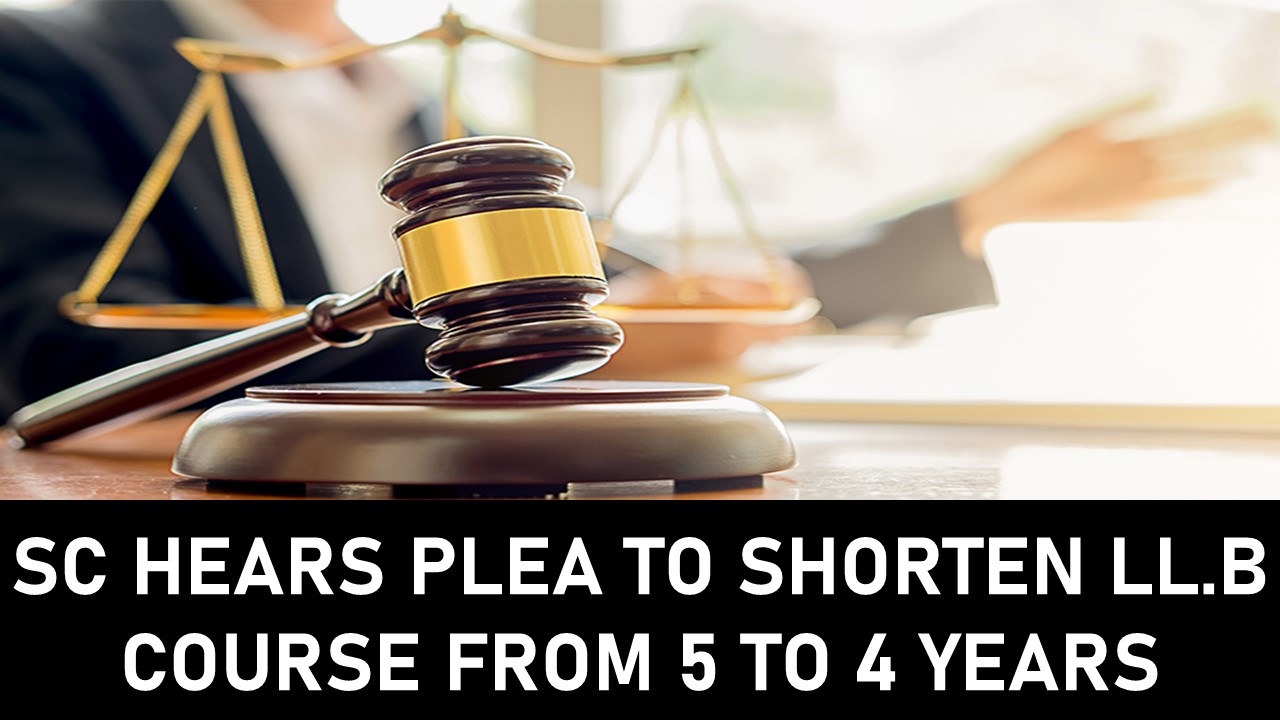
the Supreme Court has looked into the matter of a Public Interest Litigation (PIL) asking for the current 5-year LL.B course to be replaced with a 4-year law degree course.
Supreme Court Reviews Appeal to Replace 5-Year Law Degree Course With 4-Year LL.B
 Nidhi
Nidhi May 10, 2025
Supreme Court Hears Appeal to Shorten LL.B Course From 5 to 4 Years
On Friday, the Supreme Court has looked into the matter of a Public Interest Litigation (PIL) asking for the current 5-year LL.B course to be replaced with a 4-year law degree course as the National Education Policy 2020 also supports four-year professional degree courses for undergraduates.
A bench of the Supreme Court, including Justice Vikram Nath and Justice Sandeep Mehta, did not send notice on the petition. Instead, they connected it to another case about the one-year LL.M course.
The PIL was registered by Advocate Ashwini Kumar Upadhyay, arguing that the 5-year LL.B has been introduced to make more money and that too in the name of education. He stated that the 5-year period of the course does not truly show a student's potential. Additionally, the applicant has also appealed to the Centre to establish a Legal Education Commission or an Expert Committe made up of Eminent Educationists, Jurists, Retired Judges, Lawyers, and Professors to check the syllabus, curriculum, and duration of both LL.B and LL.M courses, and to suggest necessary steps to help attract top talent to the legal profession.
The current petition states that the injury caused to students is significant, as the 5-year period of the BA-LLB and BBA-LLB courses is too long for the amount of material covered. The long duration increases the financial burden on middle and lower-class families, making it difficult for them to afford. Additionally, it takes more years for the student to start earning and support their family.
Mentioning the New Education Policy, 2020, which encourages four-year graduation programs across professional and academic fields, he said that the Bar Council of India (BCI) has not taken necessary steps to review the current syllabus, curriculum, and duration of the LL.B and LL.M courses.
When Senior Advocate Vikas Singh appeared for the petitioner in court today, Justice Vikram Nath questioned, "You think something important is raised [in this PIL]?" To which Singh answered, " I tell your lordship what persuaded me to appear. My Yoga teacher he is having difficulty in educating his daughter because of the fees structure and he has to pay her fees for five years. Four year, education policy also says. There is another court which is examining whether LLM one year should be banned."
Justice Nath advised taking the issue to the Bar Council. Singh then asked to tag it with the one-year LL.M case before Justice Surya Kant's bench, which the Court allowed.
Previously, the same petitioner had filed an appeal asking to change the 5-year LL.B course to a 3-year course after Class 12. However, the Supreme Court denied this request of the petitioner. CJI DY Chandrachud said, "We need mature people coming into the profession. This 5-year course has been very beneficial."
About Author


Nidhi
Content Writer
Nidhi is a skilled content writer specializing in personal finance. She creates clear, engaging articles on mutual funds, investments, insurance, and wealth-building strategies. With a passion for simplifying complex financial topics, Nidhi helps readers make informed money decisions with confidence. She can be reached at [email protected]
Nidhi is a skilled content writer specializing in personal finance. She creates clear, engaging articles on mutual funds, investments, insurance, and wealth-building strategies. With a passion for simplifying complex financial topics, Nidhi helps readers make informed money decisions with confidence. She can be reached at [email protected]
 Studycafe
 New Delhi, Delhi, India
 1832
1832My Recent Articles
- Karnataka High Court Gives Another Chance in GST Matter Due to Lack of Hearing
- Delay Should Be Condoned if Explanation is Unrefuted: ITAT
- Non-Service of Income Tax Notice, Ill health of taxpayer, ITAT condones Appeal filing delay
- Books of Accounts Cannot be Rejected Without Any Specific Defect: ITAT Kolkata
- Karnataka High Court Sends ITC Matter Back to GST Authorities for Reconsideration
Up Next
Loading suggestions…


Recent Posts

All Posts


Tags
No tags yet.
Recent Posts
All Posts
Tags
No tags yet.