Woman Sold Flat, Sought Section 54 Tax Exemption During Appeal; ITAT Rejects Claim Not Made in Return or Assessment Proceedings:
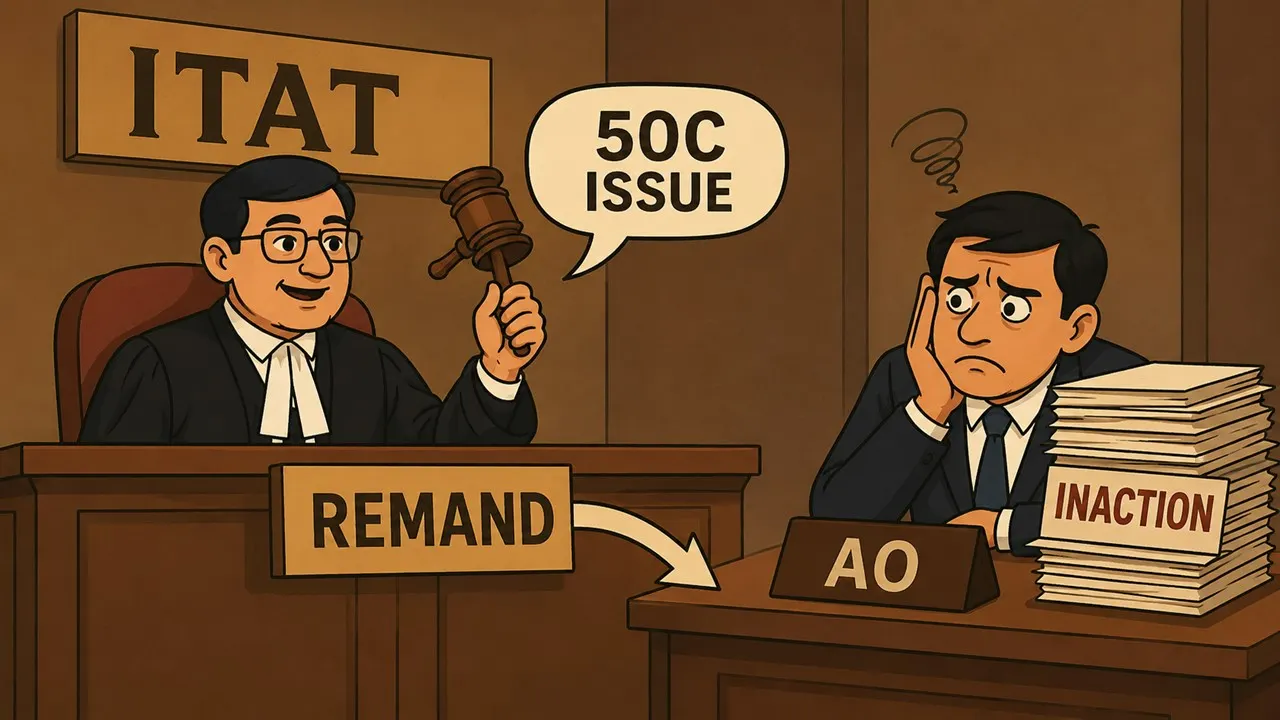
The ITAT Delhi criticized an Assessing Officer for repeatedly ignoring remand report requests and urged CBDT to act against erring officers, while upholding the remand of a capital gains dispute involving a flat sale and rejecting a Section 54 deduction claim raised for the first time in appeal.
Fresh Deduction Claim Cannot Bypass Return Filing Requirements Under Law
 Meetu Kumari
 Jun 12, 2026
Woman Sold Flat, Sought Section 54 Tax Exemption During Appeal; ITAT Rejects Claim Not Made in Return or Assessment Proceedings
The Income Tax Appellate Tribunal (ITAT) has upheld the rejection of a taxpayer’s claim for deduction under Section 54 of the Income Tax Act, 1961, holding that the benefit cannot be entertained for the first time at the appellate stage when no such claim was made either in the return of income or during assessment proceedings. The Tribunal also affirmed the decision of the Commissioner (Appeals) to remand the issue of computation of long-term capital gains under Section 50C back to the Assessing Officer for fresh verification.
The Bench comprising Judicial Member Madhumita Roy and Accountant Member Amitabh Shukla dismissed the appeal filed by Surbhi Khandelwal for AY 2018-19.
The case arose from a search conducted in the Rajeshwar Singh Yadav Group, during which a bank locker belonging to the assessee was found. During assessment proceedings, the Assessing Officer noticed that the assessee was a co-owner of a residential flat at Indirapuram, Ghaziabad, which had been purchased in 2010 and sold in 2017.
Applying the provisions of Section 50C, the Assessing Officer adopted a higher stamp duty valuation and recomputed the long-term capital gains, resulting in an addition of ₹17.84 lakh being the assessee’s share.
Before the Commissioner (Appeals), the assessee sought admission of additional evidence and also claimed, for the first time, deduction under Section 54 on account of investment in a residential property. The appellate authority repeatedly sought a remand report from the Assessing Officer to verify the basis on which the stamp duty value had been adopted. However, despite multiple communications and intervention sought from supervisory authorities, no remand report was furnished.
Consequently, the Commissioner (Appeals) restored the issue relating to computation of capital gains under Section 50C to the Assessing Officer for fresh verification, while rejecting the assessee’s claim under Section 54 on the ground that it had never been made in the return of income.
Before the Tribunal, the issue centred on whether the assessee could seek deduction under Section 54 at the appellate stage by relying upon the Supreme Court’s decision in Goetze (India) Ltd.
The Tribunal observed that the ratio of Goetze (India) was inapplicable to the facts of the present case because the assessee had neither claimed the deduction in the return of income nor raised it during the assessment proceedings.
“It is an admitted fact on record that no claim qua deduction u/s 54 was made by the assessee neither in its Return of Income nor during the assessment proceedings.”
Accordingly, the Bench held that there was no justification to interfere with the Commissioner (Appeals)’ decision rejecting the claim under Section 54.
On the issue of capital gains computation, the Tribunal noted that the Commissioner (Appeals) had correctly invoked the remand process after the assessee produced additional evidence challenging the stamp valuation adopted by the Assessing Officer. Since the Assessing Officer failed to furnish a remand report despite repeated requests, the appellate authority was justified in restoring the matter for fresh examination.
“An Assessing Officer is the fulcrum of assessment proceedings. He possesses the first right and responsibility to examine facts of a case before arriving at his decision qua determination of taxable income.”
While upholding the remand order, the Tribunal made strong observations regarding the increasing instances of Assessing Officers failing to submit remand reports despite repeated requests from appellate authorities. The Bench expressed concern that such conduct adversely impacts both tax administration and the delivery of justice, and recommended that the CBDT examine the issue and take corrective measures.
Identifying and acting against delinquent authority is necessary since as observed by late president Dr. A.P.J. Abdul Kalam a guilty must be punished since by non-punishment, on one hand the organization suffers at the hands of an unworthy employee and on the other it deprives the guilty an opportunity to mend one’s ways. We would like the Ld. DR to convey our views to the Chairman, Central Board of Direct Taxes being the apex governing body to urgently intervene in the matter and take necessary action so that there is miscarriage of justice.
Thus, the Tribunal upheld the order of the Commissioner (Appeals) on both counts and dismissed the assessee’s appeal.
To Read Full Order, Download PDF Given Below.
About Author


Meetu Kumari
Content Manager
Meetu Kumari is an Experienced Advocate and Content Writer with 4+ years of demonstrated history of working in the law practice industry. Skilled in Developing Content, Researching, and Drafting. Strong professional with a Bachelor of Science (B.Sc.) focused on Law from Gujarat National Law University.
Meetu Kumari is an Experienced Advocate and Content Writer with 4+ years of demonstrated history of working in the law practice industry. Skilled in Developing Content, Researching, and Drafting. Strong professional with a Bachelor of Science (B.Sc.) focused on Law from Gujarat National Law University.
 Studycafe
 Jodhpur, Rajasthan, India
 2264
2264My Recent Articles
- ITAT Condones 302-Day Delay, Restores Salary Assessment for Fresh VerificationPremium
- ITAT Condones Delay After Tax Consultant's Death, Restores Appeals for Fresh HearingPremium
- ITAT Remands Salary Addition, Says Taxability Depends on Salary Becoming Due, Not Mere ReceiptPremium
- ITAT Deletes TP Royalty Adjustment, Orders Fresh Review of Commission BenchmarkingPremium
- ITAT Quashes Reassessment Over Unsigned Section 148 Notice Issued to AssesseePremium
Up Next
Loading suggestions…


Recent Posts



All Posts


Recent Posts
All Posts