174 FAQ's on Companies Act, 2013 by ICAI
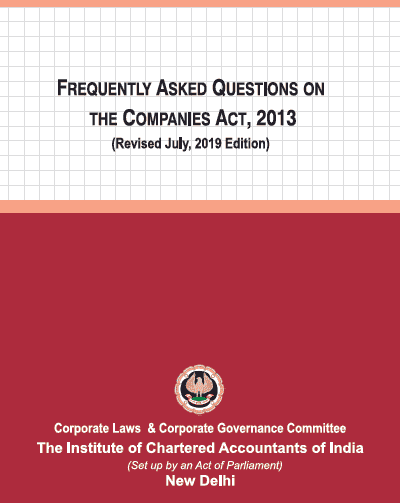
174 FAQ's on Companies Act, 2013 by ICAI Q1: What is SPICE A1: SPICE refers to Simplified Proforma for Incorporating Company Electronically.
 Pratibha Goyal
 Jul 4, 2019
174 FAQ's on Companies Act, 2013 by ICAI
Q1: What is SPICE
A1: SPICE refers to Simplified Proforma for Incorporating Company Electronically. It is a simplified integrated process for incorporating a company in Form No. INC-32 along with e-Memorandum of Association in Form No. INC-33 and e-Articles of Association in Form No. INC-34. It has been introduced by the MCA and is effective from 1 October 2016.

Q2: In case the subscriber to the memorandum is a foreign national residing outside India, his signatures and address etc. shall be witnessed by a Notary Public/Embassy/Consulate offices of Embassies as per the Rule 13 of the Companies (Incorporation) Rules, 2014. In such cases, how can the DSC of such a witness be affixed
A2: In such cases, SPICe (INC-32) shall be filed along with the manually signed and duly attested MOA and AOA.
Q3: Whether every company is required to follow the SPICE process for incorporation of a company

A3: As per Companies (Incorporation) Fifth Amendment Rules, 2016, all companies except Part I companies and a company having more than 7 subscribers/promoters are required to follow the SPICE process for incorporation with effect from 1 January 2017.
Q4: Can a company apply for name availability certificate by filing Form INC-1 prior to filing of SPICE form
A4: A company can apply for name availability by filing for RUN prior to filing of SPICE Form.
An approved name is valid for a period of(i) 20 days from the date of approval (in case name is being reserved for a new company) or (ii) 60 days from the date of approval (in case of change of name of an existing company).
Q5: Can a company be incorporated without a registered office
A5: As per the Companies Act 2013, a Company shall have its registered office within 30 days of its incorporation.
Q6: In case of an overseas subscriber and director, are the documents required to be notarised and apostilled for incorporation of a company
A6: The attestation requirements depend on the country in which registered office/reside2nce of the overseas subscriber/director is situated. The documents are required to be attested as follows:
- Residing in a country which is part of the Common Wealth, by a notary public of that country;
- Residing in a country which is party to the Hague Apostille Convention, 1961, attested by a notary public and duly apostilled in accordance with the said Hague Convention; and
- Residing in a country which is not party to said Hague Convention, authenticated by a Diplomatic or Consular Officer empowered in this behalf under Section 3 of the Diplomatic and Consular Officers (Oaths and Fees) Act, 1948 (40 of 1948) i.e. attested by Public Notary and authenticated by Indian Embassy in the country of residence.
Q7: What is the due date to intimate the ROC for change in the situation of registered office of the company
A7: As per Companies Act, 2013 every change in the situation of registered office of the company is required to be given to the ROC within 30 days of the change.
Q8: What is OPC
A8: OPC means a company which has only one person as a member.
Q9: Can a non-resident become a member of an OPC
A9: In terms of Rule 3 of the Companies (Incorporation) Rules, 2014, only a natural person who is an Indian citizen and resident in India is eligible to incorporate an OPC. Therefore, a non-resident cannot become a member or nominee of an OPC.
For the purposes of this rule, the term resident in India means a person who has stayed in India for a period of not less than one hundred and eighty two days during the immediately preceding one calendar year.
Q10: How many OPCs can be incorporated by a person or in how many OPCs, he shall be eligible to be a nominee
A10: A natural person shall not be member of more than an OPC at any point of time and the said person shall not be a nominee of more than an OPC.
Q11: Can a company registered under Section 8 merge with another company with dissimilar objects
A11: As per Section 8 (10) of CA, 2013, a company registered under the said Section can only merge with another Section 8 company which has similar objects.
Q12: Is a Section 8 company required to seek permission of Central Government (RD) for alteration of its articles of association prior to getting the same approved by the members by means of special resolution in general meeting
A12: Yes, as per Section 8 (4)(i) of CA, 2013, Section 8 Company is required to obtain prior approval of Central Government (RD) for alteration of its articles. However, members may pass the resolution for alteration of articles prior to the approval, but it shall be effective only post approval from the Central Government (RD).
Q13: How will the surplus be treated in case of winding up of Section 8 Company
A13: As per Section 8 (9) of CA, 2013, any asset remaining after satisfaction of the debts will be transferred to another company registered under Section 8 having similar objects, subject to such conditions as the NCLT may impose, or the same may be sold and proceeds thereof shall be credited to Insolvency and Bankruptcy Fund formed under Section 224 of the Insolvency and Bankruptcy Code, 2016.
Q14: What is Small Company
A14: A Small Company, other than public company, means a company where the:
- Paid-up share capital of the company does not exceed INR 50 Lakhs or such higher amount as may be prescribed which shall not be more than ten crore rupees; and
- Turnover of which as per profit and loss account for the immediately preceding financial year does not exceed two crores rupees or such higher amount as may be prescribed which shall not be more than hundred crore rupees.
Note: No higher amount has been prescribed as yet.
Further, holding company, subsidiary company, company registered under Section 8 or a company or body corporate governed by any special act will not be considered as a small company.
Q15: Is it mandatory for the name of the company to be indicative of the nature of its business
A15: No, it is not mandatory for the name to be indicative of the nature of its business.
Q16: Can a company have multiple and varied objects under its MOA
A16: As per the Act, the Company may engage in any lawful act or activity for the time being in force. In case, company proposes to pursue any specific objective, MOA shall state the said object for which company is incorporated.
Thus, as per the Act, the question on multiple object or varied object would not arise.
About Author


Pratibha Goyal
Admin
 Studycafe
 Delhi, Delhi, India
 1080
1080My Recent Articles
- Chartered Accountants Association Embraces Income Tax Faceless Proceedings
- CBDT condones delay in filing form 10IC for AY 20-21: Know upto when to file the form to take concessional tax benefit
- ICAI Announced date of Live Coaching Classes for CA Intermediate Nov 2022 Exam
- ICAI Announced Registration Date for Online Home-Based Practical Training Assessment
- ICAI Released Mock Test Papers Series for May 2022 CA Exam
Loading suggestions…


Recent Posts



All Posts

Recent Posts
All Posts