Once your filed and verified, ITR is processed by the Income Tax Department's Centralised Processing Centre (CPC), you will get an email with an intimation notice under Section 143(1).
Nidhi | May 1, 2025 |
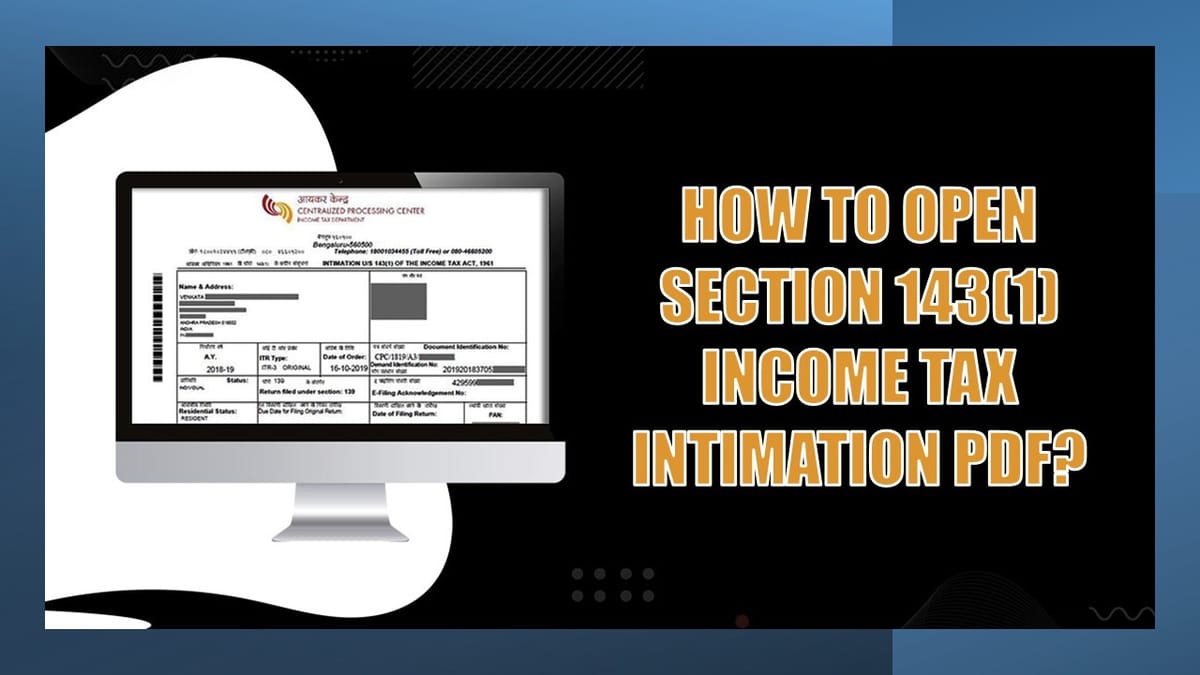

Received ITR Notice u/s 143(1); Let’s understand how to open it
Once your filed and verified Income Tax Return (ITR) is processed by the Income Tax Department’s Centralised Processing Centre (CPC), you will get an email with an intimation notice under Section 143(1). This notice comes as a PDF file, but it is password-protected. Many taxpayers face confusion because they don’t know the correct password to open the file. Here is how you can open this file.

The ITR intimation notice under Section 143(1) is protected by a password. To access the file on your device, you need to enter your PAN in lowercase along with your birth date in DDMMYYYY format. For instance, suppose your PAN is ABCDE4321F and your birth date is 01/01/2001, then your password would be abcde4321f01012001.
The Income Tax Department will give you an intimation under section 143 (1) of the Income Tax Act to let you know if you owe any extra tax or if you are eligible for a refund. It is important to read and understand this notice, as it lets you know if the income tax calculation you submitted in your ITR matches the records of the Income Tax Department.
The tax department checks for mistakes, internal inconsistencies, and ensures your tax and interest calculations are correct, along with confirming any tax payments. This is an initial review, but the department may still send you an income tax notice later asking for more information under various sections. This notice is a very important document as it explains how the income tax department has computed your income compared to what you have submitted in your return. Additionally, it lets you know if you’re eligible for a tax refund, if you owe more tax, or if no further action is needed from your side.
Taxpayers should not ignore this notice, as it could be a costly mistake, especially if it mentions that you have an outstanding tax demand. If you have an outstanding tax demand, interest at 1% per month (or part of it) will keep adding up until the demand is paid. While this situation isn’t considered tax evasion, it is treated as non-compliance.
CPC conducts a preliminary check on your ITR, and when your ITR passes this check, the income tax department will send you a Section 143 (1) intimation notice. The CPC checks the following things:
Taxpayers should note that if they have not received any Section 143 (1) intimation notice, it can mean that their ITR has not been processed by CPC. The CPC has the authority to process an ITR and send a Section 143 (1) intimation notice within nine months from the end of the financial year in which the ITR was submitted.

In case of any Doubt regarding Membership you can mail us at [email protected]
Join Studycafe's WhatsApp Group or Telegram Channel for Latest Updates on Government Job, Sarkari Naukri, Private Jobs, Income Tax, GST, Companies Act, Judgements and CA, CS, ICWA, and MUCH MORE!"