Meetu Kumari | May 18, 2026 |
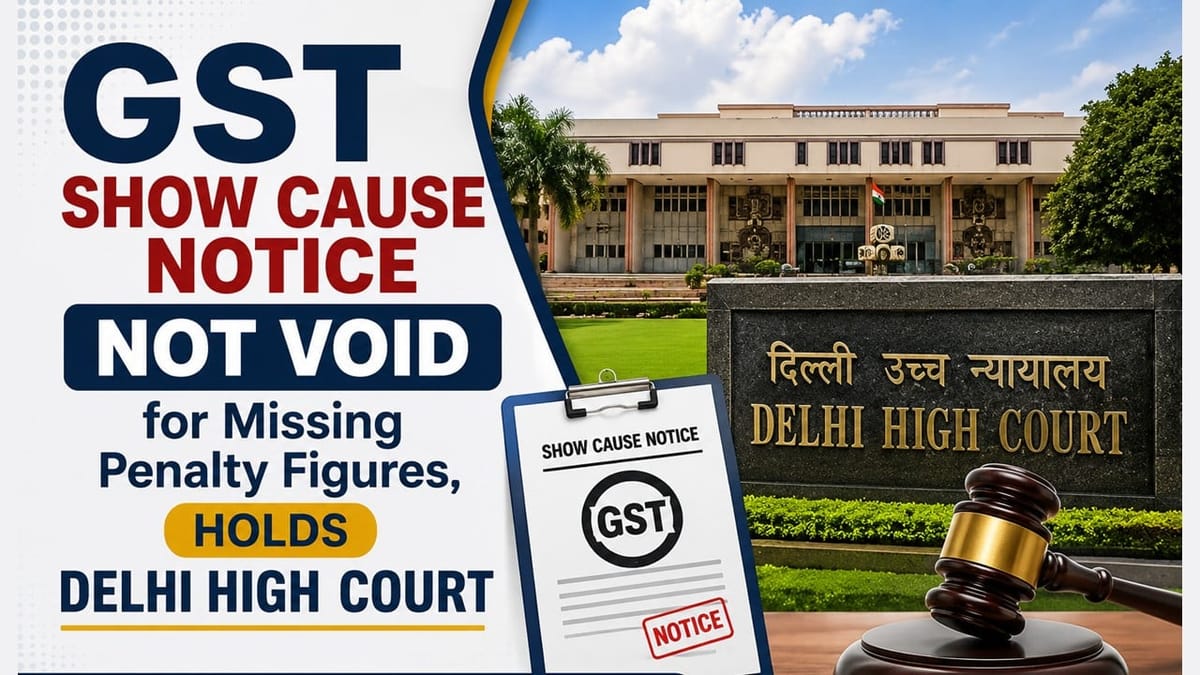

GST Show Cause Notice Not Void for Missing Penalty Figures, Holds HC
The Delhi High Court on 11 May held that a Show Cause Notice (SCN) under the CGST Act does not automatically become illegal merely because it does not mention the exact quantified amount of interest and penalty proposed to be recovered. A Division Bench comprising Justice Nitin Wasudeo Sambre and Justice Ajay Digpaul disposed of the writ petition filed by Sh. Bhupender Kumar, proprietor of M/s Dabas Construction Co., while granting liberty to pursue the statutory appellate remedy.
“The respondents must clearly propose the interest sought to be recovered and also specify the rate at which the same is sought to be levied along with proposed penalty.”

The dispute arose after the GST department issued a Show Cause Notice to the petitioner in relation to Input Tax Credit (ITC) availed for FY 2018-19, which according to the department was hit by limitation under Section 16(4) of the CGST Act. Although the petitioner later reversed the ITC in December 2023, the department proceeded to demand interest and penalty for the delayed reversal.
Before the High Court, the petitioner argued that the SCN violated Sections 75(6) and 75(7) of the CGST Act because it did not specify the exact monetary computation of interest and penalty. It was contended that absence of quantified demand rendered the proceedings legally unsustainable.

The Court, however, observed that while the expression “amount” under Section 75 would include tax, interest and penalty, non-mentioning of exact quantified figures by itself would not invalidate the Show Cause Notice. The Court pointed out that:
“Merely because the exact amount is not quantified in the notice, the same would not render the proceedings illegal.”
At the same time, the Bench clarified that tax authorities are expected to clearly indicate the proposed interest liability, applicable rate of interest, and penalty details in future notices to avoid ambiguity and unnecessary litigation.
The High Court further held that the petitioner had an effective alternative remedy by way of statutory appeal under the GST law. Thus, the writ petition was disposed of with liberty to file an appeal, and the appellate authority was directed not to reject the appeal on limitation grounds subject to compliance with the mandatory 10% pre-deposit requirement.
To Read Full Judgment, Download PDF Given Below.

In case of any Doubt regarding Membership you can mail us at [email protected]
Join Studycafe's WhatsApp Group or Telegram Channel for Latest Updates on Government Job, Sarkari Naukri, Private Jobs, Income Tax, GST, Companies Act, Judgements and CA, CS, ICWA, and MUCH MORE!"