ITAT deletes bogus purchase additions citing documentary evidence, stock records and denied cross-examination.
Meetu Kumari | Jun 22, 2026 |
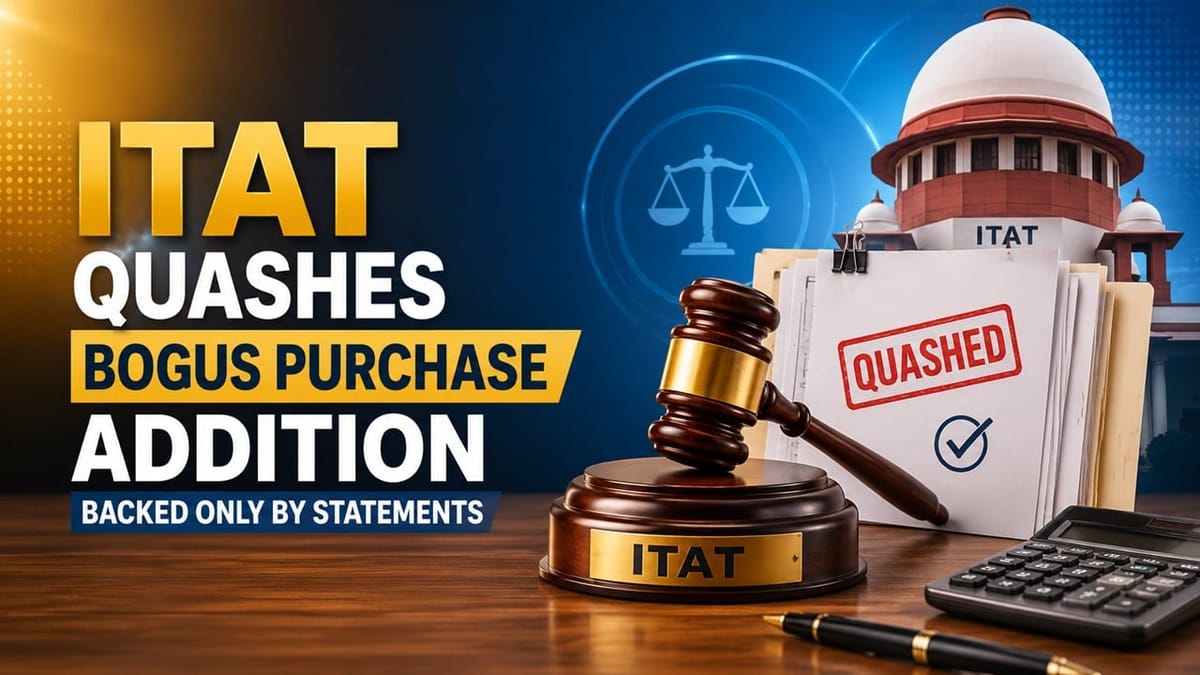

ITAT Quashes Bogus Purchase Addition Backed Only by Statements
The Mumbai Bench of the Income Tax Appellate Tribunal (ITAT) held that additions on account of alleged bogus diamond purchases could not be sustained where the assessee had furnished complete documentary evidence, established a quantitative reconciliation between purchases and exports, and was denied an opportunity to cross-examine the persons whose statements formed the basis of the addition. A Bench comprising Judicial Member Narender Kumar Choudhry and Accountant Member Prabhash Shankar directed deletion of additions sustained at 10% of alleged bogus purchases in the case of Dilipkumar Chimanlal & Company for AYs 2010-11 and 2012-13, subject to limited verification.

The assessee, engaged in the business of trading and export of diamonds, was subjected to reassessment proceedings based on information received from the Investigation Wing following a search conducted on the Bhanwarlal Jain Group. According to the department, the assessee had obtained accommodation entries in the form of bogus purchase bills from entities allegedly controlled by the group.
During the assessment proceedings, the assessee furnished purchase invoices, confirmations, bank statements, export documents, affidavits from suppliers and quantitative records demonstrating a one-to-one correlation between purchases and subsequent exports. Despite these documents, the Assessing Officer treated the purchases as non-genuine and estimated profit at 8% of the alleged bogus purchases. On appeal, the Commissioner (Appeals) enhanced the addition by directing application of a 10% profit rate.

Before the Tribunal, the assessee argued that all primary evidences supporting the purchases had been placed on record and that neither the investigation report nor the statements relied upon by the department were supplied. It was also contended that no opportunity to cross-examine Bhanwarlal Jain or other persons whose statements formed the basis of the reassessment was provided.
The Tribunal noted that the authorities had not pointed out any defect in the documentary evidence produced by the assessee. It further observed that the sales and export transactions had been accepted as genuine and that the quantitative reconciliation of purchases and exports remained undisputed throughout the proceedings.
“The assessee has established the reconciliation between the alleged purchases and the corresponding sales, which has also been accepted by the Commissioner (Appeals).”
The Bench held that denial of cross-examination despite reliance on third-party statements amounted to a violation of the principles of natural justice. Referring to the Supreme Court’s ruling in Andaman Timber Industries, it observed that an order founded upon statements of third parties cannot survive when the affected assessee is denied an opportunity to test such evidence through cross-examination.
The Tribunal also relied on its earlier decision in a similar diamond trading case involving identical facts, where additions were deleted after considering purchase documentation, stock reconciliation and accepted export sales. It distinguished the Bombay High Court ruling in Kanak Impex (India) Ltd. on the ground that, unlike that case, the present assessee had furnished comprehensive evidence substantiating the transactions. “Suspicion, howsoever strong, cannot take the place of proof.”
Holding that the assessee had discharged its primary onus and that the additions were based solely on third-party information without proper verification or adherence to natural justice, the Tribunal directed deletion of the additions sustained at 10% of the alleged bogus purchases. However, it directed the Assessing Officer to verify the correlation between the purchases and corresponding sales and the profit of 4.87% already offered to tax. Accordingly, the assessee’s appeals were allowed subject to such verification, while the Revenue’s appeal seeking restoration of the entire addition was dismissed.
To Read Full Order, Download PDF Given Below

In case of any Doubt regarding Membership you can mail us at [email protected]
Join Studycafe's WhatsApp Group or Telegram Channel for Latest Updates on Government Job, Sarkari Naukri, Private Jobs, Income Tax, GST, Companies Act, Judgements and CA, CS, ICWA, and MUCH MORE!"