The ITAT Delhi deleted a Rs 10 lakh penalty under Section 269ST, ruling that cash receipts above Rs 2 lakh attract penalty only when specific statutory conditions are proven.
Saloni Kumari | Jun 24, 2026 |
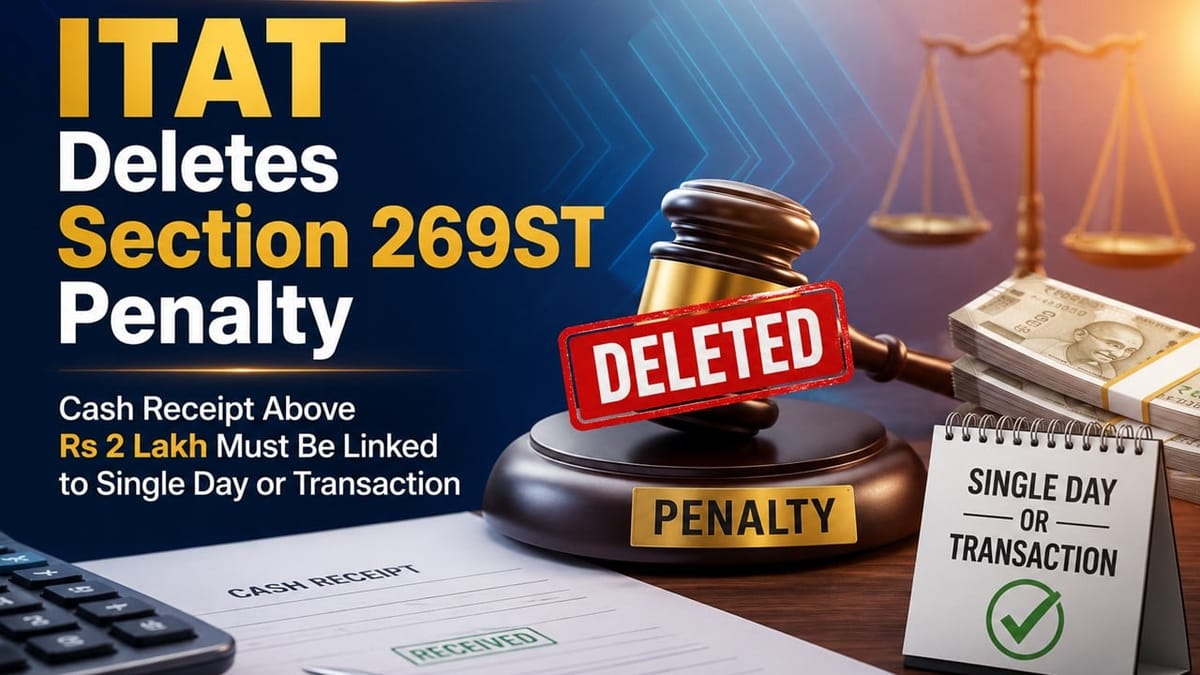

ITAT Deletes Section 269ST Penalty, Says Cash Receipt Above Rs 2 Lakh Must Be Linked to Single Day or Transaction
The ITAT Delhi, in a recent significant case, has held that a penalty under Section 269ST of the Income Tax Act can only be imposed on a taxpayer if he/she receives cash of Rs 2 lakh or more in a day, or in respect of a single transaction, or in respect of transactions relating to one event/occasion. Hence, the tribunal deleted the Rs 10 lakh penalty.
A search operation was initiated in relation to Shri Parasmal Jain and Balar Marketing Group cases. During the course of the same, the tax authorities found certain criminality documents concerning Hawala cash transactions and confiscated them immediately.

The documents indicated that the assessee, Mool Chand Jain, had received cash amounting to Rs 10 lakh through a hawala cash token from a group entity during the year under consideration, i.e., Assessment Year 2018-19. Consequently, notice under Section 153C was served to the assessee. In response to the notice, the assessee acknowledged that he had duly made cash sales to M/s Balar Marketing Private Limited, which were indeed not reflected in the income tax return (ITR).
Considering the assessee’s response, the tax authorities made an addition of Rs 80,000/- computed at 8% of Rs 1,000,000/- as profit on a presumptive basis under Section 44AD to the assessee’s income. Additionally, in violation of the said section, penalty proceedings were initiated against the assessee under Section 269ST for receiving cash on account of sales of Rs 10 lakh.

The aggrieved assessee approached the Commissioner of Income Tax (Appeals) [CIT(A)] challenging the Section 269ST penalty. However, the same was dismissed on the grounds that the assessee had contravened provisions of Section 269ST by accepting cash of Rs 10 lakhs during the year under consideration.
Thereafter, the case was taken before the ITAT Delhi. When the tribunal analysed the case, it noted that “penalty proceedings u/s 269ST were also initiated based on the assessee’s admission. However, before levying penalty u/s 271DA, it had to be ascertained whether the cash exceeding Rs. 2 lakhs was paid on any one day in relation to a single transaction by the assessee so as to attract the penal provisions.”
The tribunal held that Section 269ST can only be said to be violated if the assessee had received cash of Rs 2 lakhs or more in a day in respect of a single transaction or in respect of transactions relating to one event/occasion. However, the tax authorities had failed to record the same in the impugned penalty order. The Section 269ST penalty was merely levied because the assessee had accepted the receipt of the cash of Rs 10 lakh in question during the relevant AY. Accordingly, the tribunal quashed the impugned Rs 10 lakh penalty imposed under Section 269ST. Hence, the appeal is fully allowed.

In case of any Doubt regarding Membership you can mail us at [email protected]
Join Studycafe's WhatsApp Group or Telegram Channel for Latest Updates on Government Job, Sarkari Naukri, Private Jobs, Income Tax, GST, Companies Act, Judgements and CA, CS, ICWA, and MUCH MORE!"