All About Proposed E-Invoicing System
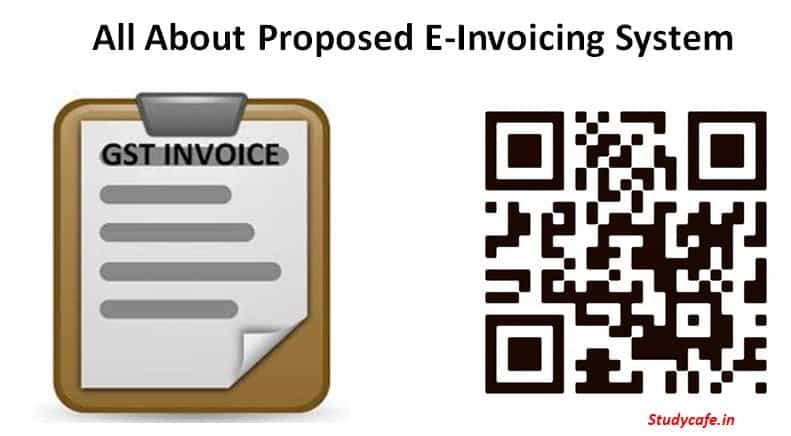
• The GST Council has approved introduction of ‘E-invoicing’ or ‘electronic invoicing’ in a phased manner for reporting of business to busin
 Pratibha Goyal
 Dec 17, 2019
• Generation of invoice in a standard format so that invoice generated on one system can be read by another system.
• Reporting of e-invoice to a central system.
• Basic aim- Ability to pre-populate the return and to reduce the reconciliation problems. • Adoption of e-invoice by GST System is not only part of Tax reform but also a Business reform as it make the e-invoices completely inter-operable eliminating transcription and other errors. • Other benefits of e-invoice system: • Better taxpayer services• Reduce reporting in multiple formats (one for GSTR-1 and the other for e-way bill)

• To generate Sales and purchase register (ANX-1 and ANX-2) from this data to keep the Return (RET-1 etc.) ready for filing under New Return. e-Way bill can also be generated using e- Invoice data
• Reduction of tax evasion• Complete trail of B2B invoices
• System level matching of input credit and output tax

• The interaction between the business (supplier in case of invoice) and the Invoice Registration Portal (IRP).
• The interaction between the IRP and the GST/E-Way Bill Systems and the Buyer.
• As the process evolves and system matures the same would be intercommunicated between buyer’s software and seller’s software, banking systems etc. • Flow from Supplier (commonly known as seller) to IRP • The generation of the invoice by the seller in his own accounting or billing system (it can be any software utility that generates invoice including those using excel or GSTN’s provided Offline Utility). • The invoice must conform to the e-invoice schema (standards) that is published and have the mandatory parameters. • The optional parameters can be according to the business need of the supplier. • The supplier’s (seller’s) software should be capable to generate a JSON of the final invoice that is ready to be uploaded to the IRP. The IRP will only take JSON of the e-invoice • Generate the unique Invoice Reference Number (IRN) (in technical terms hash of 3 parameters using a standard and well known hash generation algorithm e.g. SHA256). This is an optional step. The seller can also generate this and upload along with invoice data. The 3 parameters which will be used to generate IRN (hash) are:• Supplier GSTIN,
• Supplier’s invoice number and,
• Financial year (YYYY-YY). (The IRN or hash generation algorithm will be prescribed by GSTN in the e-invoice standard)
• Uploading of the JSON of the e-invoice (along with the hash, if generated) into the IRP by the seller. The JSON may be uploaded directly on the IRP or through GSPs or through third party provided Apps. • The IRP will also generate the hash and validate the hash of the uploaded json, if uploaded by the supplier • The QR code will contain GSTIN of seller and buyer, Invoice number, invoice date, number of line items, HSN of major commodity contained in the invoice as per value, hash etc. • The hash computed by IRP will become the IRN (Invoice Reference Number) of the e-invoice. This shall be unique to each invoice and hence be the unique identity for each invoice for the entire financial year in the entire GST System for a taxpayer • Flow from IRP to GST System/E-Way Bill System & Buyer • E-Invoice data would be consumed by GST System for generation of e-way bill or populating relevant parts GST Returns • The GST System will update the ANX-1 of the seller and ANX-2 of the buyer, which in turn will determine liability and ITC • E-Way bill system will create Part-A of e-way bill using this data to which only vehicle number will have to be attached in Part-B of the e-way bill. The QR code will enable quick view, validation and access of the invoices from the GST system from hand held devices. • All accounting and billing software companies are being separately asked to adopt the e-invoice standard so that their users can generate the JSON from the software and upload the same on the IRP. • Small taxpayers can use one of the eight free accounting/billing software currently listed by GSTN. Also, GSTN will provide Offline Tool where data of an invoice, generated on paper can be entered which in turn will create JSON file for uploading on the IRP. • Taxpayers can also use one of the commercially available accounting/billing software for this purpose • QR Code • The IRP will generate a QR code containing the unique IRN (hash) along with important parameters of invoice and digital signature so that it can be verified on the central portal as well as by an Offline App. • This will be helpful for tax officers checking the invoice on the roadside where Internet may not be available all the time. The web user will get a printable form with all details including QR code. • The facility of QR code verification will be made available only through the GST System and not the IRP. This is because the IRP will not have the mandate to store invoices for more than 24 hours. In order to achieve speed and efficiency, the IRP will be a lean and focused portal for providing invoice registration and verification service, IRN and the QR codes. Hence, storing of the invoices will not be a feature of the IRP. • To help small taxpayers adopt e-invoice system, GSTN has empanelled eight accounting & billing software which provide basic accounting and billing system free of cost to small taxpayers. Those small taxpayers who do not have accounting software today, can use one of the empanelled software products, which come in both flavors, online (cloud based) as well as offline (installed on the computer system of the user). Click Here to Buy CA Final Pendrive Classes at Discounted Rate Tags : GST, GST Notifications, E-Invoice For Regular Updates Join : https://t.me/StudycafeAbout Author


Pratibha Goyal
Admin
 Studycafe
 Delhi, Delhi, India
 1080
1080My Recent Articles
- Chartered Accountants Association Embraces Income Tax Faceless Proceedings
- CBDT condones delay in filing form 10IC for AY 20-21: Know upto when to file the form to take concessional tax benefit
- ICAI Announced date of Live Coaching Classes for CA Intermediate Nov 2022 Exam
- ICAI Announced Registration Date for Online Home-Based Practical Training Assessment
- ICAI Released Mock Test Papers Series for May 2022 CA Exam
Loading suggestions…


Recent Posts
All Posts

Recent Posts
All Posts