B.Tech Biotechnology in Delhi NCR: Exploring The Curriculum, College Facilities and Career Prospects:
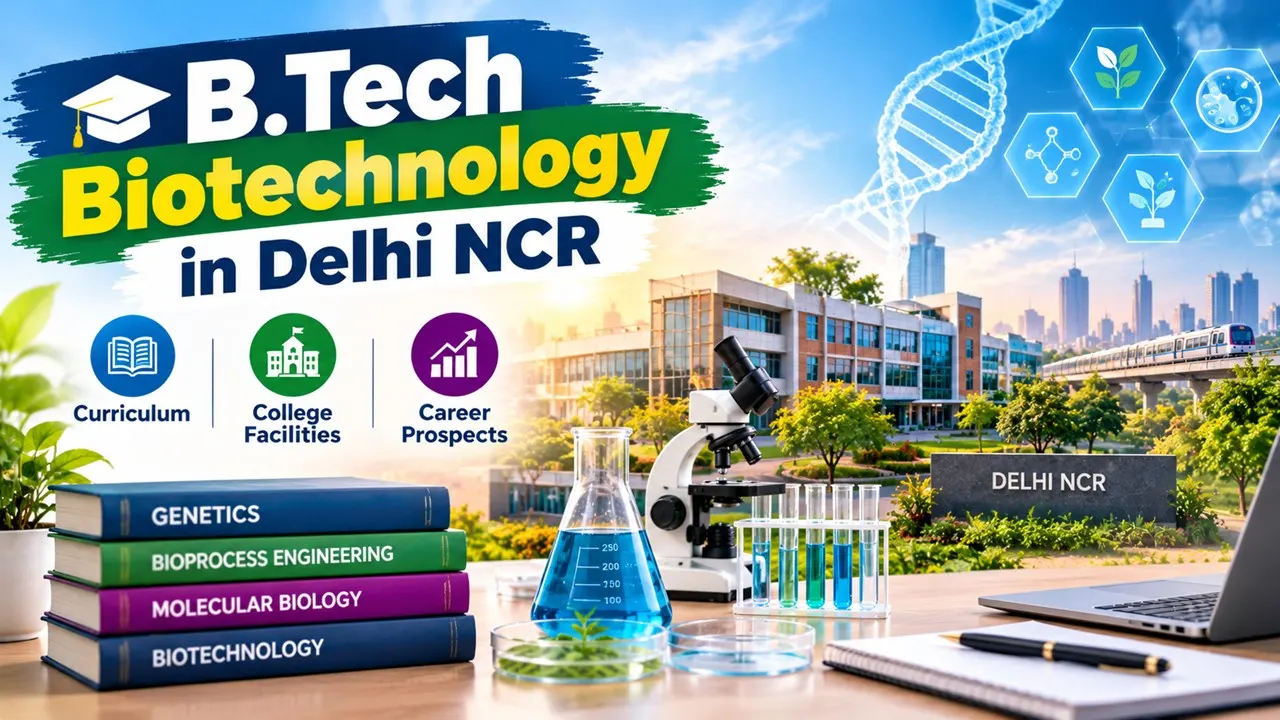
Explore how B.Tech Biotechnology combines biology, engineering, programming, and hands-on lab training to prepare students for research and industry careers.
Why Lab Training Matters in Biotechnology
 Vanshika verma
 Oct 29, 2026
Table of Contents
A lot of students assume B.Tech Biotechnology is a biology degree with an engineering label stuck on it. It isn’t. Alongside genetics and microbiology, you also study maths, programming, thermodynamics and process engineering, and that mix is what separates it from a B.Sc.
Part of the reason is what the field itself has become. Biotechnology stopped being a purely theoretical subject once pharmaceutical companies, diagnostic firms, and research institutions started looking for graduates who could walk into a wet lab or computational facility on day one.
If you’re comparing B.Tech colleges in India for this branch, you should evaluate lab access: how frequently students work in a lab, what equipment they use, and how early that exposure begins.

Why This Field Runs on Lab Work More Than Most
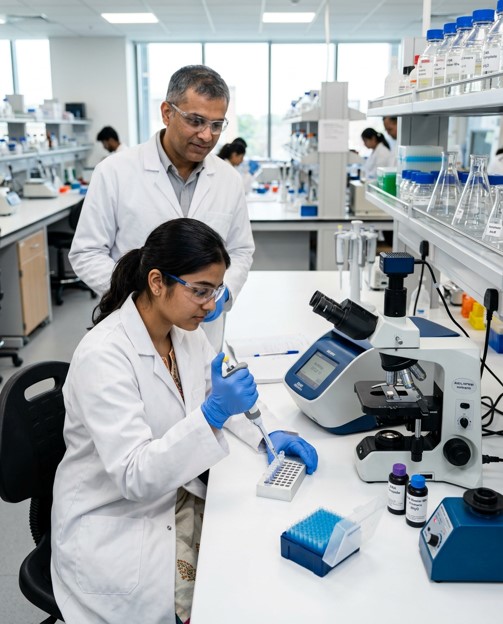
Biotechnology sits directly between biology and process engineering, and neither half functions well as pure theory. You can spend an entire semester explaining how restriction enzymes cut DNA at specific sequences or how bioreactor parameters affect yield, but you only fully grasp it once you run the digest, analyse the gel, or monitor a fermentation cycle firsthand.
A number of engineering institutions across the country have built their programs around this reality, treating hands-on training as the bridge between classroom concepts and industry requirements. At Jaypee Institute of Information Technology (JIIT) in Noida, the curriculum runs core practical courses alongside the theory modules they support, so concepts are tested in the lab in the same semester they are taught.

What the Four-Year Path Looks Like
A degree like this works best when each year adds something the next one depends on. JIIT is one example of how that four-year lab progression is laid out, and the same pattern is worth looking for in any program you are comparing.
Stage | What students work on | What it builds | Where it leads |
First Year | Basic bioscience lab techniques, physics, chemistry, and C++/Python coding fundamentals | Foundational wet-lab discipline and basic programming literacy | Sets up the foundation for second-year bioprocess, microbiology, and analytics subjects |
Second Year | Biochemical techniques, genetics, thermodynamics, and microbiology labs | Handling biomolecules, isolating microbes, and studying inheritance patterns | Prepares students for advanced gene work and bioprocess engineering |
Third Year | Genetic engineering, AI-driven biotechnology, cell culture, and bioinformatics labs | Recombinant DNA work, sequence alignment, cell line maintenance, and minor project execution | Core pharma R&D, computational biology, or bioprocess roles |
Fourth Year | Advanced discipline electives and a two-part major thesis project | Specialised research depth in a chosen direction | Specializing in bio-manufacturing or moving on to GATE, MS, or Ph.D. studies |
One detail that often gets overlooked in B.Tech biotechnology colleges is the balance between biology and computational tools. Modern biotech R&D relies heavily on data science. When high-throughput DNA sequencing generates gigabytes of genetic information, or when pharmaceutical firms simulate drug-protein interactions, wet-lab skills alone are not enough.
This is where a B.Tech structure proves its worth. Learning software development and data analysis alongside biological techniques ensures graduates can speak the language of both biology labs and software teams.
Before shortlisting a program, it helps to ask how much of the degree happens outside the classroom. JIIT's curriculum, for one, includes three mandatory summer training stints of at least four weeks each-after the second, fourth, and sixth semesters - to ensure students build real industry exposure.
Where Advanced Research Happens: Dedicated Centers
Core teaching labs cover the fundamentals every biotech student needs. What separates one program from another usually shows a level above that, in the research facilities students get access to once they move past basic coursework.
Institutes like JIIT run advanced setups across specialised research hubs:
Ø Centre of Excellence in Emerging Diseases: Focuses on molecular diagnostics, therapeutic target discovery, and recombinant vaccine development.
Ø Centre of Excellence in Plant & Microbial Biotechnology: Drives research in functional genomics, plant tissue culture, and agricultural bio stimulants.
Ø Centre for Technology Solutions for Soil & Water Remediation: Conducts environmental biotechnology research, including bioremediation and waste management.
Undergraduates at JIIT get opportunities to work directly alongside faculty and doctoral scholars on active projects funded by national agencies like DBT, ICMR, and DST.
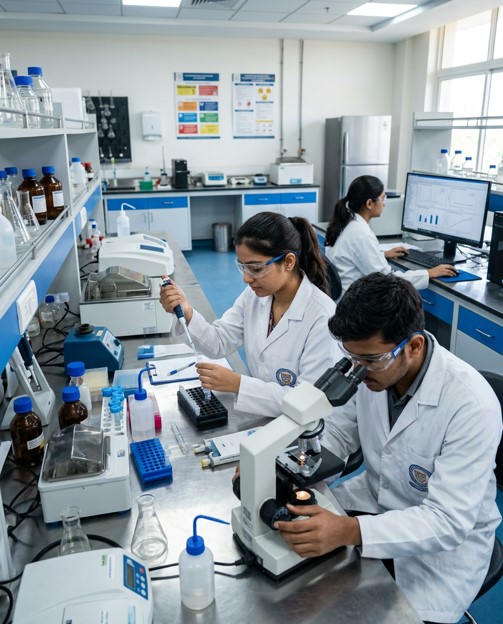
Students also get access to industry-grade equipment, such as real-time PCR, HPLC systems, biosensors, and bioreactors, through DST-FIS-supported laboratories and BIRAC-supported BioNEST incubators, instead of relying solely on demonstration models.
What This Builds by Graduation
None of these matters if it does not translate into something a student can use. By their final year, someone who has gone through a lab-focused track has run PCR independently, handled recombinant DNA work, analysed sequence databases, and spent real time inside a cell culture or bioprocess facility.
That practical training shows up in what graduates can do next:
· Core Industry Careers: Employers in pharma, diagnostics, and biomanufacturing look for candidates who can operate wet-lab equipment or handle computational pipelines without needing months of retraining.
· Bioinformatics and Bio-AI: Blending biological lab data with Python and machine learning opens roles in computational genomics and AI-driven drug discovery.
· Higher Studies & Global Research: Real experimental experience gives students an edge when applying for MS or Ph.D. programs, and it also helps with GATE preparation. JIIT biotechnology alumni regularly move on to advanced research degrees at top institutions in India and abroad, including the IITs, Johns Hopkins, Penn State, Georgia Tech, and Max Planck Institutes.
What to Compare When Choosing the Program
For students shortlisting B.Tech colleges in India, a useful comparison should include:
· How lab courses are distributed across all four years.
· Whether programming and data tools are taught alongside biological sciences.
· The availability of research-grade facilities vs. basic demonstration labs.
· Structured pathways for multi-semester projects and mandatory summer internships.
· Opportunities for undergraduates to join faculty-led research projects.
Conclusion
Biotechnology was never going to stay a lecture-based subject for long. The tools involved; sequencing, cell culture, bioprocess monitoring, and recombinant DNA work - are things you either learn by doing or do not really learn at all. What separates one biotech program from another increasingly comes down to how much of that actually happens before graduation.
Jaypee Institute of Information Technology, Noida, offers B.Tech in Biotechnology alongside programs across engineering, computing, science, and management.
Exploring btech colleges in Delhi NCR? Visit the website to explore the full curriculum and research facilities.
About Author


Vanshika verma
Content Writer
 Studycafe
 Delhi, Delhi, India
 2149
My Recent Articles
- CBI Arrests Income Tax Inspector in Mumbai for Allegedly Accepting Rs 15 Lakh Bribe to Close Benami Property Case
- Centre Amends Customs Duty Exemptions for Defence Equipment and Spare Parts
- Government Amends GST Rate Notification Under Section 11(1) of the CGST Act, 2017, to Update The Definition of Nominated Agency
- GST Reverse Charge Provisions Expanded to Cover Used Cooking Oil, Plastic Waste and E-Waste from November 1
- Central Government Amends GST Notification to Include Psyllium Seeds (Isabgol) Under Tariff Item 1211 90 13 from November 1
Loading suggestions…

Recent Posts



All Posts



Tags
Recent Posts
All Posts