Capital Gains in ITR: Common Mistakes Taxpayers Should Avoid While Filing Returns:
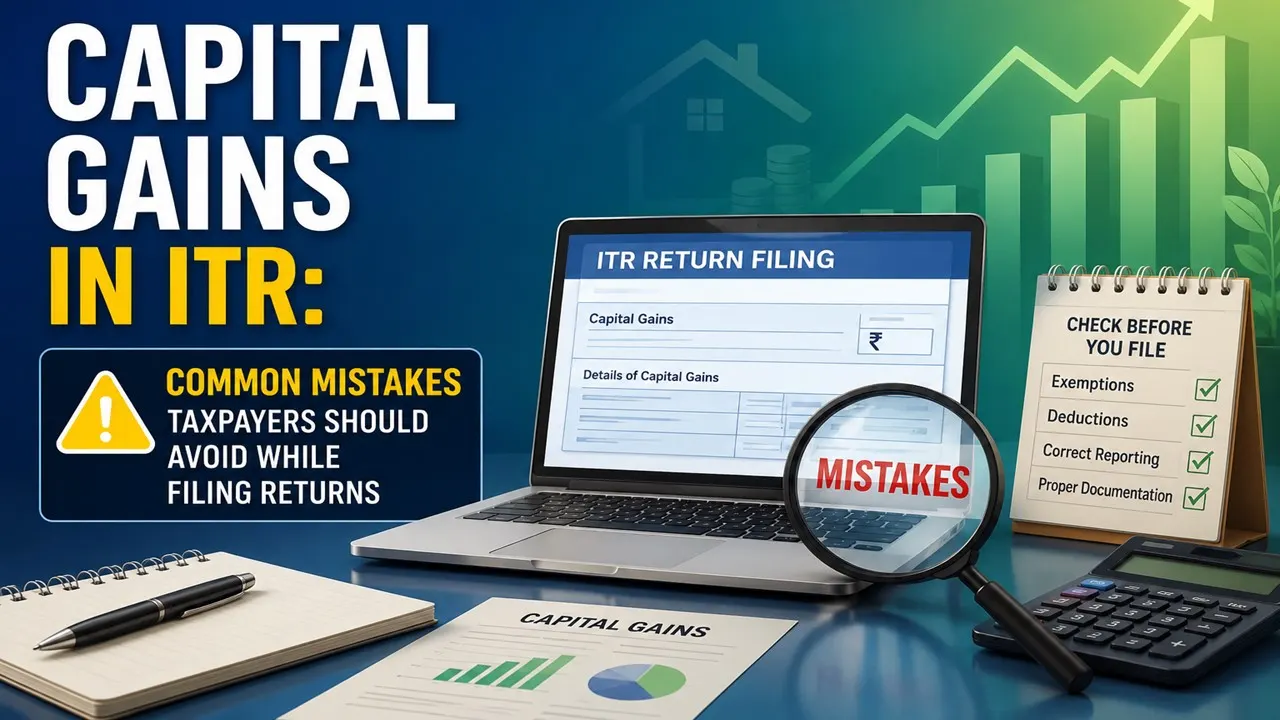
Avoid common capital gains reporting mistakes in ITR filing to prevent tax notices, delayed refunds and incorrect tax liability.
Key capital gains reporting mistakes every taxpayer should avoid while filing ITR
 Meetu Kumari
 Jul 21, 2026
Table of Contents

Many individual taxpayers view filing an Income Tax Return (ITR) as a straightforward exercise—declaring salary income, reporting investments, and paying any balance tax. However, reporting capital gains can quickly turn an otherwise simple tax return into a complex compliance exercise.
In the post-COVID era, it has become increasingly common for salaried employees to invest in equities, mutual funds, exchange-traded funds (ETFs), and other financial assets. During the financial year, taxpayers may sell shares, redeem mutual fund units, book gains from foreign Employee Stock Options (ESOPs) or Restricted Stock Units (RSUs), or dispose of inherited property. While these transactions may appear straightforward, an incorrect holding period, a mismatch with the Annual Information Statement (AIS), or failure to disclose foreign assets can result in tax notices, delayed refunds, or additional tax demands.

As the ITR filing season for Financial Year (FY) 2025-26 progresses, scrutiny of capital gains reporting has become more rigorous than ever. With the Income Tax Department increasingly relying on technology, data analytics, the Annual Information Statement (AIS), broker reports, mutual fund disclosures, and overseas information exchange mechanisms, filing an accurate return now requires not only correct tax computation but also complete, accurate, and consistent reporting.
Eight Common Capital Gains Mistakes Taxpayers Make
Taxpayers often make avoidable mistakes while reporting capital gains. Some fail to report all purchase or sale transactions carried out through multiple brokers or mutual fund platforms.
Others apply the wrong holding period and incorrectly classify gains as Short-Term Capital Gains (STCG) or Long-Term Capital Gains (LTCG). Another common error is relying solely on brokerage statements without reconciling the reported figures with the Annual Information Statement (AIS). Such omissions or inconsistencies can trigger scrutiny, delay refunds, or even result in tax demands.

The first step in capital gains taxation is to identify the asset that has been sold or transferred and determine whether the resulting gain is taxable. Generally, profits arising from the sale or transfer of a capital asset are taxable in the year in which the transfer takes place after deducting the cost of acquisition, eligible cost of improvement, expenses incurred wholly and exclusively in connection with the transfer, and applicable exemptions wherever the law permits reinvestment.
Although the underlying principle appears straightforward, taxpayers often face difficulties in correctly identifying the nature of the capital gain and applying the appropriate tax provisions.
One of the most common errors in capital gains reporting is the incorrect classification of gains as Short-Term Capital Gains (STCG) or Long-Term Capital Gains (LTCG). For instance, consider two investors selling listed equity shares. One sells the shares after holding them for eight months, while the other sells after fourteen months. Although both transactions involve the same asset class, their tax treatment may differ significantly because of the applicable holding period.
This distinction is crucial because the applicable tax rates, exemptions, set-off and carry-forward of losses, and reporting requirements vary depending on whether the gain is classified as short-term or long-term.
Thus, taxpayers should first identify the nature of the capital asset and then determine the applicable holding period before computing the tax liability. Correct classification at this stage helps avoid errors in reporting and significantly reduces the likelihood of future disputes with the Income Tax Department.
About Author


Meetu Kumari
Content Manager
 Studycafe
 Jodhpur, Rajasthan, India
 2264
2264My Recent Articles
- ITAT Condones 302-Day Delay, Restores Salary Assessment for Fresh VerificationPremium
- ITAT Condones Delay After Tax Consultant's Death, Restores Appeals for Fresh HearingPremium
- ITAT Remands Salary Addition, Says Taxability Depends on Salary Becoming Due, Not Mere ReceiptPremium
- ITAT Deletes TP Royalty Adjustment, Orders Fresh Review of Commission BenchmarkingPremium
- ITAT Quashes Reassessment Over Unsigned Section 148 Notice Issued to AssesseePremium
Loading suggestions…


Recent Posts


All Posts


Recent Posts
All Posts