High Court Quashes GST Demand Against Amul Over Non-Cross-Charging of Common Expenses:
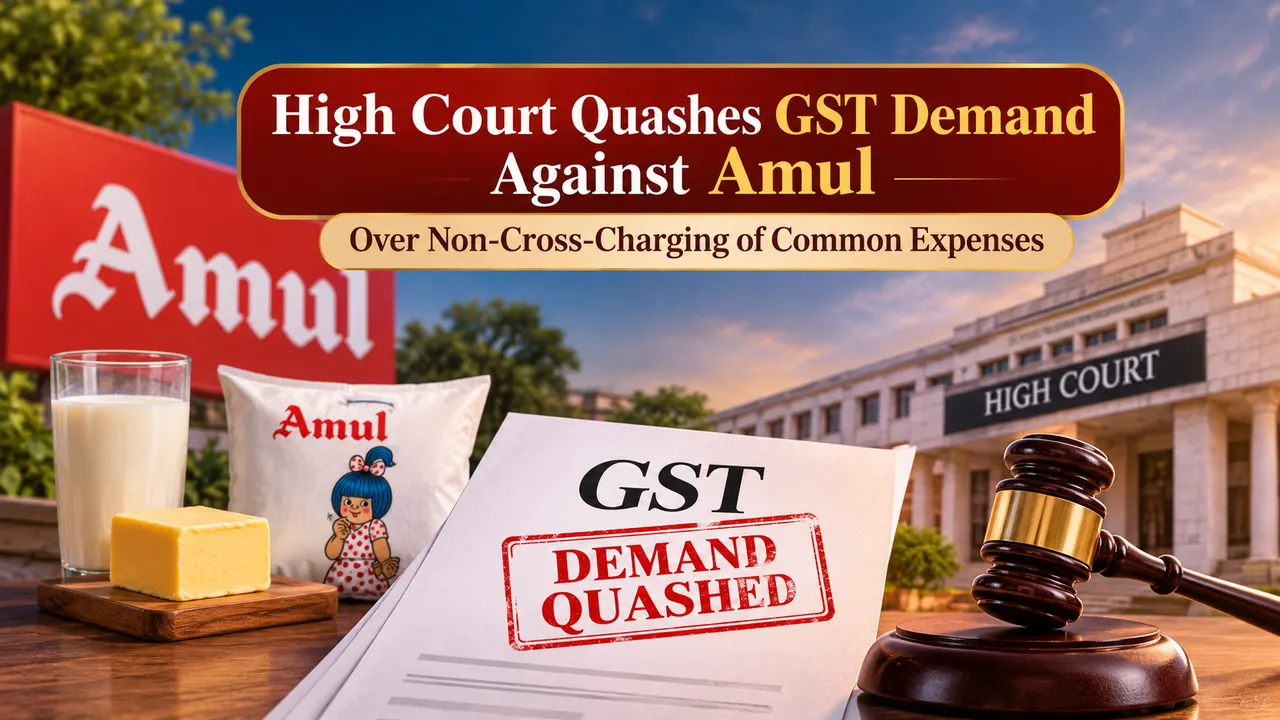
The Gujarat High Court held that non-issuance of invoices requires nil valuation under Rule 28 where full ITC is available.
High Court Quashes Rs. 43.43 Crore GST Demand
 Saima
Saima Oct 18, 2026
Gujarat Co-operative Milk Marketing Federation Limited which is popularly known as Amul, operates as an apex body for various milk cooperatives and undertakes corporate activities from its Head Office at Anand, Gujarat. During the period from July 2017 to March 2019, the Federation incurred common corporate expenses, including advertisement and publicity, IT infrastructure, annual maintenance services, legal and litigation expenses, insurance and employee salaries, without proportionately allocating such expenditure to its branches and depots through cross-charging.
The GST authorities alleged that the Head Office had provided services to its distinct establishments and that the corresponding expenditure was liable to GST. Invoking Section 74 of the Central Goods and Services Tax Act, 2017, the authorities issued a show-cause-cum-demand notice dated August 31, 2022, alleging suppression of facts and an intention to evade tax. By an Order-in-Original dated January 1, 2025, the Additional Commissioner of CGST confirmed an IGST demand of Rs. 43,43,12,441, along with applicable interest and penalty. Aggrieved by the order, the Federation approached the Gujarat High Court.

The Gujarat High Court observed that the Head Office and branches or depots holding separate GST registrations across different States are treated as distinct persons, and supplies between them in the course or furtherance of business may attract GST even without consideration. However, the Court distinguished establishments operating under separate GST registrations from branches functioning under a single registration. It held that cross-charging must be examined in the context of the applicable registration and valuation provisions and cannot be applied indiscriminately to all internal allocations of expenditure.
The Court noted that CBIC Circular No. 199/11/2023-GST dated July 17, 2023, and Circular No. 210/4/2024-GST dated June 26, 2024, clarify the valuation of services supplied between related or distinct persons. Where the recipient is eligible for full input tax credit and the Head Office has not issued a tax invoice for a particular service, the value of that service may be deemed to be ‘Nil’ under the second proviso to Rule 28 of the CGST Rules.

Allowing the writ petition, the Gujarat High Court quashed and set aside Order-in-Original No. 74/CGST/(Ahmedabad South)/ADC/PBM/24-25 dated January 1, 2025, which had confirmed the IGST demand of Rs. 43,43,12,441 against Gujarat Co-operative Milk Marketing Federation Limited, along with interest and penalty. The Court made the Rule absolute.
About Author


Saima
Content Writer
 StudyCafe
 Delhi, Delhi, India
 555
555My Recent Articles
- High Court Quashes Income Tax Demand Against Contractual Worker Over Misuse of PAN
- ITAT Deletes Rs 2.06 Crore Addition Under Section 68 for Unsecured Loans
- ITAT Holds Section 263 Revision Invalid on Taxability of Interest Under Section 28 of Land Acquisition Act
- ITAT Upholds Section 68 Addition for Bogus Loans But Restricts Estimated Profit to 2% of Sales
- High Court Strikes Down Retrospective Section 147A of Income Tax Act
Loading suggestions…


Recent Posts

All Posts

Recent Posts
All Posts