CBIC Directs CGST Authorities to Share Data with State Mining Departments for Detecting GST Evasion in Illegal Mining Cases:
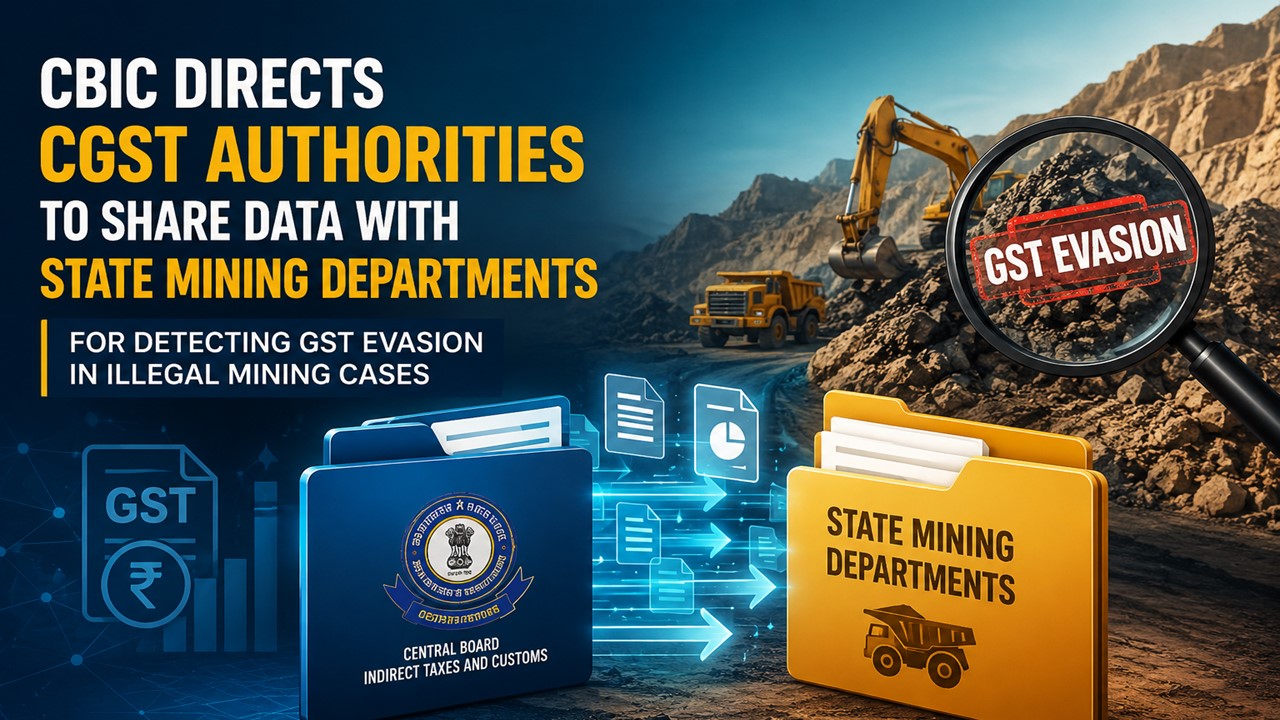
CBIC directs CGST authorities to coordinate with State Mining Departments for sharing illegal mining data to identify GST evasion, tax suppression, and compliance violations in the mineral sector.
Centre Introduces Mining Data Coordination Mechanism
 Saloni Kumari
 Aug 7, 2026
The Central Board of Indirect Taxes and Customs (CBIC) directed the CGST authorities to coordinate with State Mining Departments for sharing information related to illegal mining and transportation of minerals. The CBIC has given the aforementioned directions to the CGST authorities vide Instruction No. 01/2026-GST, dated August 3, 2026.
The instruction has been released following the observations in the Draft Performance Audit Report of the Comptroller and Auditor General of India (C&AG) on "Assessment, Levy and Collection of GST on Minerals". The report emphasised that the State Mining Authorities had been frequently detecting cases of illegal mining, illegal transportation of minerals, seizure of minerals and vehicles, cancellation of mining leases, excess extraction of minerals, and others. Such practices are considered violations of the mining laws.

The instruction reads that "such information has potential implications under the Central Goods and Services Tax Act, 2017, as it may indicate suppression of taxable supplies, non-registration, undervaluation, non-payment or short payment of tax or other forms of GST evasion."
The CBIC noted that such information can help GST authorities identify possible tax-related violations, including suppression of taxable supplies, non-registration under GST, undervaluation of supplies, non-payment or short payment of tax, wrongful availment of input tax credit, and other GST offences.

However, the board also observed that they presently do not have any structured mechanism for regular sharing of information between State Mining Authorities and CGST field formations. To resolve this problem, the CBIC has given certain instructions to all the Principal Chief Commissioners/Chief Commissioners of CGST Zones, including the following:
Each CGST Zone needs to have a Nodal Officer for coordination with the respective State Mining Departments.
The CGST Zones have also been directed to establish a system for periodic exchange of information on illegal mining and mineral transportation cases.
The information received must be analysed to identify GST implications, and appropriate action should be initiated wherever required under the CGST Act, 2017.
Refer to the official instruction for complete information.
About Author


Saloni Kumari
Content Writer
 StudyCafe
 Delhi, Delhi, India
 2898
2898My Recent Articles
- ITAT Says Cash Sales Cannot Be Treated as Bogus Without Proper Enquiry, Deletes Rs 24.59 Lakh Demonetisation Addition
- CIT(E) Cannot Impose Future Litigation Conditions on Section 12AB Registration and Section 80G Approval, Says ITAT
- CBI Arrests Long-Absconding Proclaimed Offender Kavita in Rs 3.63 Crore Bank Fraud Case After 9 Years
- ITAT Remands Rs 44.08 Lakh Creditor Addition and Rs 17.91 Lakh Agricultural Income Claim for Fresh Review
- Voltas Limited Gets Complete Relief as GST Department Withdraws Rs 15.43 Crore Tax Demand SCN
Loading suggestions…


Recent Posts

All Posts
Recent Posts
All Posts