CBIC Grants Customs Duty Exemption on Artworks and Antiquities for Public Exhibitions:
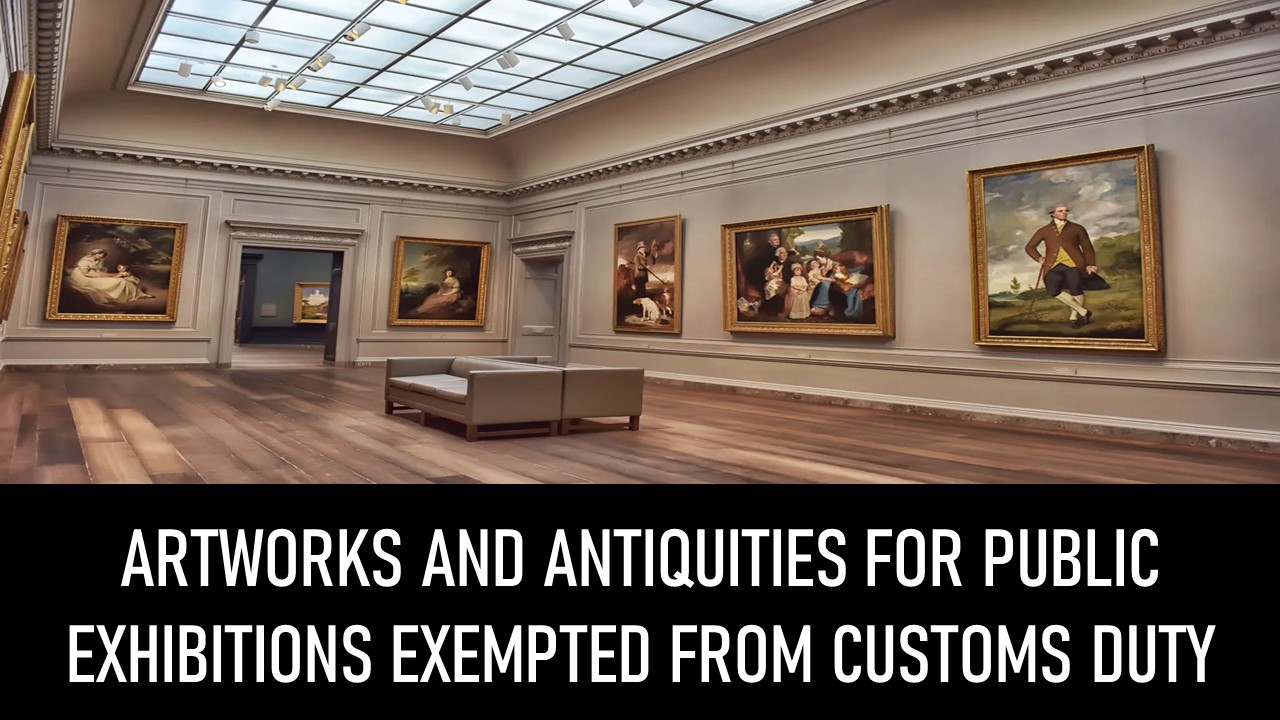
The Central Government has decided to fully exempt some goods, including works of art, memorials, and antiques, from customs duty when they are imported into India
Artworks and Antiquities for Public Exhibitions Exempted From Customs Duty
 Nidhi
Nidhi May 10, 2025
CBIC Grants Customs Duty Exemption on Artworks and Antiquities for Public Exhibitions
The Central Government has decided to fully exempt some goods, including works of art, memorials, and antiques, from customs duty when they are imported into India. The exemption applies to goods falling under the Customs Tariff Act, 1975, but only under specific conditions.
As per the Notification No. 29/2025-Customs, dated 9th May, 2025, "In exercise of the powers conferred by sub-section (1) of section 25 of the Customs Act, 1962 (52 of 1962), the Central Government, on being satisfied that it is necessary in the public interest so to do, hereby exempts goods of the description specified in column (2) of the TABLE below and falling within the First Schedule to the Customs Tariff Act, 1975 (51 of 1975) (hereinafter referred to as the said Act), when imported into India, from the whole of the duty of customs leviable thereon specified in the said Schedule, subject to the relevant conditions specified in the Annexure to this notification, the Condition number of which is referred to in the corresponding entry in column (3) of the said TABLE".
According to the table mentioned in the notification, the exemption applies to the following goods.
- Works of art, such as statuary and pictures, that are meant for public exhibition in museums or galleries.
- Works of art, namely memorials of a public character that are meant to be put up in a public place, including materials used or to be used in their construction, whether worked or not.
- Antiques, as defined by the Antiquities and Art Treasures Act, 1972, are intended for display in museums or galleries.
- The museum or art gallery itself must be the importer.
- The Importer must submit an undertaking to the Assistant Commissioner of Customs or the Deputy Commissioner of Customs that the goods imported shall only be used for public exhibition and not for sale, trade, or any other commercial purpose after import. If he fails to follow this condition, he must pay the full customs duty.
- The importer must present a certificate from an Authorised Officer (per the Ministry of Culture’s Gazette Notification), confirming that the importer operates a museum or art gallery that allows unrestricted public access, and the building of such museum or gallery is clearly to run the museum or gallery.
About Author


Nidhi
Content Writer
Nidhi is a skilled content writer specializing in personal finance. She creates clear, engaging articles on mutual funds, investments, insurance, and wealth-building strategies. With a passion for simplifying complex financial topics, Nidhi helps readers make informed money decisions with confidence. She can be reached at [email protected]
Nidhi is a skilled content writer specializing in personal finance. She creates clear, engaging articles on mutual funds, investments, insurance, and wealth-building strategies. With a passion for simplifying complex financial topics, Nidhi helps readers make informed money decisions with confidence. She can be reached at [email protected]
 Studycafe
 New Delhi, Delhi, India
 1832
1832My Recent Articles
- Karnataka High Court Gives Another Chance in GST Matter Due to Lack of Hearing
- Delay Should Be Condoned if Explanation is Unrefuted: ITAT
- Non-Service of Income Tax Notice, Ill health of taxpayer, ITAT condones Appeal filing delay
- Books of Accounts Cannot be Rejected Without Any Specific Defect: ITAT Kolkata
- Karnataka High Court Sends ITC Matter Back to GST Authorities for Reconsideration
Up Next
Loading suggestions…


Recent Posts

All Posts


Tags
No tags yet.
Recent Posts
All Posts
Tags
No tags yet.