CBIC Issues Guidelines for Departmental Appeals to GSTAT in Common Adjudicating Authority Cases:
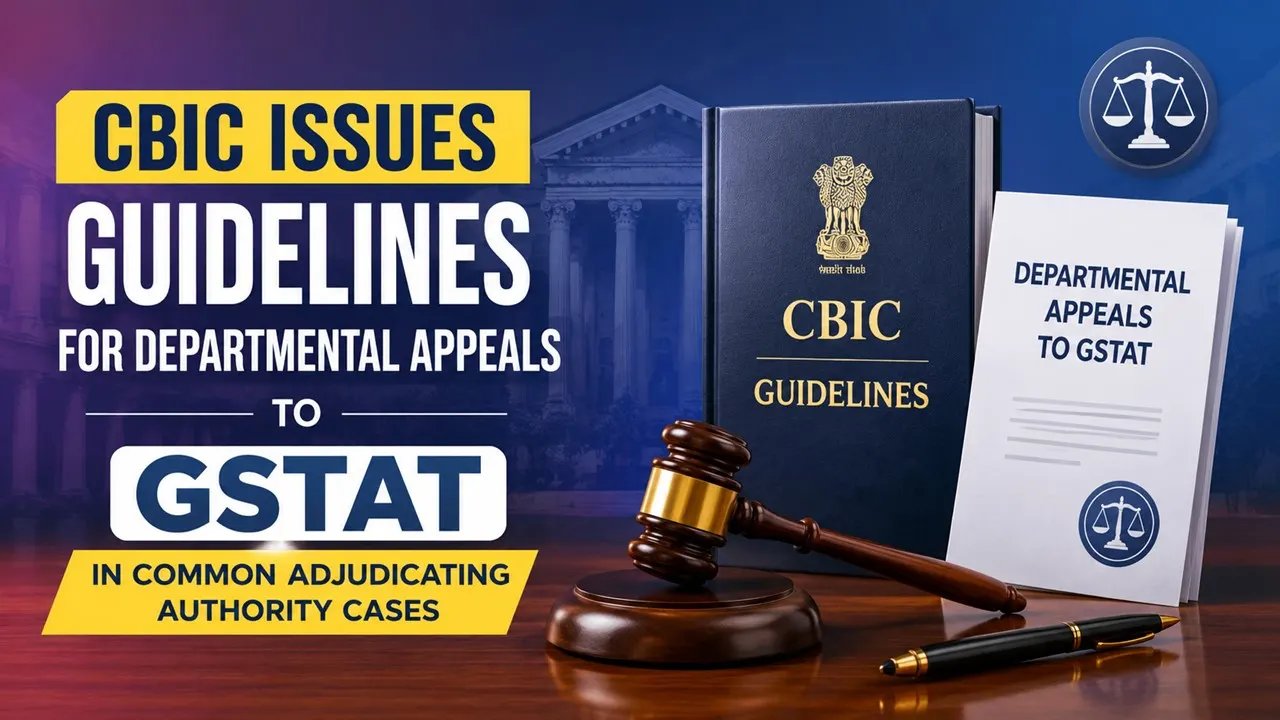
The CBIC has issued a circular establishing a standardized procedure for departmental appeals before GSTAT in DGGI Cases
CBIC Clarifies Appellate Procedure for Filing Appeals Before GSTAT
 Saima
Saima Jul 25, 2026
The Central Board of Indirect Taxes and Customs (CBIC) has issued Circular No. 256/02/2026-GST on 25th July 2026, establishing a standardized procedure for departmental appeals before the Goods and Services Tax Appellate Tribunal (GSTAT) against Appellate Authority orders stemming from Common Adjudicating Authority (CAA) decisions in DGGI cases. The circular resolves jurisdictional ambiguities regarding reviewing authorities, filing entities, and appropriate tribunal benches.
To handle complex, multi-jurisdictional tax evasion cases investigated by the Directorate General of Goods and Services Tax Intelligence (DGGI), Additional and Joint Commissioners of Central Tax were designated as Common Adjudicating Authorities (CAA) with all-India jurisdiction under Notification No. 02/2017-Central Tax (as amended). While earlier circulars provided guidelines for issuing show-cause notices and filing first appeals under Section 107 of the CGST Act, field formations faced issues regarding second appeals before the Goods and Services Tax Appellate Tribunal (GSTAT) under Section 112.

References have been received from field formations seeking clarification regarding the filing of an appeal by the department before the Goods and Services Tax Appellate Tribunal (hereinafter referred to as 'GSTAT') against an order of appellate authority (where Order-in-Original has been passed by a Common Adjudicating Authority in respect of DGGI cases). Clarifications are being sought as to:
(a) Who will be the reviewing authority in respect of such orders of appellate authority in CAA cases?

(b) which jurisdictional authority will be required to file an appeal before the GSTAT in such CAA cases?
(c) Whether an appeal before the GSTAT, in such CAA cases, is required to be filed before the bench of GSTAT having territorial jurisdiction over the location of the taxable person/noticee or is to be filed before the bench of GSTAT having jurisdiction over the commissionerate of the CAA.
In consultation with the Union Ministry of Law and Justice, the CBIC laid down the following uniform procedure under Circular No. 256/02/2026-GST:
Communication of Order: Upon passing an order under Section 107 of the CGST Act, 2017, the Appellate Authority must upload the order on the common portal and send both email and physical copies to the Principal Commissioner or Commissioner having jurisdiction over the Common Adjudicating Authority (CAA).
Inter-Departmental Consultation: The Commissioner having jurisdiction over the CAA will examine the order, consult DGGI for comments if necessary, and forward recommendations to the jurisdictional CGST Commissioners of all individual noticees involved in the original order.
Reviewing Authority under Section 112(3): The jurisdictional CGST Principal Commissioner/Commissioner of each respective taxable person/noticee acts as the statutory reviewing authority under Section 112(3) of the CGST Act. Upon evaluating the legality and propriety of the appellate order alongside the CAA Commissioner's inputs, the Reviewing Authority may direct a subordinate officer to file an appeal before GSTAT.
Separate Appeals & Territorial Jurisdiction: Separate appeals must be filed for each taxable person or noticee by their respective jurisdictional CGST Commissionerate before the specific GSTAT Bench that holds territorial jurisdiction over that particular noticee.
Intimation Requirement: Once an appeal is filed or if a decision is made not to appeal, the reviewing authority must intimate the Commissioner having jurisdiction over the CAA along with a copy of the memorandum of appeal.
For full information, refer to the official circular.
About Author


Saima
Content Writer
 StudyCafe
 Delhi, Delhi, India
 565
565My Recent Articles
- ITAT Quashes Assessment for Non-Service of Section 143(2) Notice
- ITAT Deletes Expense Disallowance Based on Mere Suspicion
- ITAT Allows Section 54 Deduction on Two Adjoining Flats
- ITAT Remands PE Dispute Involving UK Software Company to AO
- ITAT Denies Section 80GGC Deduction for Political Donation
Loading suggestions…


Recent Posts


All Posts



Recent Posts
All Posts