CBIC Orders Interim GST Reforms: No Arrests, Limited E-Way Bill Checks and Rs 10,000 SCN Limit:
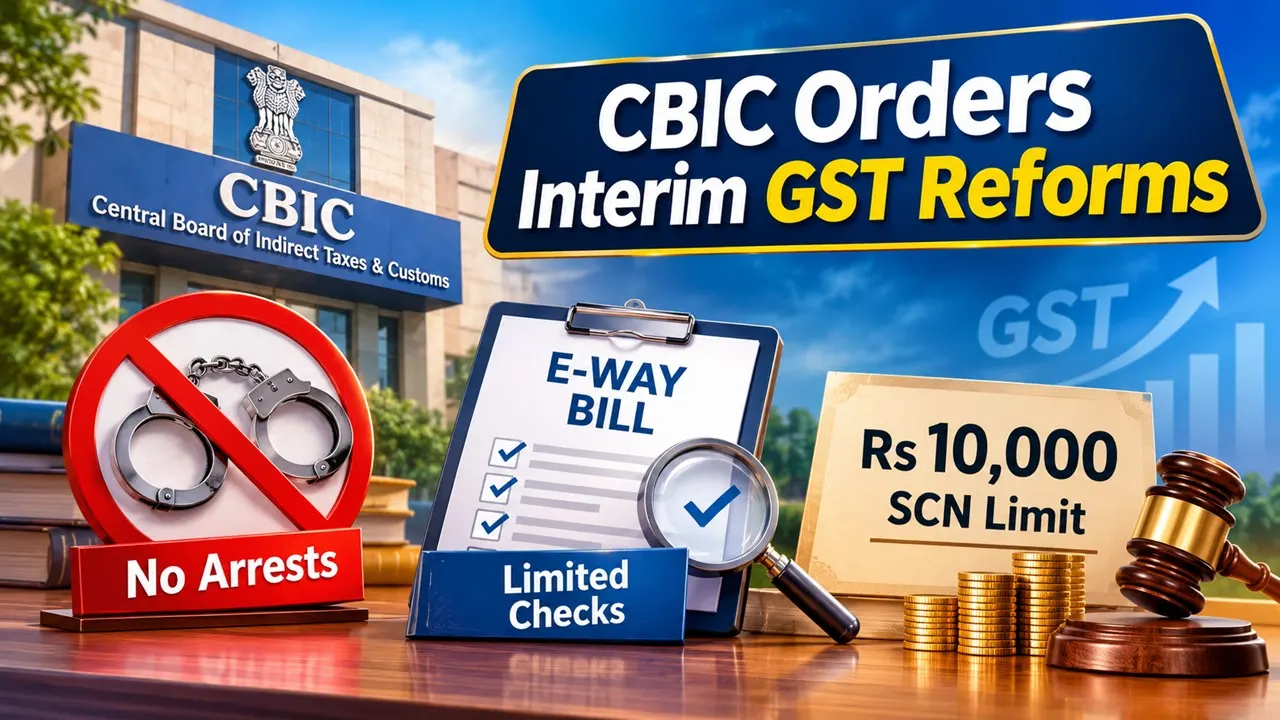
CBIC directs GST field formations to stop arrests, restrict e-way bill vehicle inspections and avoid issuing show cause notices involving tax amounts below Rs 10,000 as interim measures pending legislative amendments.
CBIC Directs GST Officers to Avoid Unnecessary Arrests, Inspections and SCNs
 Saloni Kumari
 Oct 31, 2026

The 57th Goods and Services Tax (GST) Council meeting held on October 08, 2026, at New Delhi, had recommended a large number of reforms such as omission of arrest provisions, rationalising the e-way bill-related inspection and verification procedures, and prescribing a minimum limit of Rs 10,000 for issuance of show cause notices (SCN) under section 73, 74 and 74A of the CGST Act.
The Central Board of Indirect Taxes and Customs (CBIC), through Instruction No. 02/2026-GST dated October 30, 2026, has directed its field formations to implement key GST reforms recommended by the GST Council in its 57th meeting, even before the required legislative amendments come into force. The measures aim to reduce hardships for taxpayers, simplify compliance and minimise unnecessary litigation.

Although the aforementioned suggested amendments in the GST Council meeting are expected to come into force from April 1, 2027, the Central Government has decided to implement these changes as an interim measure until the legislative amendments are notified.
Under the first direction, all CGST field formations have been instructed not to make any further arrests under GST. This follows the GST Council's recommendation to omit Section 69 of the CGST Act, 2017, which deals with arrest powers under GST.

The CBIC has also restricted the interception and inspection of vehicles carrying goods under the e-way bill provisions. A vehicle can now be intercepted only on the basis of specific intelligence authorised by an officer not below the rank of Joint Commissioner, who must record the reasons for suspecting a violation in writing. Inspection and detention of goods will generally be permitted only where the supplier or recipient is registered or located within the jurisdiction of the inspecting officer.
Where neither the supplier nor the recipient falls within the officer's jurisdiction, the officer must allow the vehicle and goods to pass without obstruction and forward the information to the appropriate jurisdictional officer for necessary action. However, if the vehicle does not have an e-way bill and no document establishing the origin or destination of the goods is produced, the inspecting officer can take action irrespective of jurisdiction. The instructions also clarify that goods and vehicles cannot be detained or seized for other reasons and cannot be confiscated under Section 130 of the CGST Act.
Further, the CBIC has directed that show cause notices should not be issued where the total tax amount involved is below Rs 10,000. This threshold will be calculated by combining CGST, SGST, IGST, UTGST and Compensation Cess.
The Principal Chief Commissioners and Chief Commissioners have been asked to monitor the implementation of these instructions. The measures will remain applicable until the corresponding amendments to the CGST Act, 2017, recommended by the GST Council, come into force.
About Author


Saloni Kumari
Content Writer
 StudyCafe
 Delhi, Delhi, India
 2997
My Recent Articles
- GST Council Releases Minutes Book and Agenda Notes (Volumes I & II) of 56th GST Council Meeting
- Petronet LNG Moves Gujarat High Court Challenging Rs 283.72 Crore GST Show Cause Notice on Use or Pay Charges
- ITAT Sets Aside CIT(A)'s Ex Parte Order in Rs 1.78 Crore Bogus Derivative Loss Dispute After Finding Need for Fresh Hearing
- Rajshree Sugars Gets Major Relief as Commissioner Drops Rs 6,283.59 Lakh Central Excise Demand
- ITAT Deletes Rs 4.42 Lakh Penalty, Says PF and ESI Disallowance Does Not Amount to Misreporting
Loading suggestions…


Recent Posts


All Posts


Recent Posts
All Posts