ITAT Deletes Rs 4.42 Lakh Penalty, Says PF and ESI Disallowance Does Not Amount to Misreporting:
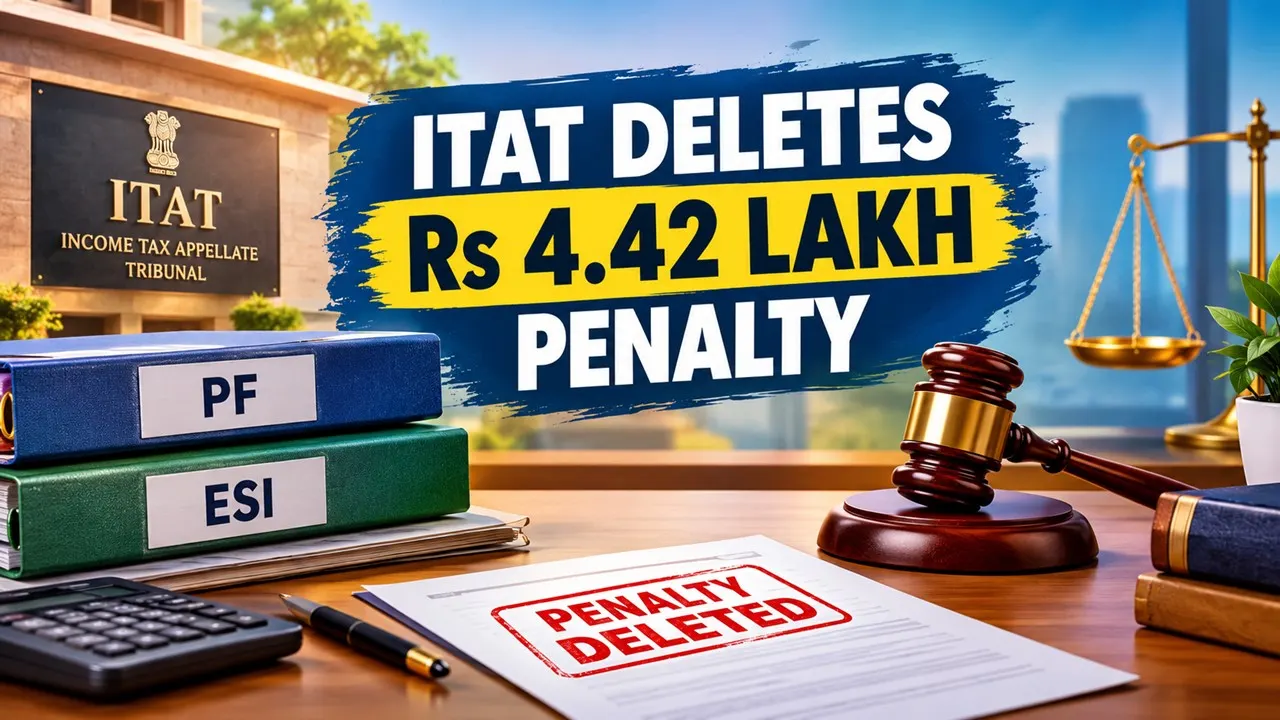
The ITAT deleted a Rs 4.42 lakh penalty under Section 270A, ruling that mere disallowance of delayed PF and ESI contribution deductions does not automatically constitute misreporting of income.
PF and ESI Deduction Disallowance Not Enough to Impose Misreporting Penalty, Holds ITAT
 Saloni Kumari
 Oct 31, 2026

The ITAT Ahmedabad deleted the penalty of Rs 4.42 lakh imposed on Nascent Info Technologies Pvt. Ltd. for delayed payment of contributions made towards employees’ provident fund (PF) and Employees’ State Insurance (ESI).
For the Assessment Year 2017-18, the company had declared an aggregate income amounting to Rs 6.14 crore after claiming deductions on the employees’ provident fund (PF) and Employees’ State Insurance (ESI) contributions.

However, during the assessment of the tax return, the Assessing Officer (AO) disallowed Rs 7.16 lakh claimed towards employees’ PF and ESI contributions on the ground of making payments after the prescribed due date. Further, a penalty of Rs 4.42 lakh was levied on the company under Section 270A, alleging misreporting of income.
According to the provisions of sub-section (9) of the Income Tax Act, mis-reporting of income occurs when there are the following charges on the taxpayer:
"(a) misrepresentation or suppression of facts;

(b) failure to record investments in the books of account;
(c) claim of expenditure not substantiated by any evidence;
(d) recording of any false entry in the books of account;
(e) failure to record any receipt in books of account having a bearing on total income; and
(f) failure to report any international transaction or any transaction deemed to be an international transaction or any specified domestic transaction, to which the provisions of Chapter X apply."
The company, not being satisfied with the penalty order, challenged the same before the Commissioner of Income Tax (Appeals) [CIT(A)]; however, the appeal contending the same was dismissed on the ground of newly implemented penalty provisions, effective from 2017, which provide a statutory classification of defaults instead of leaving the matter entirely to judicial interpretation.
Subsequently, the company approached the Income Tax Appellate Tribunal (ITAT). It was noted by the tribunal that simply disallowing the deduction does not automatically mean the income was misreported.
The tribunal cited an earlier decision in a case titled Hiro Mulchand Tanwani v. ITO, wherein the coordinate bench had held that the tax department must establish that the case falls within the specific circumstances listed under Section 270A(9).
The tribunal noted that the material on record did not satisfy any of the aforementioned conditions to confirm that the income was misreported. Consequently, the tribunal held that "the mere disallowance of the claim, by itself, is not sufficient to justify the levy of penalty for misreporting." Subsequently, the impugned CIT(A)'s order was set aside, and the Rs 4.42 lakh penalty was deleted.
About Author


Saloni Kumari
Content Writer
 StudyCafe
 Delhi, Delhi, India
 2993
My Recent Articles
- Rajshree Sugars Gets Major Relief as Commissioner Drops Rs 6,283.59 Lakh Central Excise Demand
- ITAT Remands Tax Matter to AO After Finding Natural Justice Violation and CIT(A)'s Failure to Examine Appeal on Merits
- Max Healthcare Subsidiary Kalinga Hospital Faces NCLT Proceedings; Hearing Adjourned to October 30
- Supreme Court: Income Tax Reassessment Invalid Without Mandatory Section 143(2) Notice Issuance Even If Taxpayer Participates
- CBI Registers Case Against Chandra Proteco and Its Bank Fraud of Over Rs 210.13 Crore
Loading suggestions…


Recent Posts



All Posts

Recent Posts
All Posts