Charging Section of CGST Act 2017 Section 9
Charging Section of CGST Act 2017 Section 9 Introduction: Charging section of the CGST act only deal with collection of CGST. As per CGST Ac
 Editor
 Dec 26, 2018
Table of Contents

Charging Section of CGST Act 2017 Section 9
Introduction:
Charging section of the CGST act only deal with collection of CGST. As per CGST Act 2017 there shall be levied a tax called Goods and Service Tax on all the Intra state supplies of goods and services on the value determined u/s 15 of the CGST Act 2017. There are also such exclusion from levying CGST on which GST is levied by the Central government on the recommendation of the council.
However intra-state supply of alcoholic liquor for human consumption is outside the purview of CGST.
 What is Forward charge
Forward charge or direct charge is the mechanism where the supplier of goods or services is liable to pay tax.
For example: -
1. If a chartered accountant provided a service to his client, the GST will be payable by the chartered accountant.
2. If a car manufacturing company sold some auto parts to a trader and collected tax from the trader, the manufacturing company remits the tax to the government.
Note: Under the current tax system, most transactions are covered under the forward charge mechanism.
Exclusion from GST:-
CGST on supply of following items has not been levied immediately. It shall be levied with effect from such date as may be notified by the Government on the recommendation of the GST council:
What is Forward charge
Forward charge or direct charge is the mechanism where the supplier of goods or services is liable to pay tax.
For example: -
1. If a chartered accountant provided a service to his client, the GST will be payable by the chartered accountant.
2. If a car manufacturing company sold some auto parts to a trader and collected tax from the trader, the manufacturing company remits the tax to the government.
Note: Under the current tax system, most transactions are covered under the forward charge mechanism.
Exclusion from GST:-
CGST on supply of following items has not been levied immediately. It shall be levied with effect from such date as may be notified by the Government on the recommendation of the GST council:
POINT TO BE CONSIDERED FOR THE RCM:-
 Disclaimer: The contents of this document are solely for informational purpose. It does not constitute professional advice. Neither the authors accepts any liabilities for any loss or damage of any kind arising out of any information in this document nor for any actions taken in reliance thereon.
Charging Section of CGST Act 2017 Section 9
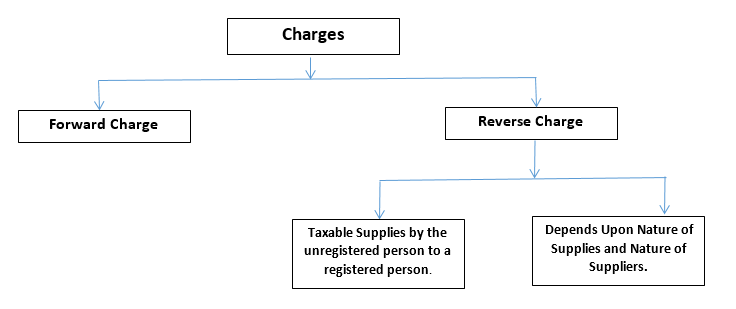
There are two types of Charges under GST.- Forward Charge: Section 9(1) deals with forward charge.
- Reverse Charge: Section 9(3) and 9(4) deals with reverse charge.
What is Forward charge
Forward charge or direct charge is the mechanism where the supplier of goods or services is liable to pay tax.
For example: -
1. If a chartered accountant provided a service to his client, the GST will be payable by the chartered accountant.
2. If a car manufacturing company sold some auto parts to a trader and collected tax from the trader, the manufacturing company remits the tax to the government.
Note: Under the current tax system, most transactions are covered under the forward charge mechanism.
Exclusion from GST:-
CGST on supply of following items has not been levied immediately. It shall be levied with effect from such date as may be notified by the Government on the recommendation of the GST council:
- Petroleum crude
- High speed diesel
- Motor spirit (commonly known as petrol)
- Natural gas
- Aviation turbine fuel.
| Kindly note that RCM for persons covered by section 9 (4) of the CGST Act that is where taxable supplies are by any unregistered person to a registered person has been deferred till 30/09/2019 |
- Registration Compulsory to pay tax under reverse charge.
- A supplier cannot take ITC of GST paid on goods or services used to make supplieson which the recipient is liable to pay tax.
- Self-invoicing is to be done.
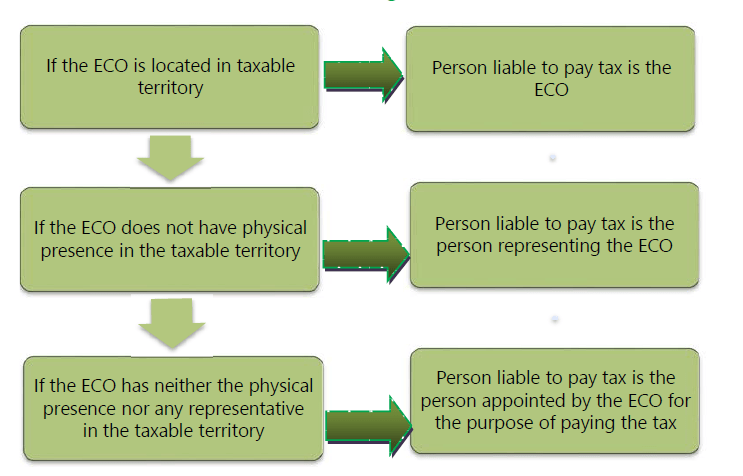
- The Government may, on the recommendations of the GST Council, by notification, specify categories of services the tax on Intra-State supplies of which shall be paid by the electronic commerce operator if such services are supplied through ECO, and all the provisions of this Act shall apply to such electronic commerce operator as if he is the supplier liable for paying the tax in relation to the supply of such services.
- Where an electronic commerce operator (ECO) does not have a physical presence in the taxable territory The person representing ECO shall be liable to pay tax:
- Where an electronic commerce operator (ECO) does not have a physical presence in the taxable territory and also he does not have a representative in the said territory - In such case ECO shall appoint a person in the taxable territory for the purpose of paying tax and such person shall be liable to pay tax.
Disclaimer: The contents of this document are solely for informational purpose. It does not constitute professional advice. Neither the authors accepts any liabilities for any loss or damage of any kind arising out of any information in this document nor for any actions taken in reliance thereon.Up Next
Loading suggestions…


Recent Posts
All Posts
Tags
No tags yet.
Recent Posts
All Posts
Tags
No tags yet.