Child Actor, Influencer or Investor? Know How Minor's Income is Taxed:
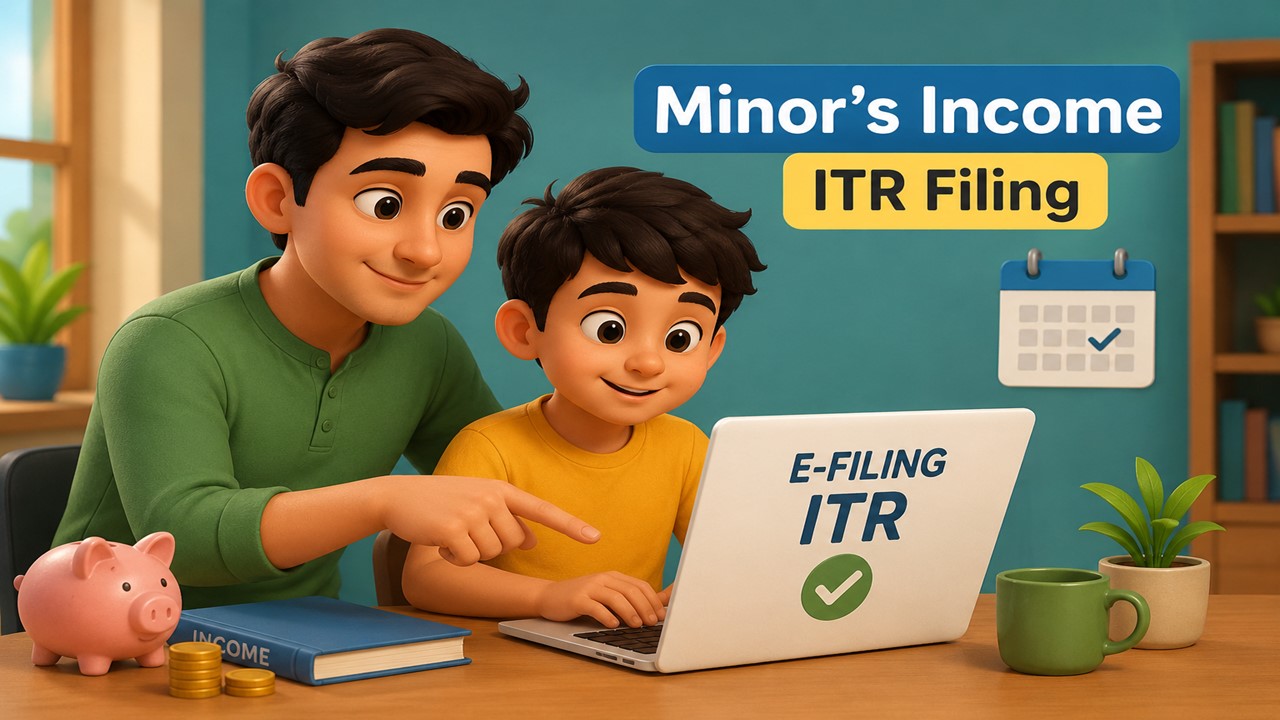
A complete guide on the taxation of minor children's income, clubbing provisions under Section 64(1A), exceptions, exemptions and more.
Know How Minor’s Income is Taxed
 Khush Trivedi
 Jun 16, 2026
Child Actor, Influencer or Investor? Know How Minor's Income is Taxed
Introduction
As return filling season has been started the most un touched topic regarding the tax filling is the treatment of Minor child income the tax treatment & reporting requirements under the income tax act.
Nowadays in the era of social media there are lots of child actors who became famous & earning through various modes but many of you don’t know the tax treatment
Let’s Decode it
The Core Rule Section 64(1A)
Under Section 64(1A), all income of a minor child (whether from investments, interest, rent, business, etc.) shall be included in the total income of whichever parent has the higher income in that financial year which is the fundamental clubbing rule.
Who is a Minor Under the Income Tax Act?
For the purposes of Section 64(1A), a minor means a person who has not yet attained the age of 18 years.
Which Parent's Income is it Clubbed With?
The income of a minor is clubbed with the income of the parent whose total income (before including the minor's income) is greater.
This determination is made every year as the parent with higher income may change year to year, and accordingly the income will shift between parents.
& If, Parents are Separated or divorced income will club to the parent who maintains the minor.
What Incomes are Clubbed?
Section 64(1A) covers all income accruing or arising to the minor from any source whatsoever which includes:
Is there any Exemption available?
Once a minor's income is clubbed with the parent's income, Section 10(32) provides a partial relief.
The parent in whose hands the minor's income is clubbed is entitled to claim an exemption of ₹1,500 per minor child per year from the clubbed income.
How is a Minor's Income Reported in the ITR?
Minor's income is not reported as a separate line item under a distinct head. Instead, it is included in the relevant income head in the parent's ITR and the exemption u/s 10(32) is claimed.
- Interest income on Fixed Deposits, Recurring Deposits, savings accounts opened in the minor's name
- Dividend income on shares or mutual funds held in the minor's name
- Capital gains on sale of assets (shares, mutual funds, property) registered in the minor's name
- Rental income from property gifted to or purchased in the name of the minor
- Income from business carried on by the minor (except certain exceptions)
- Gifts received by the minor child, to the extent taxable under Section 56(2)(x)
- Income from any investment, scheme, or instrument held in the minor's name
|
Sr. No |
Exception | Condition | Tax Treatment |
| 1 | Income from manual work | Minor earns income through own physical/manual work |
Taxed in minor's own hands, minor files separate ITR |
|
2 |
Income from special skill, talent, or knowledge | Income arises from minor's own exceptional skill, talent, or specialised knowledge/experience (e.g., child actor, sportsperson, musician, programmer prodigy) | Taxed in minor's own hands; minor files separate ITR |
| 3 | Minor with disability u/s 80U | Minor suffers from any disability specified under Section 80U (blindness, low vision, hearing impairment, loco-motor disability, mental illness, etc.) |
Clubbing does not apply; all income taxed in minor's hands independently |
- ITR 1: Can include minor's interest/dividend income if total remains within ITR-1 eligibility & claim 10(32) in Schedule Exempt Income
- ITR 2: Report minor's capital gains in Schedule CG & claim 10(32) exemption.
- ITR 3: Include minor's income in respective head & claim 10(32)
- ITR 4: If minor has capital gains, parent may switch to ITR-2 or ITR-3 instead of ITR-4
- The minor holds shares, mutual funds, or any demat account (PAN is mandatory for demat)
- TDS has been deducted on the minor's income
- The minor has earned income from own skill/talent that requires independent ITR filing
| Particulars | Clubbed? | Exemption u/s 10(32) |
ITR Disclosure |
|
FD/RD interest in minor's name |
Yes | ₹1,500 per child | Schedule SPI + EI |
| Dividend from shares/MFs in minor's name | Yes | ₹1,500 per child |
Schedule SPI + EI |
|
Capital gains on minor's investments |
Yes | ₹1,500 per child | Schedule SPI + EI + CG |
| Income from manual work by minor | No | Not applicable |
Minor files own ITR |
|
Income from own talent/special skill |
No | Not applicable | Minor files own ITR |
| Income of disabled minor (u/s 80U) | No | Not applicable |
Minor files own ITR |
About Author


Khush Trivedi
Content writer
 Study cafe
 AHMEDABAD, Gujarat, India
 46
46My Recent Articles
- Taxation of Preliminary Expenses Under the Income Tax Act: Complete Guide to Section 35D
- Selling a Property or Asset? Know These Capital Gains Tax Exemptions
- Taxation of Joint Development Agreements (JDA): Everything Landowners Need to Know
- Section 139(9) Defective Return Notice: Complete Guide to Fixing Your ITR
- Section 32 of the Income Tax Act, 1961: Depreciation on Business Assets
Up Next
Loading suggestions…


Recent Posts

All Posts



Tags
Recent Posts
All Posts