Clerical mistake in invoice number accompanying transport: HC Confirms Penalty:
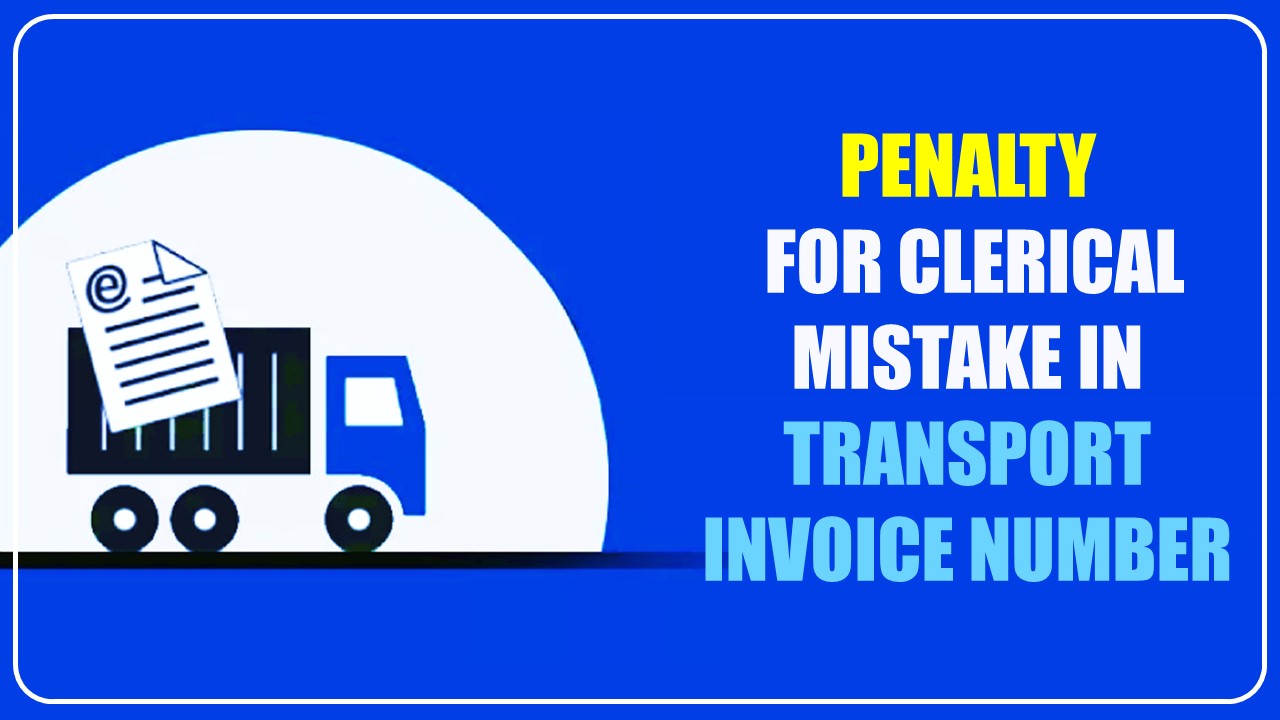
The Patna HC has confirmed the Penalty due to a clerical mistake in the invoice number accompanying transport.
Penalty for clerical mistake in transport invoice number
 Priyanka Kumari
 Dec 12, 2023
“29. It has been repeatedly argued before us that apart from the declaration forms the assessees possessed documentary evidence like invoice, books of accounts, etc. to support the movement of goods and, therefore, it was open to the assessees to show to the competent authority that there was no intention to evade the tax. We find no merit in this argument. Firstly, we are concerned with contravention of Section 78(2) which requires the goods in movement to travel with the declaration in Form ST 18-A/18-C duly filled in. It is Section 78(2)(a) which has been contravened in the present case by the assessees by carrying the goods with blank forms though signed by the consignee. In fact, the assessees resorted to the above modus operandi to hoodwink the competent officer at the check-post. As stated above, if the form is left incomplete and if the description of the goods is not given then it is impossible for the assessing officer to assess the taxable goods. Moreover, in the absence of value/price it is not possible for the AO to arrive at the taxable turnover as defined under Section 2(42) of the said Act. Therefore, we have emphasised the words “material particulars” in the present case. It is not open to the assessees to contend that in certain cases of inter-State transactions they were not liable in any event for being taxed under the RST Act, 1994 and, therefore, penalty for contravention of Section 78(2) cannot be imposed. As stated hereinabove, declaration has to be given in Form ST 18-A/18-C even in respect of goods in movement under inter-State sales. It is for contravention of Section 78(2) that penalty is attracted under Section 78(5). Whether the goods are put in movement under local sales, imports, exports or interState transactions, they are goods in movement, therefore, they have to be supported by the requisite declaration. It is not open to the assessee to contravene and say that the goods were exempt. Without disclosing the nature of transaction it cannot be said that the transaction was exempt. In the present case, we are only concerned with the goods in movement not being supported by the requisite declaration.
31. We may mention some of the judgments cited on behalf of the assessees. Section 28-B of the Uttar Pradesh Sales Tax Act, 1948 came for interpretation before this Court in Sodhi Transport Co. v. State of U.P. [(1986) 2 SCC 486 : 1986 SCC (Tax) 410 : (1986) 1 SCR 939] In that case the constitutional validity of Section 28-B of the said Act was challenged. It was held by this Court that since Section 28-B created rebuttable presumption as regards the proof of a set of circumstances, the effect of such a provision was to shift the burden of proving to the assessee who was given an opportunity to displace the presumption by leading evidence. This judgment has no application because the very words contained in Section 28-B required the authorities to raise a rebuttable presumption that the goods must have been sold in the State if the transit pass was not handed over at the check-post. In the present case, we are not concerned with the transit pass. In the present case, there are no words in Section 78(5) similar to Section 28-B of the Uttar Pradesh Sales Tax Act, 1948 which states that if the transit pass was not handed over to the officer at the check-post, the Department would be entitled to raise the presumption that the goods in transit were sold in the State. As stated hereinabove, we have to go by the words used in the section to ascertain whether the legislature has excluded the element of mens rea. It is the statutory law enacted by the competent legislature which can exclude the presumption under common law. We hold that Section 78(5) excludes the presumption of mens rea which is normally prevailing in common law. Our reasoning is also based on one more factor, namely, that Section 78(5) provides a remedy for recovery of the loss caused to the State by such contravention.
32. In the present case, the assessees have relied upon the judgment of this Court in State of Rajasthan v. D.P. Metals [(2002) 1 SCC 279]. In that case the facts were as follows: The assessee firm manufactured stainless steel sheets. The assessee was a registered dealer. On 22-1-1997 a truck was inspected by CTO. The same was found without Form ST 18-A. A show-cause notice was issued to the assessee. After the hearing, a penalty was levied under Section 78(5) of the RST Act, 1994. It was held that under Section 78(5) levy of penalty was on the person in charge of the goods. It was held that the said penalty was leviable under two circumstances. Firstly, if there was non-compliance with Section 78(2)(a) of the said Act, namely, that it was not carrying the documents mentioned in that clause. Secondly, if false or forged documents/declaration was submitted then penalty under Section 78(5) was leviable. After analysing the said section, this Court held that in the case of submission of false or forged documents/declaration, the authority was entitled to presume the motive to mislead the authorities. However, in such cases that presumption was rebuttable by the assessee on producing the requisite documents referred to in Section 78(2)(a). That, once the ingredient of Section 78(5) stood established after giving a hearing, there was no discretion with the officer to reduce the amount of penalty or to waive the penalty. If by mistake some of the documents were not readily available at the time of checking, principles of natural justice might require opportunity being given to produce the same.

33. In our view, the aforestated judgment in D.P. Metals [(2002) 1 SCC 279] has no application to the present case. We are not concerned in the present case with false or forged documents/declaration. In the present case the goods in movement were carried with the blank declaration Form ST 18-A/18-C which was duly signed by the assessee. Therefore, as stated above, we hold that the goods in movement were carried without the declaration Form ST 18-A/18 C. Therefore, Section 78(2)(a) stood attracted. Moreover, in the present case, there were no special circumstances indicated by the assessee as to why the forms which were duly signed were not filled in. Therefore, in our view the above judgment in D.P. Metals [(2002) 1 SCC 279] has no application to the facts of the present case. As stated, we are concerned with the blank declaration Form ST 18-A/18-C which has travelled with the goods in movement, though signed, was left deliberately blank. The declaration Form ST 18-A/18-C is like a return under the Income Tax Act, 1961. The assessing officer completes the assessment on the basis of Form ST 18- A/18-C. If that form is left blank in all material respects then it is impossible for the AO to arrive at the taxable turnover of the assessee. Therefore, in our view, the judgment of this Court in D.P. Metals [(2002) 1 SCC 279] has no application to the present case.
The facts in the aforesaid case has to be looked at with the declaration of law in Guljag Industries (supra) and D. P. Metals (supra), in mind. In the present case, there was a mistake in the invoice number as indicated in the declaration form which was accompanying the transport. A reasonable ground of attempt to carry out multiple transport arise, since if there was no checking at the check-post then there could have been a further transport made under the same invoice, thus, enabling an inter-State sale of the goods transported by the subject invoice and SUVIDHA Form, which could go unnoticed by the Department. Section 60(4) enables a seizure of goods along with the carrier if the authority suspects the transport to be in contravention of the provisions of Section 60(2). Section 60(4) (b) makes Section 56 applicable mutatis mutandis. The penalty is imposable under Section 56(4) (b) if the person in charge of the goods fails to satisfy the officer regarding the proper accounting of goods. The ingredients of Section 60(4) (b) read with Section 56(4) (b) are available in the instant case. No reason was found to interfere with the penalty imposed. The writ petition would stand dismissed. For Official Judgment Download the PDF Given Below:About Author


Priyanka Kumari
Content Writer
 Studycafe
 Faridabad, Haryana, India
 324
324My Recent Articles
- MSME Sector contributes 29.1% Gross Value Added in India's GDP
- NFRA imposes Penalty of Rs.3 Lakh and 3 Year Ban on CA and CA Firm w.r.t. Statutory Audit
- Zomato shares drop by 5% amid Rs. 402 crore GST tax notice
- Govt notifies Central Goods and Services Tax (Second Amendment) Act, 2023
- 10% GST pre-deposit obligation is confined to contested tax quantum excluding penalty, fee and interest [Read Judgement]
Loading suggestions…


Recent Posts

All Posts
Tags
Recent Posts
All Posts