GST Demand Orders Quashed as Invalid Section 74 Notice Found Fatal:
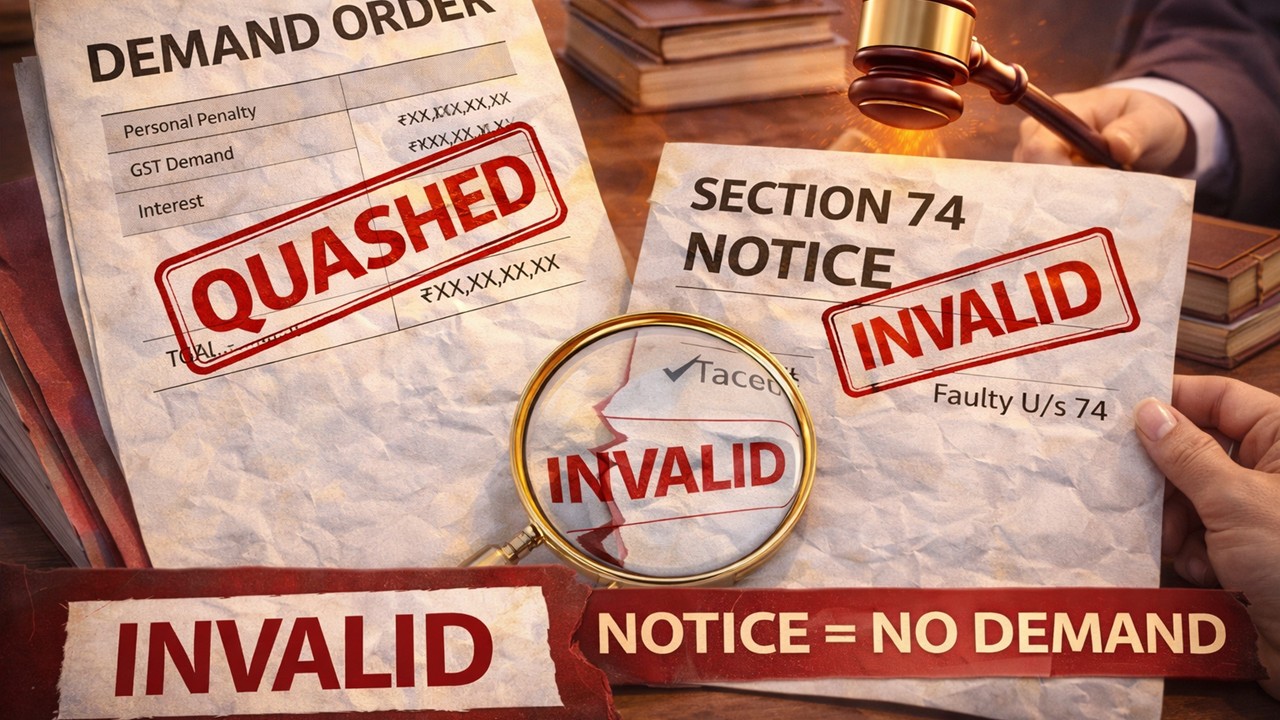
High Court quashes GST demand, finds no fraud allegation and hearing violation Invalid Section 74 notice and no hearing vitiates GST demand: High Court High Court quashes GST demand, finds no fraud allegation and hearing violation
Invalid Section 74 notice and no hearing vitiates GST demand: High Court
 Meetu Kumari
 Mar 29, 2026
GST Demand Orders Quashed as Invalid Section 74 Notice Found Fatal
The petitioners challenged GST demand orders raised over multiple years, which were preceded by notices indicating tax and penalty liabilities. They had made some payments, largely towards penalty, claiming it was under pressure. Later, formal show cause notices were issued under Section 74, followed by final orders confirming the demands.
The petitioners approached the Court, arguing that the entire process was flawed from the beginning. According to them, the notices did not contain any clear allegations of fraud or suppression, which is essential for invoking Section 74. They also pointed out that no proper hearing was granted before passing the orders.
Central Issue: Whether GST demands under Section 74 can stand when the show cause notice lacks fraud allegations and no hearing is provided.
HC's Ruling: The Court found serious defects in the proceedings and set aside both the notices and the final orders. It held that Section 74 can be invoked only when there are clear allegations of fraud, wilful misstatement, or suppression of facts. In this case, the notices merely referred to unpaid tax without establishing such elements, making them legally unsustainable.
The Court also noted that the authorities failed to grant a proper hearing and did not record adequate reasoning in their orders. These lapses were held to be violations of mandatory legal requirements. Given these foundational flaws, the Court rejected the objection regarding alternative remedy and exercised its writ jurisdiction. If required, The authorities have been given liberty to start fresh proceedings in accordance with law.
To Read Full Judgment, Download PDF Given Below
About Author


Meetu Kumari
Content Manager
Meetu Kumari is an Experienced Advocate and Content Writer with 4+ years of demonstrated history of working in the law practice industry. Skilled in Developing Content, Researching, and Drafting. Strong professional with a Bachelor of Science (B.Sc.) focused on Law from Gujarat National Law University.
Meetu Kumari is an Experienced Advocate and Content Writer with 4+ years of demonstrated history of working in the law practice industry. Skilled in Developing Content, Researching, and Drafting. Strong professional with a Bachelor of Science (B.Sc.) focused on Law from Gujarat National Law University.
 Studycafe
 Jodhpur, Rajasthan, India
 2264
2264My Recent Articles
- ITAT Condones 302-Day Delay, Restores Salary Assessment for Fresh VerificationPremium
- ITAT Condones Delay After Tax Consultant's Death, Restores Appeals for Fresh HearingPremium
- ITAT Remands Salary Addition, Says Taxability Depends on Salary Becoming Due, Not Mere ReceiptPremium
- ITAT Deletes TP Royalty Adjustment, Orders Fresh Review of Commission BenchmarkingPremium
- ITAT Quashes Reassessment Over Unsigned Section 148 Notice Issued to AssesseePremium
Up Next
Loading suggestions…


Recent Posts


All Posts


Recent Posts
All Posts