GSTAT Allows Inverted Duty Refund Despite Same HSN for Inputs and Outputs:
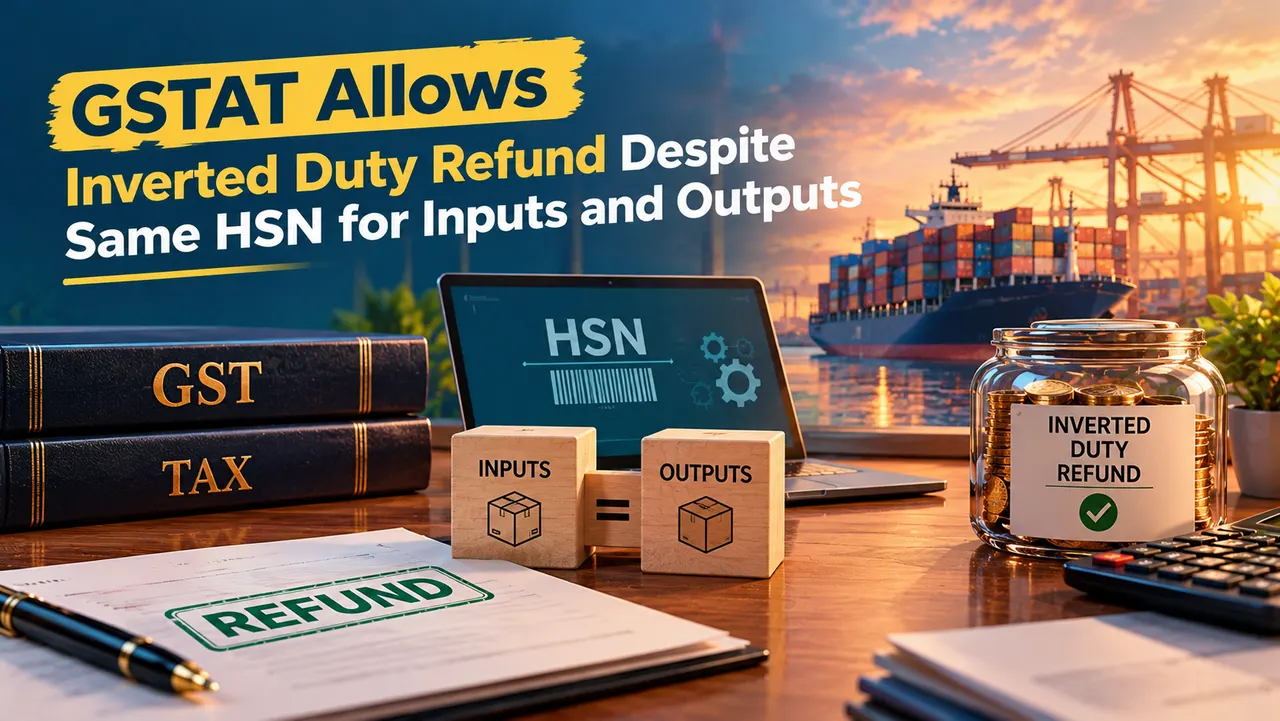
The GSTAT holds that higher GST on Ancillary Inputs can justify refund under Section 54(3)(ii) of the CGST Act.
GSTAT Dismisses Revenue Appeal
 Saima
 Oct 25, 2026

M/s Vaishnodevi Buildcon Private Limited is engaged in manufacturing crushed stone and stone aggregates from riverbed material, boulders, rocks and gravel. The company claimed a refund of accumulated ITC amounting to Rs 7,04,974 under the inverted duty structure for the period from 1 May 2022 to 31 August 2022. The company’s principal inputs and finished products fell under HSN Code 2517 and attracted GST at 5%. However, the company also used other inputs, including screening plant spare parts, crusher plant spare parts, conveyor belt spare parts, vehicle tyres, vehicle maintenance items and lubricants, which attracted GST at 18% or 28%.
The original adjudicating authority sanctioned the refund vide Order dated 6 October 2023, after considering the company’s response to the show-cause notice. Subsequently, the Revenue challenged the refund sanction order before the first appellate authority, which rejected the Revenue’s appeal vide Order-in-Appeal No. 525/SLG-GST/2024-25 dated 7 January 2025. Aggrieved by the appellate order, the Revenue approached the GSTAT.

The Tribunal observed that Section 54(3)(ii) of the CGST Act permits a refund of unutilised ITC where credit has accumulated because the rate of tax on inputs is higher than the rate of tax on outward supplies, subject to the statutory conditions and exceptions. It emphasised that the expression “inputs” used in the provision is in the plural and is not restricted to the principal raw material alone. The definition of “input” under Section 2(59) of the CGST Act covers any goods, other than capital goods, used or intended to be used by a supplier in the course or furtherance of business.
Accordingly, the Tribunal held that the tax rates applicable to the various inputs used in the manufacturing process must also be considered. In the present case, several inputs attracted GST at 18% or 28%, whereas the final outward supply attracted GST at 5%. Therefore, the fact that the principal input and finished product fell under the same HSN code did not, by itself, defeat the company’s entitlement to a refund.

Regarding Circular No. 135/5/2020-GST, the Tribunal observed that paragraph 3.2 concerns cases where ITC accumulates because the GST rate on the same goods changes at different points in time. In the present case, the principal inputs and finished products attracted the same GST rate of 5%, while other inputs used in the manufacturing process attracted higher rates. Therefore, the circular was not applicable to the facts of the case.
The Tribunal further held that Circular No. 173/05/2022-GST, being clarificatory in nature and amending the relevant provisions of the earlier circular, could not be applied when the original circular itself was inapplicable to the case. The Tribunal found no merit in the Revenue’s arguments and held that M/s Vaishnodevi Buildcon Private Limited was eligible for a refund of accumulated ITC under Section 54(3)(ii) of the CGST Act, 2017. Accordingly, the Tribunal upheld the Order-in-Appeal dated 7 January 2025 and dismissed the Revenue’s appeal bearing No. APL/33/KLK/2026. The parties were directed to bear their own costs.
About Author


Saima
Content Writer
 StudyCafe
 Delhi, Delhi, India
 575
My Recent Articles
- ITAT Deletes Rs 10 Lakh Penalty for Non-Disclosure of Foreign Investment in Schedule FA
- High Court Rejects Customs Department’s Plea to Condonate 154-Day Delay in Filing Appeal
- ITAT Remands Rs 1.30 Crore Unexplained Money Addition and Penalty for Fresh Hearing
- ITAT Remands Rs 2.20 Crore Addition Under Section 69C for Fresh Examination
- ITAT Remands Interest Addition to CIT(A) for Fresh Adjudication Due to Email Access Issues
Loading suggestions…


Recent Posts

All Posts

Recent Posts
All Posts