GSTAT Upholds Penalty for Expired E-Way Bill and Incorrect Dispatch Details:
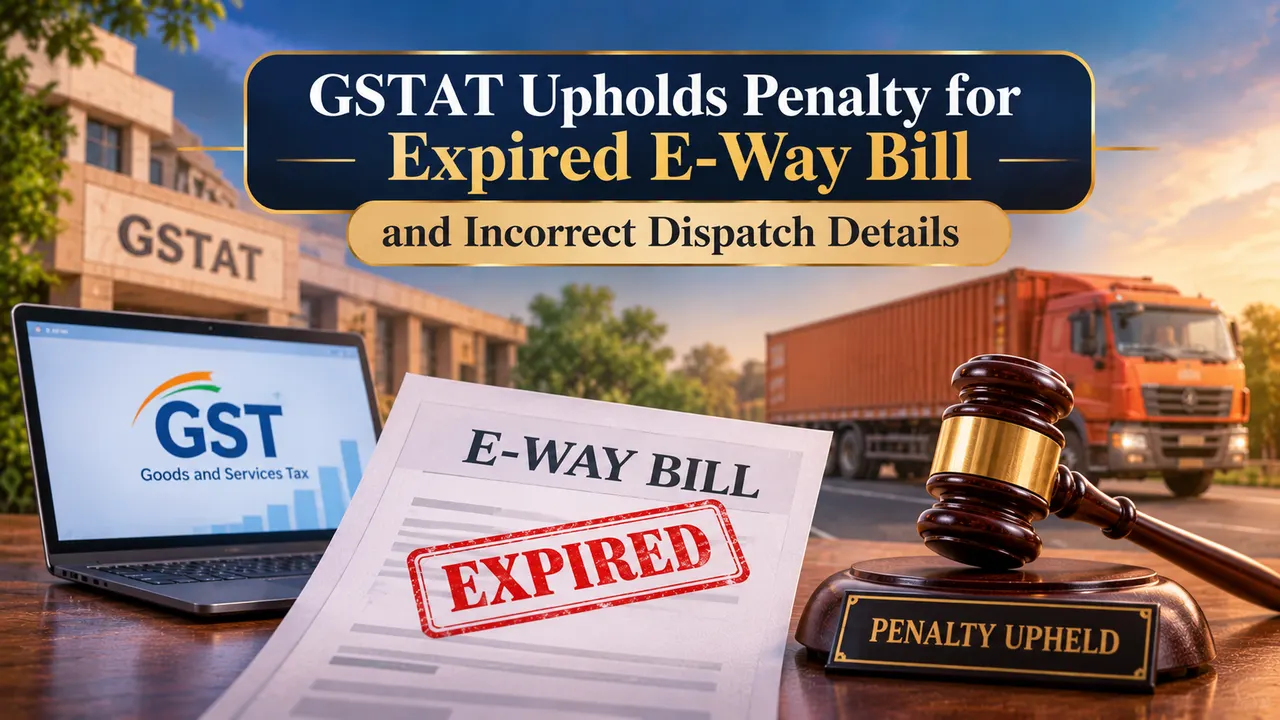
The GSTAT holds that sale during transit does not exempt taxpayer from E-way bill compliance.
GSTAT Upholds Rs 4.40 Lakh Penalty
 Saima
 Oct 19, 2026

Akash Sales Corporation purchased 34.770 MT of M.S. scrap from Ananya Trading Co., West Bengal, under Invoice No. 53 dated 4 May 2024, with the goods dispatched from Visakhapatnam to Bhilai. The supplier generated an e-way bill that remained valid until 8 May 2024 and identified Bhilai as the destination. While the goods were still in transit and had not reached Bhilai, Akash Sales Corporation sold the same scrap to Shri Bajrang Power & Ispat Ltd., Raipur, through Invoice No. 383 dated 5 May 2024. The appellant subsequently generated another e-way bill declaring Bhilai as the dispatch location, although the goods had never physically reached Bhilai.
On 7 May 2024, the vehicle was intercepted at Dhaneli Chowk, Raipur. The second e-way bill had expired on 6 May 2024, and no extension or replacement was produced. The authorities imposed a penalty of Rs 4,40,744, comprising Rs 2,20,372 each under CGST and SGST, which the appellant paid through Form GST DRC-03 to secure the release of the goods and vehicle.

The Joint Commissioner (Appeals), State Tax, upheld the penalty. Aggrieved by the decision, the appellant approached the GSTAT.
The Tribunal held that Section 129(1), as applicable on 7 May 2024, does not expressly require proof of intention to evade tax as an independent jurisdictional condition. However, the imposition of a penalty is not automatic. The authorities must examine the taxpayer’s explanation, the nature of the discrepancy and the circumstances of the alleged contravention, in accordance with Sections 129(3) and 129(4).

The Tribunal accepted that Section 10(1)(b) of the IGST Act permits an intermediary to make an onward supply without physically receiving the goods first. However, this provision does not automatically change the destination recorded in an existing e-way bill or dispense with the requirements of Section 68 and Rules 138 and 138A of the CGST Rules. The first e-way bill, although valid until 8 May 2024, continued to show Bhilai as the destination. Once the goods were diverted towards Raipur, the document no longer accurately reflected the actual movement.
The GSTAT dismissed the appeal filed by Akash Sales Corporation and upheld the Order-in-Appeal dated 15 September 2025, insofar as it upheld the penalty of Rs 4,40,744 under Section 129(1)(a) of the CGST/CGGST Acts.
About Author


Saima
Content Writer
 StudyCafe
 Delhi, Delhi, India
 558
My Recent Articles
- GSTAT Remands GST Penalty Case for Fresh Adjudication Over Uncertain Goods Movement
- GSTAT Upholds Penalty for Transporting Goods Under Expired E-Way Bill
- High Court Quashes GST Demand Against Amul Over Non-Cross-Charging of Common Expenses
- High Court Quashes Income Tax Demand Against Contractual Worker Over Misuse of PAN
- ITAT Deletes Rs 2.06 Crore Addition Under Section 68 for Unsecured Loans
Loading suggestions…


Recent Posts

All Posts

Recent Posts
All Posts