Haryana's One-Time Tax Settlement Scheme 2025: Get Rebate up to Rs. 1 Lakh:
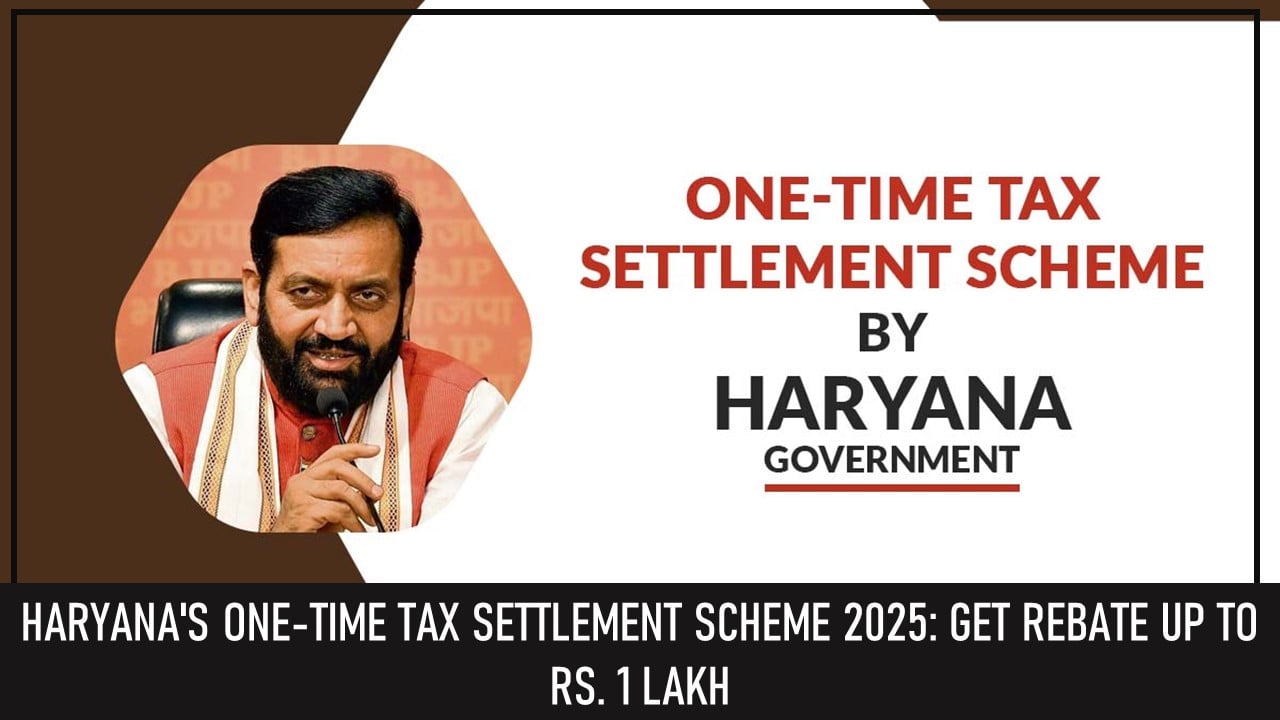
The One Time Settlement Scheme 2025 introduced by the Haryana Government allows taxpayers to get a rebate of up to Rs. 1 lakh against an outstanding tax due in Haryana.
Clear Outstanding Taxes with Haryana OTS 2025: Rebate Benefits up to Rs. 1 Lakh
 Nidhi
Nidhi Apr 25, 2025
Table of Contents

The One Time Settlement Scheme 2025 introduced by the Haryana Government allows taxpayers to get a rebate of up to Rs. 1 lakh against an outstanding tax due in Haryana. Along with this, they will also get a full waiver of interest and penalty. There is no rebate for unpaid tax dues above Rs. 10 lakh. However, you can still settle the outstanding tax amount without any payment of interest and penalty.
The OTS scheme 2025 is available for six months from April 1, 2025. Under this scheme, there are three payment slabs based on cumulative outstanding tax amounts. This will ensure that more people can access this scheme.
Taxpayers having outstanding tax dues of Rs. 10 lakh are required to pay only Rs. 3.6 lakh after getting a waiver of Rs. 1 lakh and shall need to pay only 40% of the remaining balance. This will offer major relief for small and medium taxpayers.
As per the Haryana Chief Minister Sh. Nayab Singh Saini, the OTS scheme 2025 is meant for taxpayers who could not pay their outstanding tax liability due to several reasons. The scheme allows taxpayers with dues up to Rs. 10 lakh to get a rebate of up to Rs. 1 lakh. The scheme will be available for the coming 180 days (6 months). He appealed to the taxpayers to pay their tax dues as soon as possible.
What is Haryana's One Time Settlement Scheme?
The One Time Settlement Scheme 2025 is an initiative launched by the Haryana Government for recovering the outstanding dues. The main objective of the government is to recover the outstanding tax liability of several indirect taxes, which were included in the Goods and Services Tax introduced in 2017. Back in 2023, the government launched a special One Time Settlement Scheme that was introduced on January 1, 2024. The aim was to help people clear their tax dues by offering waivers on the total tax dues. Compared to the earlier OTS 2023 Scheme, the new OTS Scheme 2025 is much easier to understand and apply. Under the 2025 scheme, the tax amount already calculated under the relevant Act is treated as the final amount for settlement and there are no further classifications or subcategories of the quantified tax due. It also eliminates the need for filing separate applications for each year. Only one single application is enough. This will reduce the unnecessary burden on the taxpayers. So, if someone has unpaid tax dues from before June 30, 2017, they can take advantage of this scheme.Who are eligible for the OTS Scheme 2025?
"As per the Haryana GST Department, Any person or assessee, whether registered or not, who has Quantified Outstanding Dues for the period up to June 30, 2017, can opt to avail the benefits of the OTS Scheme, 2025. It is to be noticed that the quantified outstanding dues must be for the period up to June 30, 2017 but may have been decided at any time as of the date of filing application OTS-1."Who are not eligible for the OTS Scheme 2025?
The following applicants shall not be eligible for the Haryana OTS scheme 2025:- Someone whose name is registered under criminal records under the relevant Acts.
- Whose 2023 OTS application hasn’t been rejected by the time this scheme starts?
- If someone has received wrong tax refunds under the relevant law, they won’t be eligible for the scheme.
Which Acts does the Haryana OTS Scheme 2025 cover?
- The Haryana One Settlement Scheme 2025 applies to quantified outstanding dues in the following seven acts:
- The Haryana Value Added Tax Act, 2003
- The Central Sales Tax Act, 1956
- The Haryana Tax on Luxuries Act, 2007
- The Haryana Entertainment Duty Act, 1955
- The Haryana General Sales Tax Act, 1973
- The Haryana Local Area Development Tax Act, 2000
- The Haryana Tax on Entry of Goods into Local Areas Act, 2008
Settlement of Dues
Schedule- IA clause 6(1): Determination of settlement amount in lieu of quantified outstanding dues
| Serial number (column 1) | Slab of total quantified outstanding tax due as grand total of column E of schedule I (column 2) | Waiver as per clause 6(3) (column 3) | Tax due for settlement under the scheme (column 4) | Settlement amount of tax dues in column 4 (column 5) | Settlement amount of interest as in column F of scheme I (column 6) | Settlement amount of penalty as in column G of schedule I (column 7) |
| 1 | Up to Rs 10 lakh | Rs 1 lakh | - | 40% | 0% | 0% |
| 2 | Above Rs 10 lakh to Rs 10 crore | 0 | - | 50% | 0% | 0% |
| 3 | Above Rs 10 crore | 0 | - | 100% | 0% | 0% |
Are you required to pay the full amount of outstanding dues when applying for the OTS Scheme?
No, according to the circular. Applicants can choose to pay their outstanding dues either in a lump sum or in installments, as per the options in Schedule II of the OTS Scheme. The first installment is due with the OTS-1 application, and the second installment must be paid within 60 days after receiving an interim order in Form OTS-4A.What if you failed to pay the installment amount within the prescribed period?
If an applicant doesn’t pay the second installment within 60 days from the issuance of OTS-4A, their application will be rejected. Any amount already paid with the OTS-1 application will be adjusted against the applicant's liabilities under the relevant Act, and won’t be refunded. It will be treated as if the applicant never made an application, as per clause 4(4).About Author


Nidhi
Content Writer
Nidhi is a skilled content writer specializing in personal finance. She creates clear, engaging articles on mutual funds, investments, insurance, and wealth-building strategies. With a passion for simplifying complex financial topics, Nidhi helps readers make informed money decisions with confidence. She can be reached at [email protected]
Nidhi is a skilled content writer specializing in personal finance. She creates clear, engaging articles on mutual funds, investments, insurance, and wealth-building strategies. With a passion for simplifying complex financial topics, Nidhi helps readers make informed money decisions with confidence. She can be reached at [email protected]
 Studycafe
 New Delhi, Delhi, India
 1832
1832My Recent Articles
- Karnataka High Court Gives Another Chance in GST Matter Due to Lack of Hearing
- Delay Should Be Condoned if Explanation is Unrefuted: ITAT
- Non-Service of Income Tax Notice, Ill health of taxpayer, ITAT condones Appeal filing delay
- Books of Accounts Cannot be Rejected Without Any Specific Defect: ITAT Kolkata
- Karnataka High Court Sends ITC Matter Back to GST Authorities for Reconsideration
Up Next
Loading suggestions…


Recent Posts


All Posts


Tags
No tags yet.
Recent Posts
All Posts
Tags
No tags yet.