Sales tax subsidy for industrial expansion in backward areas is capital receipt: High Court:
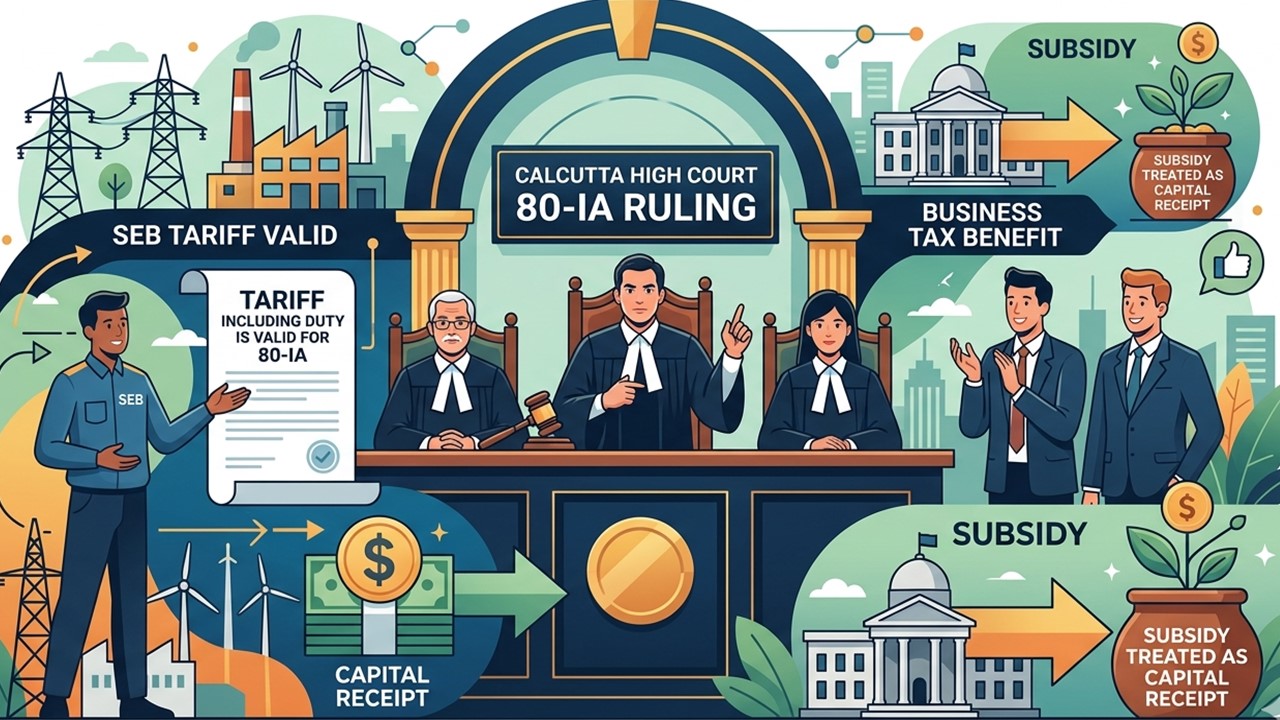
kolkata High Court allows Graphite India’s appeal, holding SEB tariff valid for 80-IA, subsidy as capital receipt, and MAT exclusion justified.
Court Holds SEB Tariff Including Duty Is Valid For 80-IA; Subsidy Treated As Capital Receipt
 Meetu Kumari
 Apr 25, 2026
Sales tax subsidy for industrial expansion in backward areas is capital receipt: ITAT
The assessee, M/s. Graphite India Ltd., engaged in manufacturing graphite electrodes and generating captive power, filed its return for AY 2002-03 claiming deductions under Sections 80-IA (power generation) and 80HHC (export profits). It computed power profits using State Electricity Board (SEB) purchase rates and treated sales tax remission subsidy under the West Bengal Incentive Scheme, 1993, as a capital receipt. It also excluded such subsidies and certain capital gains from book profits under Section 115JB.
The Assessing Officer, however, excluded electricity duty from SEB rates for 80-IA computation, reduced 80HHC profits by invoking Section 80-IA(9), treated the subsidy as a revenue receipt, and included it in book profits. The Tribunal largely upheld the AO’s view, prompting the assessee to appeal before the Calcutta High Court.
Central Issue: Whether (i) electricity duty forms part of market value under Section 80-IA, (ii) deduction under Section 80-IA reduces 80HHC profits, (iii) sales tax subsidy is capital or revenue in nature, and (iv) such subsidy is includible in book profits under Section 115JB.
HC Decided: The High Court allowed the appeal in full, ruling in favour of the assessee on all issues. On transfer pricing of captive power, the Court held that the SEB tariff represents the true market value under Section 80-IA(8), and it is impermissible to exclude electricity duty, being an integral part of the tariff. On the interplay between Sections 80-IA and 80HHC, the Court clarified that Section 80-IA(9) only prevents double deduction of the same income.
Since the deductions arose from distinct businesses' power generation and exports, no reduction was warranted. On subsidy, applying the settled “purpose test", the Court held that sales tax remission granted for industrial expansion in backward areas is a capital receipt and not taxable as revenue. Therefore, the Court also held that such a capital receipt cannot be included in book profits under Section 115JB, as its character does not change merely due to accounting treatment.
To Read Full Judgment, Download PDF Given Below
About Author


Meetu Kumari
Content Manager
Meetu Kumari is an Experienced Advocate and Content Writer with 4+ years of demonstrated history of working in the law practice industry. Skilled in Developing Content, Researching, and Drafting. Strong professional with a Bachelor of Science (B.Sc.) focused on Law from Gujarat National Law University.
Meetu Kumari is an Experienced Advocate and Content Writer with 4+ years of demonstrated history of working in the law practice industry. Skilled in Developing Content, Researching, and Drafting. Strong professional with a Bachelor of Science (B.Sc.) focused on Law from Gujarat National Law University.
 Studycafe
 Jodhpur, Rajasthan, India
 2264
2264My Recent Articles
- ITAT Condones 302-Day Delay, Restores Salary Assessment for Fresh VerificationPremium
- ITAT Condones Delay After Tax Consultant's Death, Restores Appeals for Fresh HearingPremium
- ITAT Remands Salary Addition, Says Taxability Depends on Salary Becoming Due, Not Mere ReceiptPremium
- ITAT Deletes TP Royalty Adjustment, Orders Fresh Review of Commission BenchmarkingPremium
- ITAT Quashes Reassessment Over Unsigned Section 148 Notice Issued to AssesseePremium
Up Next
Loading suggestions…


Recent Posts

All Posts

Recent Posts
All Posts