High Court Directs Taxpayer to Exhaust Statutory Appeal Remedy:
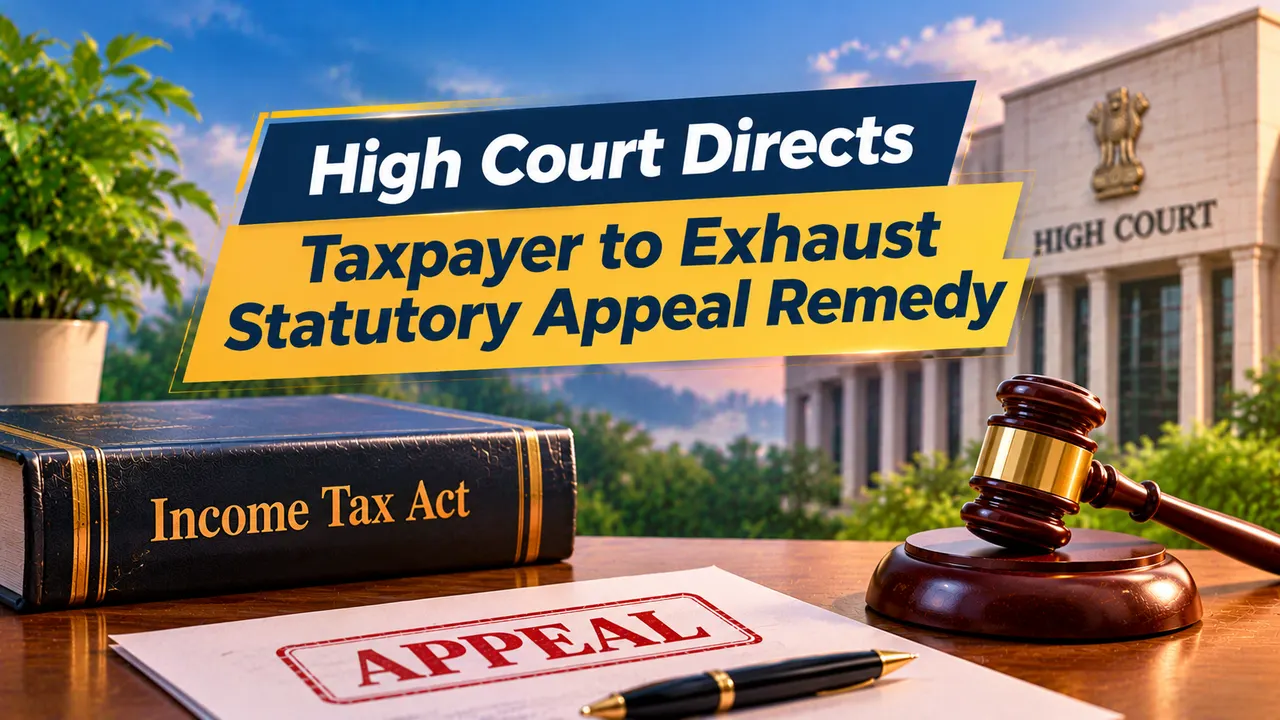
The Delhi High Court holds that detailed allegations of Bogus ITC transactions warrant consideration by Appellate Authority.
High Court Declines to Quash GST Demands
 Saima
 Nov 4, 2026

The proceedings originated from an investigation into an alleged network of firms involved in availing and passing on ineligible ITC through invoices that were not supported by actual supplies of goods. During a search conducted under Section 67(2) of the CGST Act at the premises of Mohit Jain, the GST authorities allegedly seized stamps, letterheads and invoices relating to multiple firms. The Department alleged that these firms were created and operated to facilitate fraudulent ITC transactions. During the investigation, Manoj Kumar's statement was recorded on May 19, 2023, wherein he allegedly stated that he assisted in distributing invoices unsupported by actual supplies of goods through brokers in exchange for commission.
The proceedings culminated in two separate orders-in-original dated February 4, 2025, raising demands of Rs. 6,14,568 and Rs. 2,93,53,860 against the petitioner. Aggrieved by the orders, the petitioner approached the Delhi High Court, despite the availability of a statutory appellate remedy under the CGST Act.

In the first writ petition, W.P.(C) 50/2026, the petitioner contended that the show-cause notice issued under Section 74 of the CGST Act was non-speaking and failed to disclose the essential factual particulars necessary to invoke the provision. In the second writ petition, W.P.(C) 2528/2026, the petitioner challenged the imposition of penalty, contending that neither the show-cause notice dated August 1, 2024, nor the accompanying DRC-01 dated August 2, 2024, proposed any penalty against him. Therefore, the Adjudicating Authority could not have imposed a penalty through the final order without a specific proposal in the notice.
With respect to W.P.(C) 50/2026, the Court noted that the show-cause notice extended to nearly 80 pages and contained detailed allegations concerning the transactions, interconnected firms and the alleged modus operandi adopted for availing and passing on ineligible ITC. Accordingly, the contention that the notice lacked vital particulars was not considered sufficient to justify interference under writ jurisdiction. The petitioner was, however, permitted to challenge the notice, the material relied upon and the findings of the Adjudicating Authority before the statutory appellate authority.

Regarding W.P.(C) 2528/2026, the Court observed that the objection concerning the imposition of penalty, despite the alleged absence of a specific proposal in the show-cause notice, involved examination of the notice, the petitioner's reply, his statement and the applicable statutory provisions. The Court held that this issue could appropriately be examined by the appellate authority. Importantly, it clarified that relegating the petitioner to the appellate remedy did not amount to accepting the Department's position or holding that the penalty was legally sustainable.
Accordingly, the Delhi High Court declined to interfere with either of the impugned orders and relegated the petitioner to the statutory appellate remedy available under the CGST Act. With these observations, both writ petitions, W.P.(C) 50/2026 and W.P.(C) 2528/2026, along with all pending applications, were disposed of.
About Author


Saima
Content Writer
 StudyCafe
 Delhi, Delhi, India
 613
My Recent Articles
- GSTAT Upholds GST Refund Despite Delayed Credit Notes for Earlier Period
- High Court Allows GST Audit Despite Retrospective Cancellation of Registration
- High Court Quashes GST Show Cause Notice as Time-Barred Due to Delayed Portal Upload
- ITAT Directs DSIR to Explain Exclusion of Expenses
- ITAT Restricts Addition Made Under Section 69A to Rs. 5 Lakh
Loading suggestions…


Recent Posts
All Posts
Recent Posts
All Posts