High Court Grants Bail in Cyber Fraud Case, Imposes Extensive Digital Disclosure Conditions:
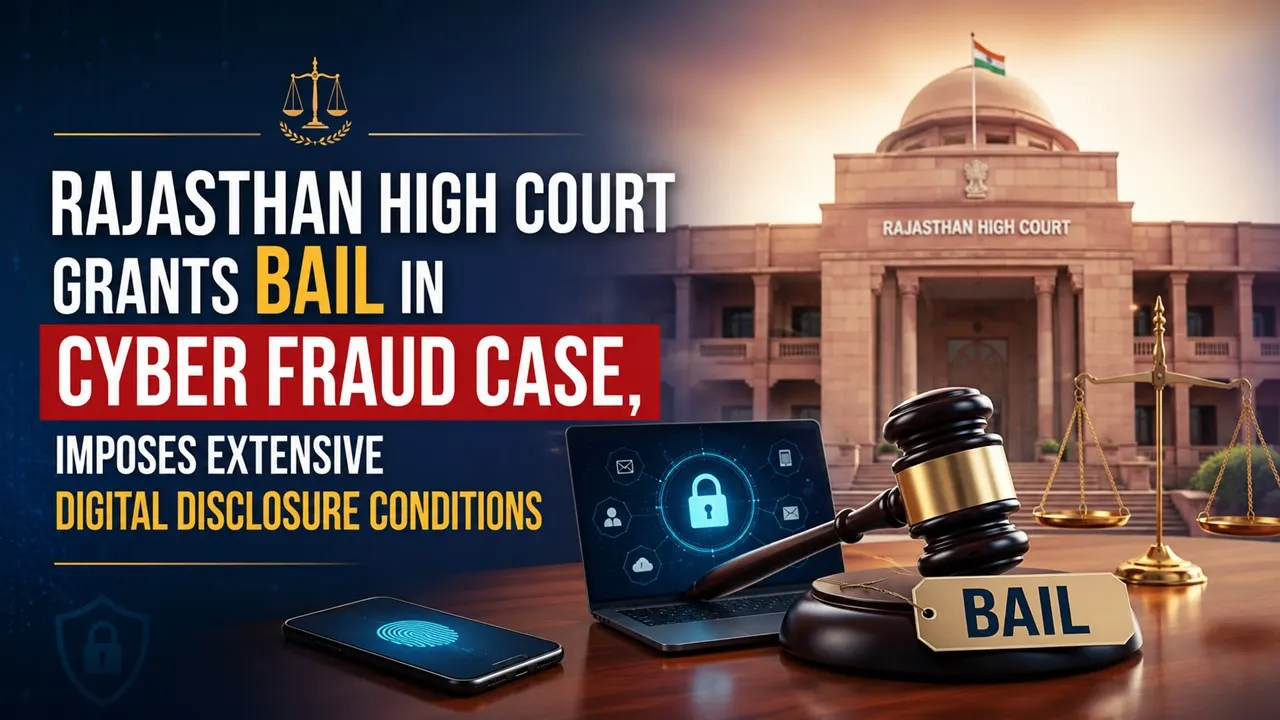
The Rajasthan HC granted bail to two accused, arrested in connection with a cyber fraud case involving allegations under provisions of BNS and Section 66D of the Information Technology Act, 2000.
Court Notes Investigation Deficiencies While Granting Bail After Chargesheet
 Meetu Kumari
 Jun 26, 2026
The Rajasthan High Court granted bail to two accused, Sahil and Wajib, arrested in connection with a cyber fraud case involving allegations under various provisions of the Bharatiya Nyaya Sanhita (BNS) and Section 66D of the Information Technology Act, 2000. The Court observed serious deficiencies in the investigation and noted that despite repeated directions, the Investigating Officer failed to submit a specific report regarding the QR codes and UPI IDs allegedly used in the offence.
The petitioners had earlier withdrawn their first bail applications with liberty to renew the request after the filing of the charge sheet. After the charge sheet was filed on 28 February 2026, they approached the court again under Section 483 of the Bharatiya Nagarik Suraksha Sanhita (BNSS). The defence argued that the allegations related to comparatively small amounts, no further recovery was required, and the trial was likely to take considerable time.

The Public Prosecutor opposed the applications. However, the Court found that the investigation suffered from a lack of clarity, particularly concerning the digital payment infrastructure allegedly involved in the offence. Justice Ravi Chirania remarked that the repeated failure to furnish a proper report indicated that the investigating officer appeared to be inadequately equipped to conduct such an investigation.
Taking note of the filing of the charge sheet, the prolonged custody of the accused, and the likelihood of a lengthy trial, the Court exercised its powers under Section 483 BNSS and directed the release of both petitioners on bail.
While granting relief, the court imposed a series of stringent conditions reflecting the digital nature of the allegations. The accused were directed to disclose details of all movable and immovable assets, bank accounts, digital wallets, UPI IDs, cryptocurrency holdings, and other financial instruments. They were also required to periodically submit transaction statements of their bank accounts and digital payment platforms to the investigating officer.

In addition, the Court directed the accused to disclose all electronic devices in their possession, including mobile phones, laptops, tablets, hard drives and pen drives, along with IMEI and serial numbers. Details of social media accounts, email accounts, websites, domains and online platforms used by them were also ordered to be furnished. The accused were further restrained from using VPNs, TOR browsers, proxy servers or other identity-masking technologies without prior permission and were required to inform the authorities before obtaining new SIM cards, phones, bank accounts or online platforms.
The Court clarified that any breach of the conditions, failure to provide the required information, or involvement in similar offences within three years could lead to cancellation of bail.
To Read Full Judgment, Download PDF Given Below
About Author


Meetu Kumari
Content Manager
 Studycafe
 Jodhpur, Rajasthan, India
 2264
2264My Recent Articles
- ITAT Condones 302-Day Delay, Restores Salary Assessment for Fresh VerificationPremium
- ITAT Condones Delay After Tax Consultant's Death, Restores Appeals for Fresh HearingPremium
- ITAT Remands Salary Addition, Says Taxability Depends on Salary Becoming Due, Not Mere ReceiptPremium
- ITAT Deletes TP Royalty Adjustment, Orders Fresh Review of Commission BenchmarkingPremium
- ITAT Quashes Reassessment Over Unsigned Section 148 Notice Issued to AssesseePremium
Loading suggestions…


Recent Posts


All Posts



Recent Posts
All Posts