SEBI Proposes Common Advertisement Code for Brokers, Mutual Funds, Advisers and Other Regulated Entities:
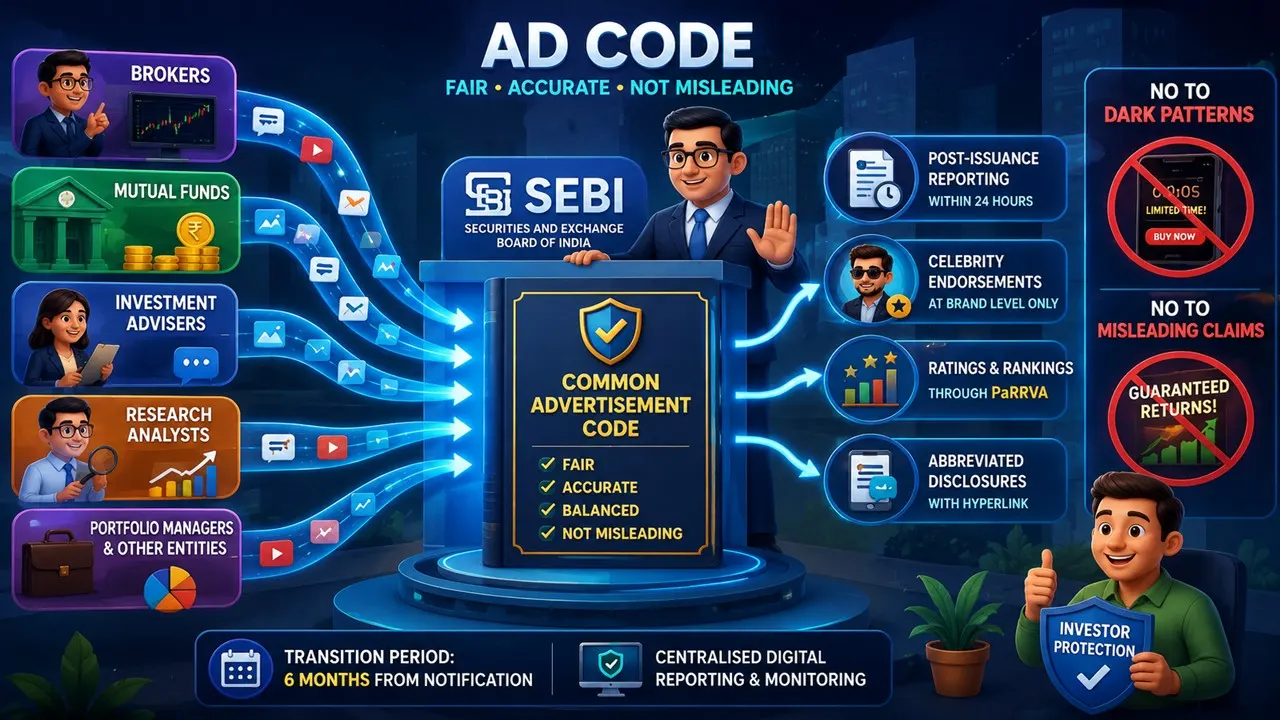
SEBI proposes common advertisement norms, simplified reporting and stronger investor protection safeguards.
Draft Framework Replaces Multiple Advertisement Regulations With Unified Code
 Meetu Kumari
 Jun 25, 2026
The Securities and Exchange Board of India (SEBI) has released a consultation paper proposing a Common Advertisement Code (CAC) for specified regulated entities, including stock brokers, depository participants, investment advisers, research analysts, online bond platform providers (OBPPs), portfolio managers, mutual funds and asset management companies. Public comments have been invited till July 14, 2026.
The proposal seeks to replace the current fragmented framework, where different categories of intermediaries are governed by separate advertisement codes, circulars and approval mechanisms. According to SEBI, the increasing use of digital and social media platforms has made it necessary to adopt a harmonised advertising framework that balances investor protection with ease of doing business.

A key proposal is the replacement of mandatory prior approval requirements with a post-issuance reporting system. Under the proposed framework, advertisements would generally need to be reported to the relevant supervisory body within 24 hours of publication. However, advertisements featuring celebrities would continue to require prior approval.
SEBI has also proposed allowing celebrity endorsements at the brand or entity level, subject to prescribed conditions and disclaimers. Celebrities would not be permitted to endorse specific products or services, as such endorsements could influence investment decisions and create unrealistic expectations regarding outcomes.
Another significant proposal relates to the use of ratings and rankings in advertisements. Regulated entities may be allowed to use rankings assigned by a Past Risk and Return Verification Agency (PaRRVA), subject to disclosure of methodology and a clarification that rankings are only one factor investors should consider while making decisions.

To address practical challenges in digital communication, SEBI has proposed permitting abbreviated disclosures in short-format communications such as SMS messages, push notifications and pop-ups, provided a hyperlink directing users to complete disclosures and disclaimers is included.
The regulator has further clarified that purely educational and investor-awareness content without promotional intent would not be treated as advertisements. Communications such as financial literacy material, responses to client queries, festive greetings, regulatory communications and sponsorship announcements without promotional claims are proposed to be excluded from the advertisement code.
The draft code also introduces an express prohibition on the use of dark patterns, including practices such as false urgency, forced actions and subscription traps, aligning the framework with consumer protection principles.
Under the proposed Common Advertisement Code, advertisements must be fair, accurate, balanced and not misleading. They would be prohibited from containing guaranteed return claims, unfair comparisons, misleading performance references, testimonials, or content that exploits investors’ lack of experience.
SEBI proposes to incorporate the Common Advertisement Code into the SEBI (Intermediaries) Regulations, 2008, supported by a centralised digital reporting and monitoring mechanism. A transition period of six months from the date of notification has also been proposed for implementation.
To Read Full Consultation Paper, Download PDF Given Below
About Author


Meetu Kumari
Content Manager
 Studycafe
 Jodhpur, Rajasthan, India
 2264
2264My Recent Articles
- ITAT Condones 302-Day Delay, Restores Salary Assessment for Fresh VerificationPremium
- ITAT Condones Delay After Tax Consultant's Death, Restores Appeals for Fresh HearingPremium
- ITAT Remands Salary Addition, Says Taxability Depends on Salary Becoming Due, Not Mere ReceiptPremium
- ITAT Deletes TP Royalty Adjustment, Orders Fresh Review of Commission BenchmarkingPremium
- ITAT Quashes Reassessment Over Unsigned Section 148 Notice Issued to AssesseePremium
Loading suggestions…


Recent Posts



All Posts



Tags
Recent Posts
All Posts