ITAT Allows FSSAI's Section 11 Exemption Claim, Directs AO to Recompute Income After Verification:
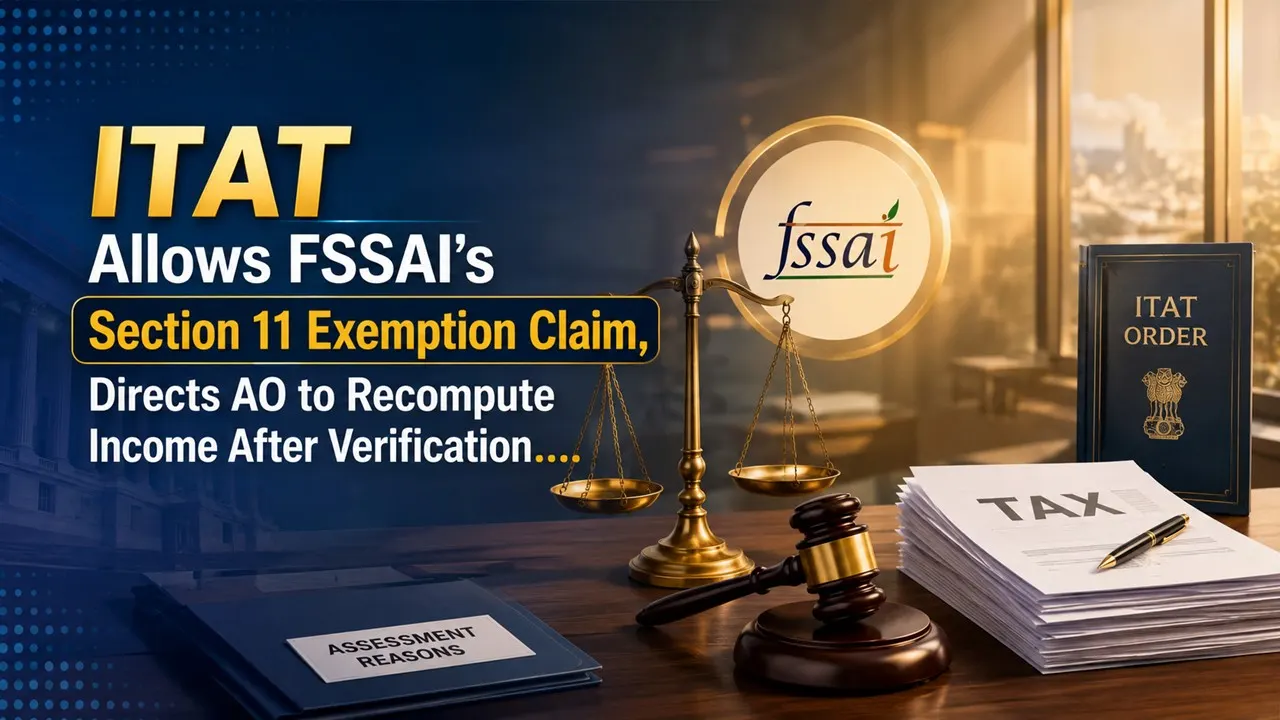
The ITAT holds that delayed filing of Forms 10 and 10B cannot defeat genuine Section 11 exemption claims.
Tribunal Treats Delayed Statutory Forms As Procedural Lapse Eligible For Condonation
 Meetu Kumari
 Jun 26, 2026
The Delhi Bench of the Income Tax Appellate Tribunal (ITAT) has allowed the appeal filed by the Food Safety and Standards Authority of India (FSSAI), holding that its claim for exemption under Section 11 of the Income-tax Act, 1961, cannot be denied merely because Form 10 and Form 10B were filed belatedly. The Tribunal directed the Assessing Officer (AO) to recompute the income after verifying the relevant facts.
The assessee, Food Safety and Standards Authority of India (FSSAI), challenged the order of the Commissioner of Income Tax (Appeals)/National Faceless Appeal Centre (NFAC), which had upheld the AO's denial of exemption under Sections 11 and 12 amounting to Rs 11.63 crore for Assessment Year 2018-19.

During the appellate proceedings, the assessee submitted that the issue was already covered by the Tribunal's decision in its own case for Assessment Year 2017-18. It explained that Form 10 and the audit report in Form 10B could not be furnished during the assessment proceedings because of the negligence of its legal consultant. These documents were later submitted before the Assessing Officer.
The CIT(A) rejected the claim, observing that Form 10 had not been filed within the prescribed time and that no condonation of delay had been obtained from the jurisdictional Commissioner of Income Tax (Exemptions). The appellate authority also held that the CBDT Circular relied upon by the assessee related to the Assessment Year 2016-17 and therefore did not assist its case.

Before the Tribunal, the assessee argued that the controversy stood concluded by the Tribunal's earlier order in its favour. The Revenue, however, supported the findings of the lower authorities.
The Tribunal noted that the identical issue had already been decided in favour of the assessee in its own case for Assessment Year 2017-18. In that decision, the Tribunal had observed that the CBDT's circulars provided for condonation of delay in filing Form 10 and Form 10B and that courts had consistently treated such procedural requirements as directory rather than mandatory. The Tribunal also relied on the Gujarat High Court's ruling in CIT v. Xavier Kelavani Mandal (P.) Ltd, which held that the delayed filing of these forms should not automatically result in the denial of exemption.
Following its earlier decision, the Tribunal accepted the assessee's substantive claim for exemption under Section 11 in principle and directed the Assessing Officer to recompute the income afresh after verifying the relevant facts in accordance with law. Thus, the appeal filed by the assessee was allowed.
To Read Full Order, Download PDF Given Below.
About Author


Meetu Kumari
Content Manager
 Studycafe
 Jodhpur, Rajasthan, India
 2264
2264My Recent Articles
- ITAT Condones 302-Day Delay, Restores Salary Assessment for Fresh VerificationPremium
- ITAT Condones Delay After Tax Consultant's Death, Restores Appeals for Fresh HearingPremium
- ITAT Remands Salary Addition, Says Taxability Depends on Salary Becoming Due, Not Mere ReceiptPremium
- ITAT Deletes TP Royalty Adjustment, Orders Fresh Review of Commission BenchmarkingPremium
- ITAT Quashes Reassessment Over Unsigned Section 148 Notice Issued to AssesseePremium
Loading suggestions…


Recent Posts


All Posts


Recent Posts
All Posts