ITAT Bangalore Quashes Section 263 Revision as Assessee Had Not Claimed Alleged Illegal Commission Expenditure:
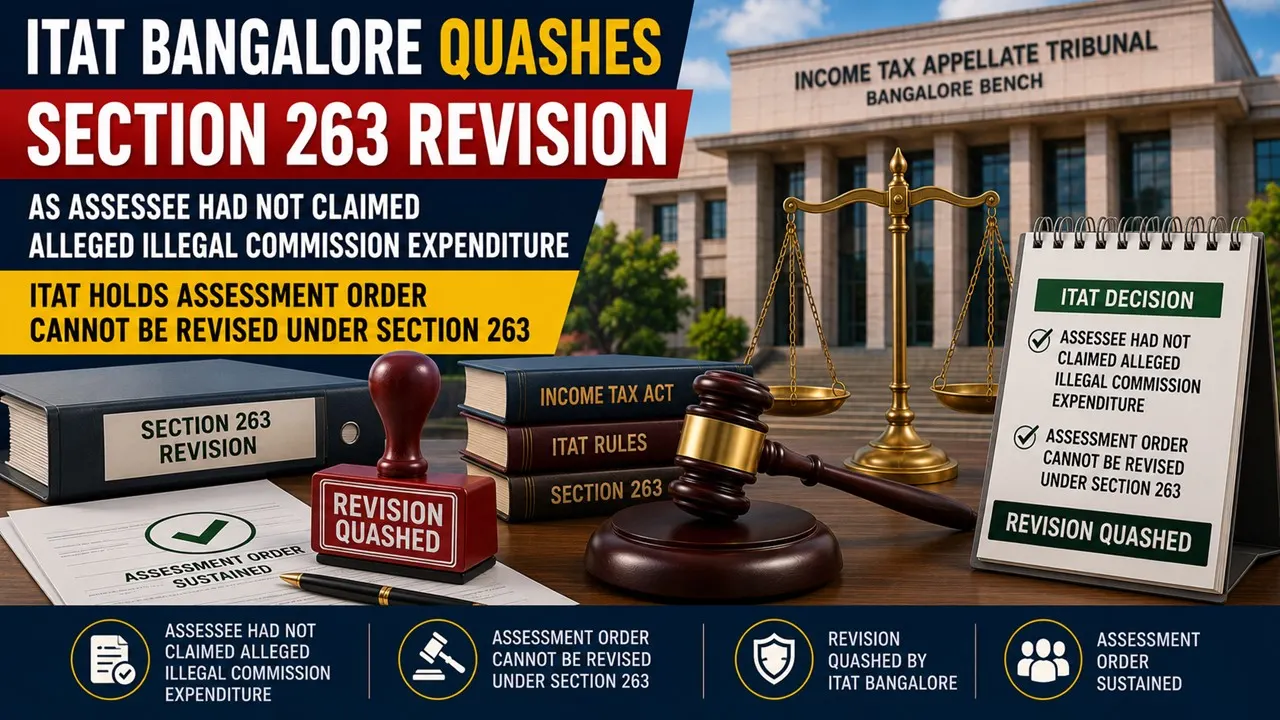
The Income Tax Appellate Tribunal (ITAT) Bangalore has quashed the revisionary order passed under Section 263 of the Income Tax Act, 1961 against Khoday India Limited holding it as unsustainable.
ITAT Holds Assessment Order Cannot Be Revised Under Section 263
 Saima
Saima Jun 15, 2026
ITAT Bangalore Quashes Section 263 Revision as Assessee Had Not Claimed Alleged Illegal Commission Expenditure
The Income Tax Appellate Tribunal (ITAT) Bangalore, has held that revisionary jurisdiction under Section 263 of the Income Tax Act, 1961 cannot be exercised where the assessee had not claimed the expenditure which was alleged to have been wrongly allowed by the AO
The assessee is M/s. Khoday India Limited and had filed its return for assessment year 2020-21 declaring a loss. After a search conducted under Section 132, assessment proceedings under Section 153A were initiated and completed on 31 March 2023.
Subsequently, the Principal Commissioner of Income Tax (Central), Bengaluru, invoked powers under Section 263 of the Act on the ground that commission expenditure amounting to Rs 18 lakh represented illegal payments and, therefore, was not allowable under Section 37(1). According to the PCIT, the AO had failed to examine the issue during assessment proceedings, which makes the assessment order erroneous and prejudicial.
The assessee contended that it had neither made any such payments nor claimed any deduction of the alleged amount. It further submitted that despite repeated requests, the authorities failed to furnish the material relied upon and also denied the opportunity to cross-examine the persons whose statements formed the basis of the proceedings. Before the Tribunal, the Revenue stated that information regarding the alleged payments had emerged during search proceedings conducted in the case of the Tuteja, Bhatia and Dhand Group and that a satisfaction note prepared by the AO formed the basis for initiating revision proceedings.
The Tribunal found that neither the Principal Commissioner in the revisionary order nor the Departmental Representative before the Tribunal could demonstrate that the deduction of Rs 18 lakh had in fact been allowed to the assessee. Holding that the existence of such expenditure itself had not been established, the Tribunal observed that there was no basis to conclude that the assessment order was erroneous and prejudicial to the interests of the Revenue. Accordingly, the Tribunal quashed the order passed under Section 263 of the Income Tax Act, 1961 and allowed the appeal filed by the assessee.

About Author


Saima
Content Writer
Saima is a Law graduate with a passion for research and content writing. She writes for Finance, Taxation and Legal Updates at Studycafe.in, simplifying complex legal decisions by the ITAT, High Court, AAR and GSTAT into uncomplicated and clear explanations.
Saima is a Law graduate with a passion for research and content writing. She writes for Finance, Taxation and Legal Updates at Studycafe.in, simplifying complex legal decisions by the ITAT, High Court, AAR and GSTAT into uncomplicated and clear explanations.
 StudyCafe
 Delhi, Delhi, India
 555
555My Recent Articles
- High Court Quashes GST Demand Against Amul Over Non-Cross-Charging of Common Expenses
- High Court Quashes Income Tax Demand Against Contractual Worker Over Misuse of PAN
- ITAT Deletes Rs 2.06 Crore Addition Under Section 68 for Unsecured Loans
- ITAT Holds Section 263 Revision Invalid on Taxability of Interest Under Section 28 of Land Acquisition Act
- ITAT Upholds Section 68 Addition for Bogus Loans But Restricts Estimated Profit to 2% of Sales
Up Next
Loading suggestions…


Recent Posts


All Posts

Recent Posts
All Posts