Supreme Court: Income Tax Reassessment Invalid Without Mandatory Section 143(2) Notice Issuance Even If Taxpayer Participates:
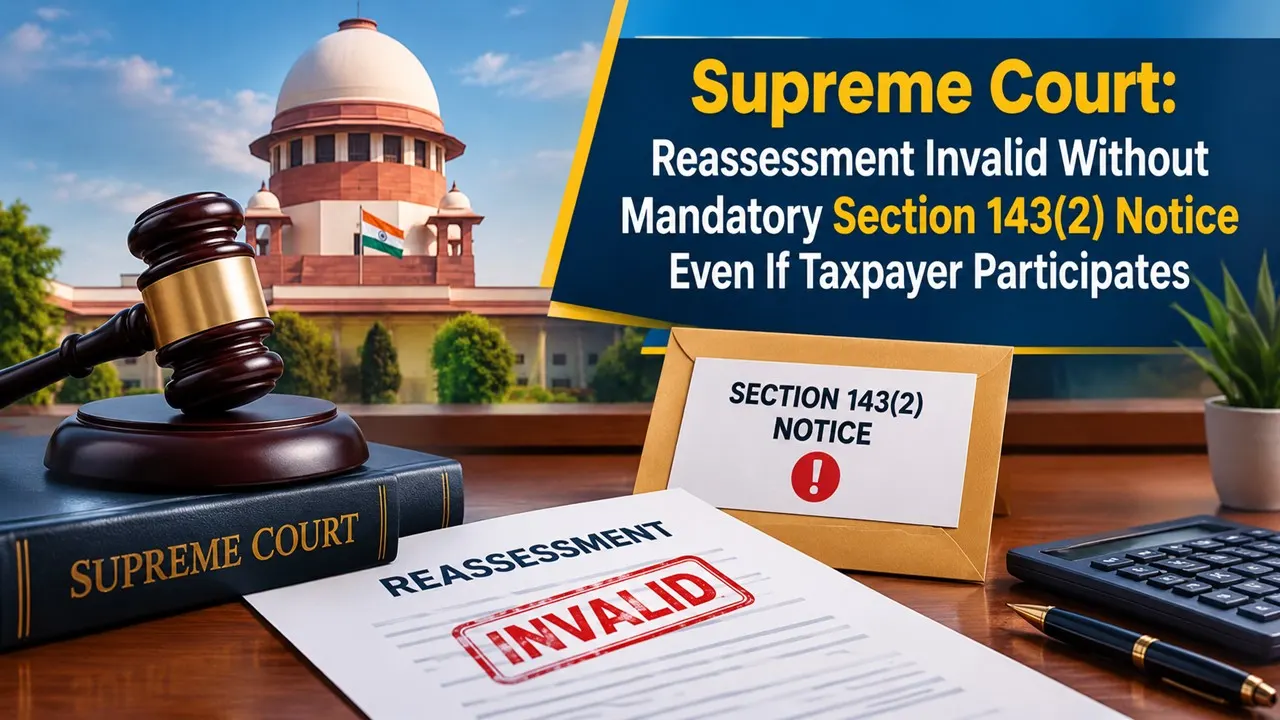
The SC has ruled that income tax reassessment proceedings are invalid in the absence of a mandatory notice under Section 143(2), clarifying that taxpayer participation cannot cure the complete non-issuance of such notice.
Section 143(2) Notice Mandatory Even When Original ITR Is Treated as Section 148 Return, SC Clarifies
 Saloni Kumari
 Oct 30, 2026

The Supreme Court, in a recent significant ruling, has clarified that income tax reassessment proceedings cannot be considered valid until the income tax authorities issue a mandatory notice under Section 143(2) of the Income Tax Act, regardless of the taxpayer's participation in the proceedings.
A notice under Section 143(2) of the Income Tax Act, 1961, is a formal communication issued by the Income Tax Department indicating that your Income Tax Return (ITR) has been selected for a scrutiny assessment.

Taxpayers should note that Section 143(2) notice is not a direct demand for tax; however, instead it is issued to verify that you have not underestimated your income, no excessive losses claimed, not underpaid tax, etc.
As per the provisions of the law, a notice under Section 143(2) should be served on a taxpayer within 3 months from the end of the financial year in which the tax return was furnished.
In the present case, the Income Tax Department had filed an appeal before the Supreme Court of India against a judgement passed by the Orissa High Court. The Supreme Court has invalidated the reassessment proceedings initiated against the taxpayer in the absence of a Section 143(2) notice.

The Supreme Court held that issuing a notice under Section 143(2) is necessary prior to initiating reassessment proceedings, as it grants the taxpayer a chance to furnish all the relevant evidence and other details in support of the income declared in the ITR. Reassessment proceedings under Section 147 of the Act without a Section 143(2) notice are completely invalid.
The court has also clarified that just because the taxpayer participated in the reassessment proceedings does not give permission to the income tax department to leave issuing the mandatory notice under Section 147.
The bench comprising Justices Sanjay Kumar and Sanjeev Sachdeva held that "where the Revenue itself contends that no notice was sent, as required under the Act, the provision of Section 292BB will have no applicability."
There are three key clarifications given by the justices in the present case:
First, despite the participation of the taxpayer in the reassessment proceedings, he/she has the authority to challenge the reassessment proceedings before the relevant appellate authority in case the tax authority does not issue a notice under Section 143(2) of the Act.
Second, the Income Tax Department is required to issue a notice under Section 143(2) of the Act, even if the taxpayer urges that the initial ITR filed under Section 139 be treated as the return filed in response to a reassessment notice under Section 148.
Third, a letter issued by the Assessing Officer (AO) under Section 142(1) of the Act asking the taxpayer why reassessment proceedings should not be initiated against him/her does not fulfil the requirement of issuing a notice under Section 143(2).
About Author


Saloni Kumari
Content Writer
 StudyCafe
 Delhi, Delhi, India
 2989
My Recent Articles
- CBI Registers Case Against Chandra Proteco and Its Bank Fraud of Over Rs 210.13 Crore
- CBDT Restricts Applicability of Chapter XIX Income Tax Provisions on Payments to IRRI Subject to Certain Conditions
- Supreme Court Sets Aside Delhi HC's Order, Holds No Disallowance of Expenses Never Claimed as Deduction Under Income Tax Act
- Kalpataru Projects International Receives GST Order Imposing Rs 6.76 Crore Penalty Over ITC and RCM Issues
- 47-Year-Old Chief Software Engineer Duped of Rs 2.17 Crore Through Fake Stock Trading App
Loading suggestions…


Recent Posts



All Posts


Recent Posts
All Posts