ITAT Restricts Addition on Alleged Bogus Purchases to 1% GP Rejecting AO’s Adoption of Higher Profit Rate from Subsequent Year:
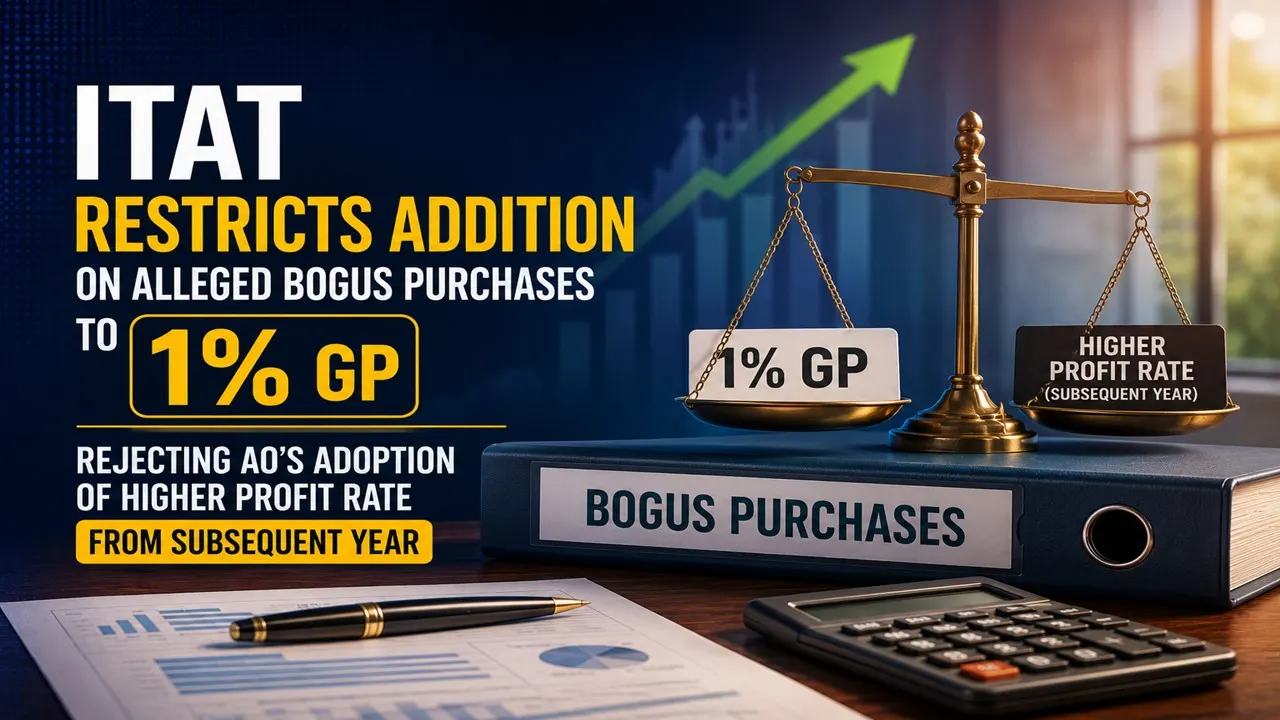
The ITAT Delhi has granted partial relief to the assessee by reducing the addition made on alleged bogus purchase transactions.
ITAT Holds GP Addition Must Reflect Relevant Assessment Years
 Saima
Saima Jun 26, 2026
ITAT Restricts Addition on Alleged Bogus Purchases to 1% GP Rejecting AO’s Adoption of Higher Profit Rate from Subsequent Year
The Income Tax Appellate Tribunal (ITAT) Delhi held that the AO was not justified in applying the gross profit rate of a later assessment year having a different business model. After considering the facts and past profits of the assessee, the Tribunal restricted the addition to 1% of the disputed transactions.
A search operation under Section 132 of the Income Tax Act was conducted at the premises of M/s Faqir Chand Lockers and Vaults Pvt. Ltd., where a locker belonging to Shri Ved Prakash Agarwal was identified and searched. Later, proceedings under Section 153A were initiated for assessment years 2013-14 to 2016-17. During assessment proceedings, the AO relied upon information received from an earlier investigation against one Hitesh Jain, who had allegedly admitted to operating several dummy concerns engaged in providing accommodation entries through bogus purchase and sale bills. The Revenue alleged that the assessee had entered into transactions with such concerns and claimed bogus purchases.
The AO observed that notices issued to the alleged suppliers were not complied with and concluded that the purchases were not genuine. After applying Section 145(3), he rejected the books of account to the extent of such transactions and treated the purchases as having been sourced from the grey market. For calculating the addition, the AO adopted the highest gross profit rate of 3.69% declared by the assessee in assessment year 2019-20 and applied the differential GP rate of 2.88% to the disputed transactions, resulting in additions for the relevant years.
[related id="425009 "]
The CIT(A) upheld the additions, making the assessee prefer appeals before the Tribunal.
The Tribunal noted that although the suppliers had not responded to notices issued under Section 133(6), the Revenue had accepted the sales declared by the assessee and all transactions had been routed through banking channels. The Tribunal also recorded that the assessee had furnished VAT registration details and banking documents to establish the identity of the parties involved in the transactions.
The Tribunal found merit in the assessee’s contention that the AO had adopted the gross profit rate of assessment year 2019-20, despite that year involving a different business pattern and product mix. The profit rate of that year, therefore, could not be mechanically applied to assessment years 2013-14 to 2016-17 and also held that the addition made by applying a GP rate of 2.88% was excessive in the facts of the case.
Accordingly, the Tribunal restricted the addition to 1% of the disputed purchases, noting that such estimation was broadly in line with the assessee’s historical gross profit rates ranging between 0.67% and 1.52% during the relevant assessment years.
About Author


Saima
Content Writer
Saima is a Law graduate with a passion for research and content writing. She writes for Finance, Taxation and Legal Updates at Studycafe.in, simplifying complex legal decisions by the ITAT, High Court, AAR and GSTAT into uncomplicated and clear explanations.
Saima is a Law graduate with a passion for research and content writing. She writes for Finance, Taxation and Legal Updates at Studycafe.in, simplifying complex legal decisions by the ITAT, High Court, AAR and GSTAT into uncomplicated and clear explanations.
 StudyCafe
 Delhi, Delhi, India
 558
558My Recent Articles
- GSTAT Upholds Penalty for Expired E-Way Bill and Incorrect Dispatch Details
- GSTAT Remands GST Penalty Case for Fresh Adjudication Over Uncertain Goods Movement
- GSTAT Upholds Penalty for Transporting Goods Under Expired E-Way Bill
- High Court Quashes GST Demand Against Amul Over Non-Cross-Charging of Common Expenses
- High Court Quashes Income Tax Demand Against Contractual Worker Over Misuse of PAN
Up Next
Loading suggestions…


Recent Posts
All Posts
Recent Posts
All Posts