ITR Filing Deadline for AY 2026-27: Why July 31 No Longer Applies to Everyone:
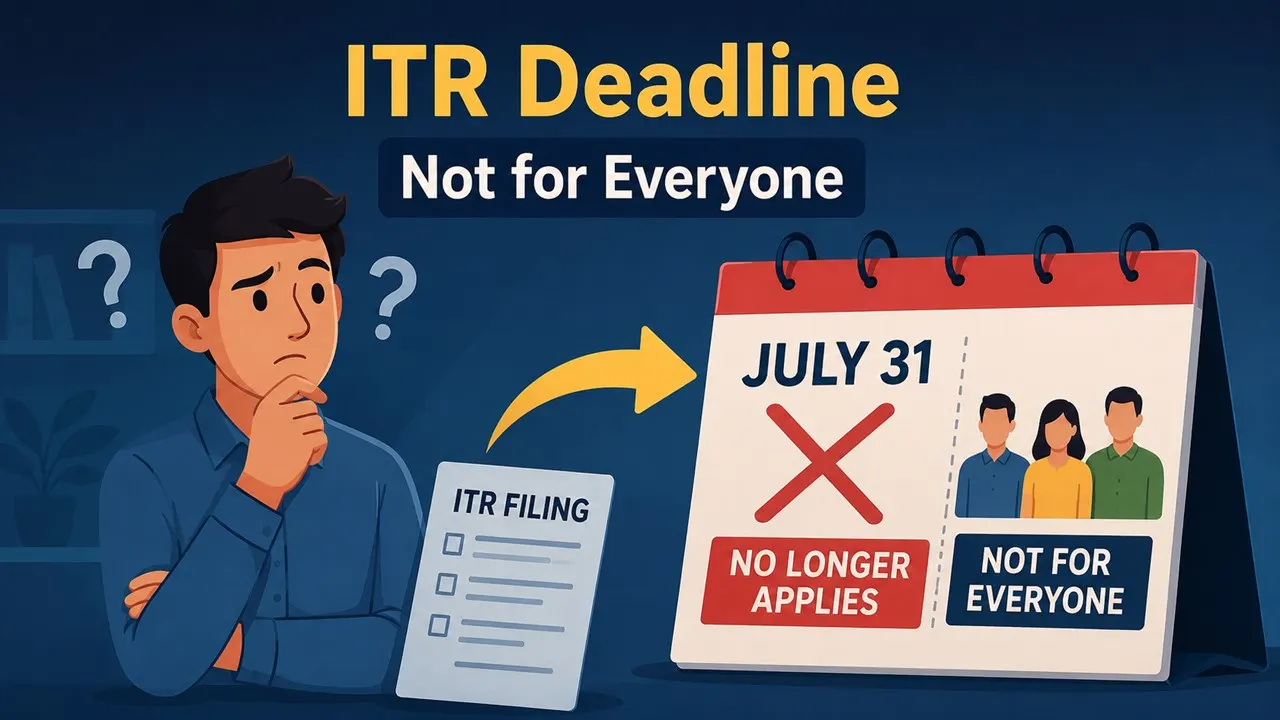
July 31 is no longer the default ITR deadline for everyone - find out which filing date applies to you for AY 2026-27.
Check Your ITR Filing Deadline for AY 2026-27
 Vanshika verma
 Jun 16, 2026
Table of Contents

ITR Filing Deadline for AY 2026-27: Why July 31 No Longer Applies to Everyone
For a long time, most taxpayers in India have linked Income Tax Return (ITR) filing to a single date - July 31. In particular, salaried workers became so used to the deadline that many assumed it was universal.
But this assumption may not be true for Assessment Year (AY) 2026-27 which is for income for Financial Year (FY) 2025-26.
The income tax filing calendar now has different deadlines for different categories of taxpayers. Your due date may be later than July 31, depending on factors such as your source of income, whether your accounts require an audit, or whether you are a partner in a firm.
At the same time, some taxpayers may mistakenly believe they have extra time and end up missing their actual filing deadline.
Because of these changes, it is important for every taxpayer to check the specific ITR due date that applies to their situation instead of relying on the traditional July 31 deadline.
Let's see what has changed:
For Assessment Year (AY) 2026-27, the government has extended the income tax return (ITR) filing due date from 31 July 2026 to 31 August 2026 for eligible non-audit business taxpayers and professionals filing ITR-3 or ITR-4. However, salaried individuals and other taxpayers filing ITR-1 or ITR-2 must generally continue to file their returns by 31 July 2026.
Announcing this change in the Union Budget 2026 on 1 February 2026, Finance Minister Nirmala Sitharaman said that a staggered filing schedule is being introduced, with individuals filing ITR-1 and ITR-2 retaining the 31 July deadline, while non-audit business cases and trusts will have a due date of 31 August.
Filing your ITR on time helps you avoid extra charges and ensures faster processing of refunds.
| ITR Form | Category | Due Date |
| ITR-1 & ITR-2 | Salary income, Capital gains income | 31st July 2026 |
| ITR-3 & ITR-4 | Business income – Non-audit cases | 31st August 2026 |
| ITR-3 & ITR-4 | Business income – Cases requiring audit | 31st October 2026 |
| Belated Return | Late filing | 31st December 2026 |
| Revised Return | Correction of earlier filed return | 31st March 2027 |
| Updated Return (ITR-U) | Within 4 years from end of relevant AY | 31st March 2031 |
Forms currently enabled for AY 2026-27 and who should use them:
ITR-1 (Sahaj): For salaried employees or pensioners with total income up to Rs 50 lakh and simple income sources. ITR-2: For individuals or HUFs who have capital gains (e.g., from shares or property), foreign assets, multiple houses, or higher income, but no business income. ITR-4 (Sugam): For small business owners, freelancers, and professionals who choose the presumptive taxation scheme under Sections 44AD, 44ADA, or 44AE.Why you should not miss your ITR deadline
If you file your Income Tax Return (ITR) late, you may have to pay a late fee, interest on unpaid taxes, face delays in getting your tax refund, and lose some tax benefits.Late Filing Fee under Section 234F
Section 234F of the Income Tax Act imposes a fee if you file your ITR after the due date.| Total Income | Late Filing Fee |
| Up to Rs 5 lakh | Up to Rs 1,000 |
| Above Rs 5 lakh | Up to Rs 5,000 |

When is the fee charged?
If you file your Income Tax Return (ITR) on or before the due date, you do not have to pay any late-filing fee. If you file after the due date, you may have to pay:- A late-filing fee under Section 234F
- Interest charges under Sections 234A, 234B, and 234C, if applicable
- If you are earning more than Rs 5 lakh in total, the late filing fee can go up to Rs 5,000.
- If your total income is Rs 5 lakh or less, then fee cannot be more than Rs 1,000.
About Author


Vanshika verma
Content Writer
Vanshika Verma is a Content Writer with 1+ year of experience at Studycafe.in. A B.Com graduate from Delhi University, She writes articles on Finance, Tax, ICAI, GST, and the latest financial news, with a focus on making complex topics easy for readers and professionals.
Vanshika Verma is a Content Writer with 1+ year of experience at Studycafe.in. A B.Com graduate from Delhi University, She writes articles on Finance, Tax, ICAI, GST, and the latest financial news, with a focus on making complex topics easy for readers and professionals.
 Studycafe
 Delhi, Delhi, India
 2114
2114My Recent Articles
- Rajasthan Police Warns of WhatsApp Account Hacking Scams, Urges People to Beware of Fake QR Codes and OTP Fraud
- Man Carrying Rs 25,000 Reward Arrested in Rs 1.22 Crore GST Evasion Case Involving Fake Firms in Bulandshahr
- Star Paper Mills to Challenge Rs 1.55 Crore GST Demand Order Over Disallowance of Input Tax Credit on Raw Materials Destroyed in Fire
- Delhi CBI Arrests Hospital Doctor and Contractual Nursing Orderly Supervisor for Alleged Rs 1 Lakh Bribery in Tender-Related Case
- ITAT Condones 2,107-Day Delay, Directs CIT(A) to Reconsider Rs 16.54 Lakh Section 80PA Deduction Claim
Up Next
Loading suggestions…


Recent Posts


All Posts



Recent Posts
All Posts