Maharashtra Lok Adalat on 22nd March 2025: Opportunity to Settle Pending Traffic Challans and Legal issues:
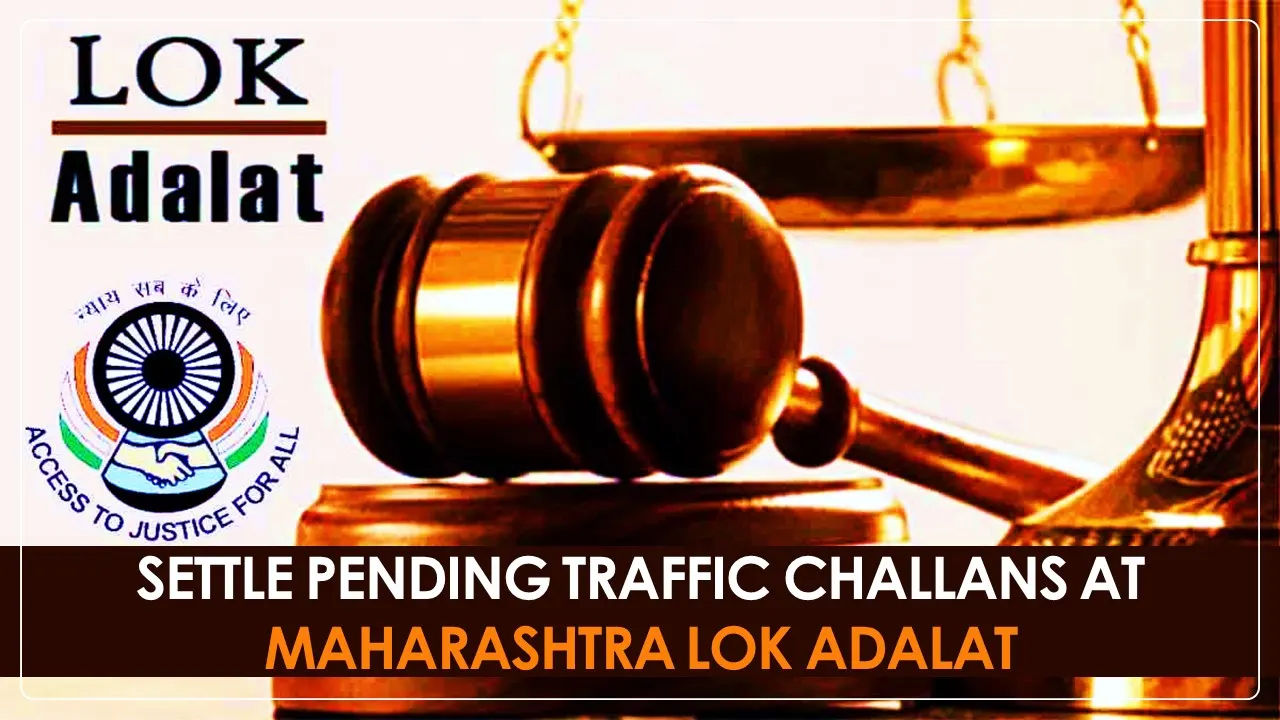
Have a pending traffic challan? Here’s a great chance for Maharashtra residents to get a full or partial waiver at the Lok Adalat on March 22, 2025, i.e., today.
Settle Pending Traffic Challans at Maharashtra Lok Adalat
 Nidhi
Nidhi Mar 22, 2025
Table of Contents

Maharashtra Lok Adalat on 22nd March 2025: Opportunity to Settle Pending Traffic Challans and Legal issues
Do you still have a pending traffic challan? Here’s a great chance for Maharashtra residents to get a full or partial waiver at the Lok Adalat on March 22, 2025, i.e., today. The Maharashtra State Legal Service Authority (MSLSA) is holding this event from 10 AM onwards in Mumbai, as well as at the Bombay High Court benches in Nagpur, Aurangabad, and Panaji (Goa).
Besides this, Lok Adalats will also be held in all district and family courts across Maharashtra. Daman and Diu will also be conducting their Lok Adalat on the same day.
How to Settle Your Pending Traffic Challan at Lok Adalat?
If you want to take advantage of this opportunity, start by checking if there are any pending traffic challans issued against your vehicle. You can check this through the Parivahan eChallan portal or the Mumbai Traffic Police App. If you see any pending traffic challans against your vehicle, you can either pay the fine settle it immediately or contest the challan in a regular court. If an e-challan remains unpaid for more than 60 days after its issuance, it is automatically transferred to a virtual court for further processing. To make the payment, you can visit the Evening Court portal (vcourts.gov.in) and select your state’s traffic department. On this portal, you can look for your challenges in the following ways:- Mobile number
- Case record number (CRN)
- Party name
- Vehicle number
What Other Types of Cases can be solved at Lok Adalats?
At such Lok Adalats, all types of compoundable criminal cases and civil cases can be solved. Compoundable cases are those where the parties involved can mutually settle the dispute and withdraw the charges, either with or without court intervention. Once a settlement is reached, no further legal proceedings or court trials are needed to close the case. As per a circular by MSLSA, Lok Adalats have the authority to handle cases related to the following matters, whether they are already pending in court or in the pre-litigation stage (before a formal lawsuit is filed):- Cases under Section 138 of the Negotiable Instruments Act
- Disputes regarding Public Utility services such as electricity and water bills cases, etc. (excluding non-compoundable)
- Money recovery cases
- Matrimonial disputes (except divorce) and other family disputes Land acquisition cases
- IPR (Intellectual Property Rights) matters/Consumer matters/other matters pending before any other Quasi-Judicial Authority
- Labour dispute cases
- Services matters, including pension cases
- Revenue and other ancillary matters, pending before High Court, District Courts, State/District/Taluka authorities
- Motor accident claim cases
- Other civil cases (rent, easementary rights, injunctions, suits, specific performance suits, etc.).
Charges for Filing and Settling Cases in a Lok Adalat?
There are no charges for mediator services if you choose to get a case clear in Lok Adalats. If any of your cases were pending in court and the same has been resolved in Lok Adalat, then you are eligible to get a refund of such court fees.Can I Challenge a Lok Adalat’s Decision?
Yes, but only in very limited cases. In most situations, the decision made by Lok Adalat is final and cannot be challenged. As per the mandate of the Civil Procedure Code of 1908, any decree passed by consent of the parties cannot be challenged by them. Therefore, both parties must agree on a settlement. After which, the Lok Adalat issues a decision (called an award), which officially closes the case. As this decision is based on mutual consent, it carries the same force as that of a decree passed by any civil court. Hence, no appeal or challenge can lie to an award or ruling delivered by the Lok Adalat. As per an expert, if a party wants to challenge a Lok Adalat’s ruling or award, which has already settled and closed the case, the only option is to file a Writ Petition in the High Court under Article 226 or Article 227 of the Indian Constitution. However, this is allowed only on very limited grounds, such as fraud, misrepresentation, or violation of public policy. It depends on the Writ Court to decide whether Lok Adalat’s ruling should be cancelled.About Author


Nidhi
Content Writer
Nidhi is a skilled content writer specializing in personal finance. She creates clear, engaging articles on mutual funds, investments, insurance, and wealth-building strategies. With a passion for simplifying complex financial topics, Nidhi helps readers make informed money decisions with confidence. She can be reached at [email protected]
Nidhi is a skilled content writer specializing in personal finance. She creates clear, engaging articles on mutual funds, investments, insurance, and wealth-building strategies. With a passion for simplifying complex financial topics, Nidhi helps readers make informed money decisions with confidence. She can be reached at [email protected]
 Studycafe
 New Delhi, Delhi, India
 1832
1832My Recent Articles
- Karnataka High Court Gives Another Chance in GST Matter Due to Lack of Hearing
- Delay Should Be Condoned if Explanation is Unrefuted: ITAT
- Non-Service of Income Tax Notice, Ill health of taxpayer, ITAT condones Appeal filing delay
- Books of Accounts Cannot be Rejected Without Any Specific Defect: ITAT Kolkata
- Karnataka High Court Sends ITC Matter Back to GST Authorities for Reconsideration
Up Next
Loading suggestions…


Recent Posts

All Posts
Tags
No tags yet.
Recent Posts
All Posts
Tags
No tags yet.