No More Paperwork, Open Post Office Savings Schemes Instantly using Aadhaar based e-KYC:
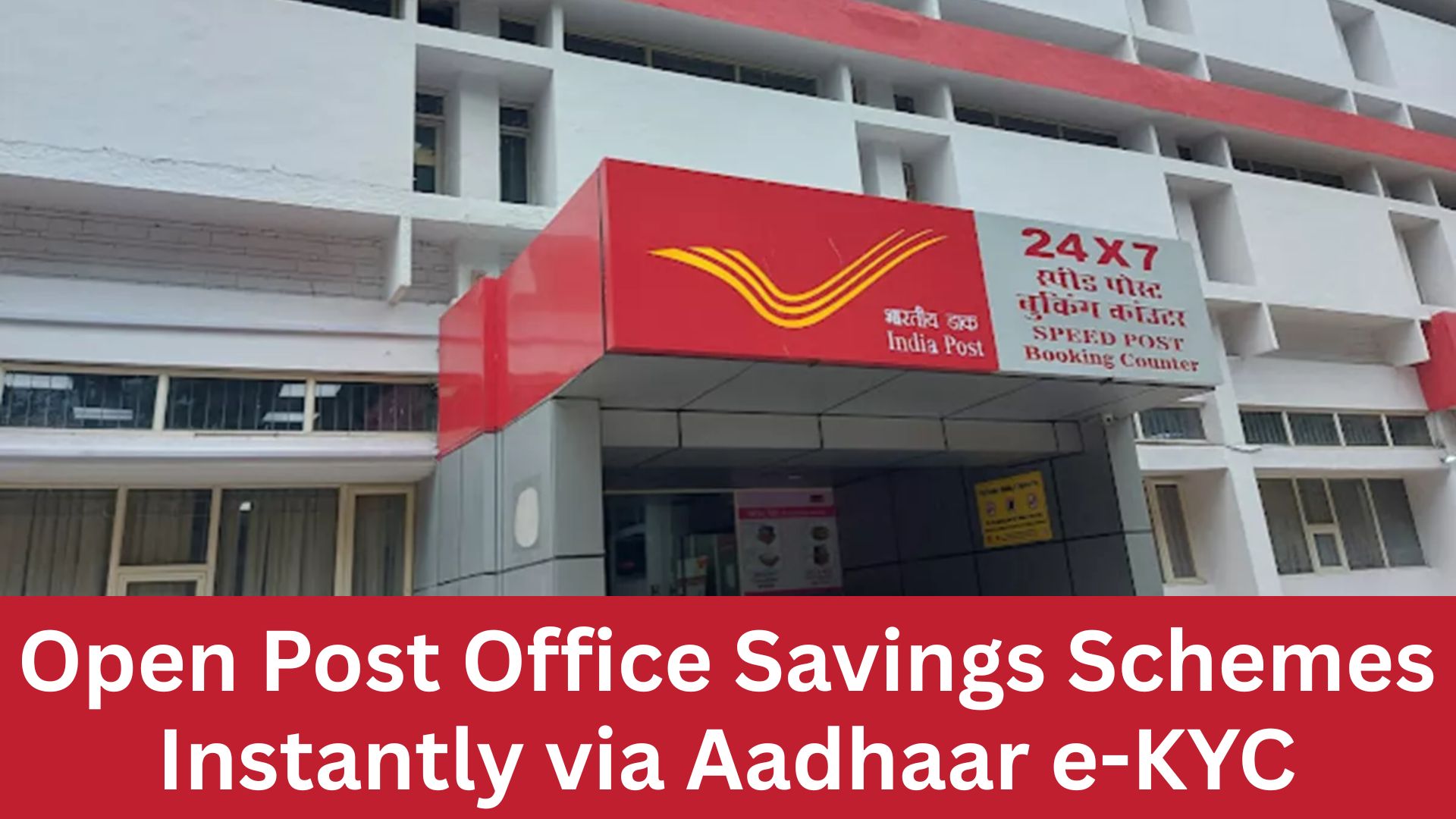
A Digital process has been started by the Department of Posts in order to open select savings schemes consist of, Monthly Income Scheme (MIS), Time Deposit (TD), Kisan Vikas Patra (KVP), and National Savings Certificate (NSC), using Aadhaar biometric authentication.
Open Post Office Savings Schemes Instantly via Aadhaar e-KYC
 Janvi Koli
 May 2, 2025
Table of Contents

No More Paperwork, Open Post Office Savings Schemes Instantly using Aadhaar based e-KYC
A Digital process has been started by the Department of Posts in order to open select savings schemes consisting of the Monthly Income Scheme (MIS), Time Deposit (TD), Kisan Vikas Patra (KVP), and National Savings Certificate (NSC) using Aadhaar biometric authentication. This process is fully digital (paperless), time-saving and does not require a physical deposit slip.
Beginning on April 23, 2025, the Aadhaar-based e-KYC process has been sustained by the Department of Posts to include popular small savings schemes, such as the Monthly Income Scheme, Time Deposit, Kisan Vikas Patra, and National Savings Certificate. Hence, the initiative succeeds the nationwide rollout of Aadhaar-based e-KYC for savings accounts, starting January 6, 2025, in order to onboard the new customers via the creation of Customer Information Files (CIFs) and the opening of the individual Post Office Savings Accounts (POSAs).
The Department of Post, in the Ministry of Communications, has published a circular on April 30, 2025, which stated that "In continuation, the Aadhaar-enabled eKYC process has been enabled for the opening of Monthly Income Account Scheme (MIS), Time Deposit Scheme (TD), Kisan Vikas Patra Scheme (KVP) and National Savings Certificate VIII Issue (NSC) scheme accounts w.e.f. 23.04.2025. Accordingly, now the post offices will be able to open the MIS, TD, KVP and NSC scheme accounts of the Single-Individual (Adult) type through Aadhaar authentication using e-KYC CIF."
Transactions based on papers
The traditional method, which includes the deposit couchers and physical forms, remains available. Customers can choose whether they want to opt for the account opening on the basis of paper or digital Aadhaar-based account opening.Privacy Guidelines for Aadhaar
All the Aadhaar numbers will be masked on forms, and if any Aadhaar will appears unmasked, the first 8 digits will be amnually blacked out, and this will be ensured by the Postmaster. It is instructed to all the post offices and CBS centres that they should hide Aadhaar numbers on both physical and digital documents.Aadhaar Biometric for the closure of accounts and account transfers
The services of the account closure, account transfers, and nomination updates via Aadhaar biometric authentication are currently under development and will begin shortly; till then, the traditional process will be followed. Circles are mainly started to confirm that paperless KYC due diligence has been performed for all the new customers and the existing or previous account holders in order to facilitate ekyc compliance and offer other benefits to both the customer and the department.How Aadhaar Biometrics works
An account opening process via a designated system menu has been started by the Counter Postal Assistant (PA). First, the biometric data or fingerprints of the depositor have been collected to seek permission for using Aadhar e-KYC. When the permission is granted, the required account details as been entered by the PA, like name, scheme, type, and deposit amount, into the system. Prior to the final submissiona second fingerprint is captured to authenticate and complete the transaction. There is no need to fill out any deposit slips by the customers as the deposit amount mentioned in the e-KYC Account Opening Form (SB-eKYC-AOF) is considered final.About Author


Janvi Koli
Digital Marketing Executive
Janvi is an expert content writer focused on taxation and compliance. She writes insightful articles on income tax, GST, company law, and government policies. Known for her practical approach, she simplifies complex regulations to help readers stay informed and compliant. She can be reached at [email protected]
Janvi is an expert content writer focused on taxation and compliance. She writes insightful articles on income tax, GST, company law, and government policies. Known for her practical approach, she simplifies complex regulations to help readers stay informed and compliant. She can be reached at [email protected]
 Studycafe
 Delhi, Delhi, India
 325
325My Recent Articles
- Ethereum Fundamentals for Finance Students through Understanding Blockchain Beyond Bitcoin
- Major Financial Changes Effective from November 1, Every Indian Should Aware Of
- Top 20 CA Firms in Mumbai for Articleship
- Know How to Setup EV Charging Stations: Step by Step Guide
- Unlock business growth this Independence Day with Bajaj Finserv Business Loan
Up Next
Loading suggestions…


Recent Posts

All Posts

Tags
No tags yet.
Recent Posts
All Posts
Tags
No tags yet.