Notice U/S 148 Invalid Without Delivering Proper Justification: HP High Court:
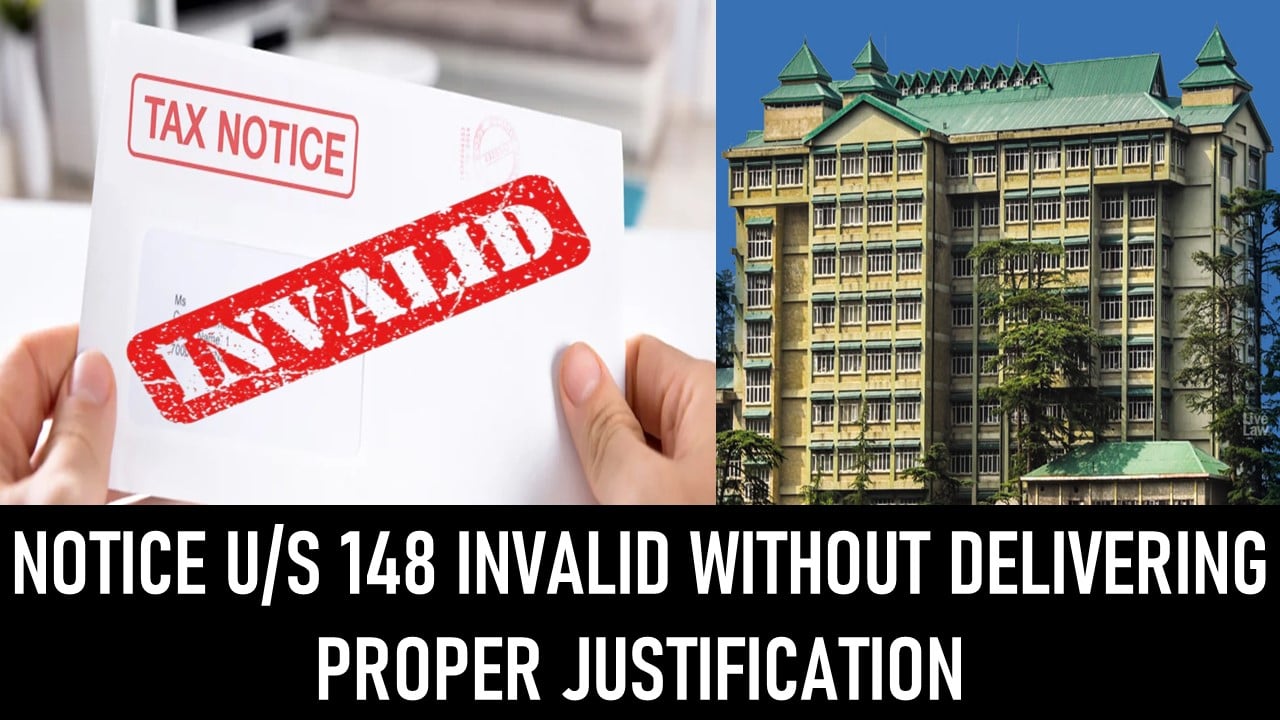
Himachal Pradesh HC ruled that the Assessing Officer cannot send a notice under Section 148 of the Income Tax Act, 1961, without giving valid reasons.
Himachal HC Ruled Notice U/S 148 Cannot be Issued Without Giving Valid Reasons
 Nidhi
Nidhi Jun 5, 2025
Table of Contents

Notice U/S 148 Invalid Without Delivering Proper Justification: HP High Court
The Himachal Pradesh High Court ruled that the Assessing Officer cannot send a notice under Section 148 of the Income Tax Act, 1961, to start reassessment proceedings unless they give valid reasons for doing it.
Facts of the Case
The petitioner, Neena Singh Thakur, was given a show cause notice under Section 148A(d) of the Income Tax Act, alleging that her income for the assessment year 2017-18 was not assessed. According to the income tax department, she did not disclose information about an immovable property she bought, which was worth Rs. 1.21 crores. The TDS returns she filed confirm this purchase. The applicant, Neena Singh Thakur, responded to the allegations by submitting the required documents. She stated that she had disclosed all the transactions and clarified that the value of the property was Rs. 1,31,63,935, not Rs. 1.21 crores, as claimed by the department. However, even after receiving her response, the Assessing Officer still issued a notice under Section 148 of the Income Tax Act. He stated that the case is at an initial stage and the applicant's explanations were not acceptable, as they required a more detailed analysis. The applicant, dissatisfied with the notice, submitted a writ petition to HC asking to cancel the notice.Findings of the Case
The court said that there is no regulation that obligates every inquiry under Section 148A to result in the issuance of a notice under Section 148. Instead, the Assessing Officer is required to carefully consider the material on record, and with the taxpayer's response, to decide whether a notice should be issued or not. The court stated that notice cannot be issued without valid reasons for starting the reassessment proceedings. In the case of S.N. Mukherjee V Union of India, 1990, the Supreme Court ruled that giving valid reasons is crucial as it gives a surety that the authority has considered the matter, and it brings clarity in decisions. Additionally, the Supreme Court also rules that giving proper reasons is also important, as it reduces the chances of biased decision-making. In the case of Pankaj Garg vs. Meenu Garg & Anr. (2013), the Supreme Court ruled that an order without any reason is not considered an order in the eyes of the law. Therefore, the court held that valid justice was not served as the order could not provide a valid reason. If an order does not have a clear reasoning, it makes it difficult for the court to function. The court set aside the order passed by the Assessing Officer as it lacked proper reasoning. The case was remanded for a fresh review according to the law. The court said that if the Assessing officer believes that a notice under section 148 should be issued, then they should give detailed reasons.About Author


Nidhi
Content Writer
Nidhi is a skilled content writer specializing in personal finance. She creates clear, engaging articles on mutual funds, investments, insurance, and wealth-building strategies. With a passion for simplifying complex financial topics, Nidhi helps readers make informed money decisions with confidence. She can be reached at [email protected]
Nidhi is a skilled content writer specializing in personal finance. She creates clear, engaging articles on mutual funds, investments, insurance, and wealth-building strategies. With a passion for simplifying complex financial topics, Nidhi helps readers make informed money decisions with confidence. She can be reached at [email protected]
 Studycafe
 New Delhi, Delhi, India
 1832
1832My Recent Articles
- Karnataka High Court Gives Another Chance in GST Matter Due to Lack of Hearing
- Delay Should Be Condoned if Explanation is Unrefuted: ITAT
- Non-Service of Income Tax Notice, Ill health of taxpayer, ITAT condones Appeal filing delay
- Books of Accounts Cannot be Rejected Without Any Specific Defect: ITAT Kolkata
- Karnataka High Court Sends ITC Matter Back to GST Authorities for Reconsideration
Up Next
Loading suggestions…


Recent Posts
All Posts

Tags
No tags yet.
Recent Posts
All Posts
Tags
No tags yet.