Penal provisions of the CGST Act prevails over Cr.PC for GST frauds
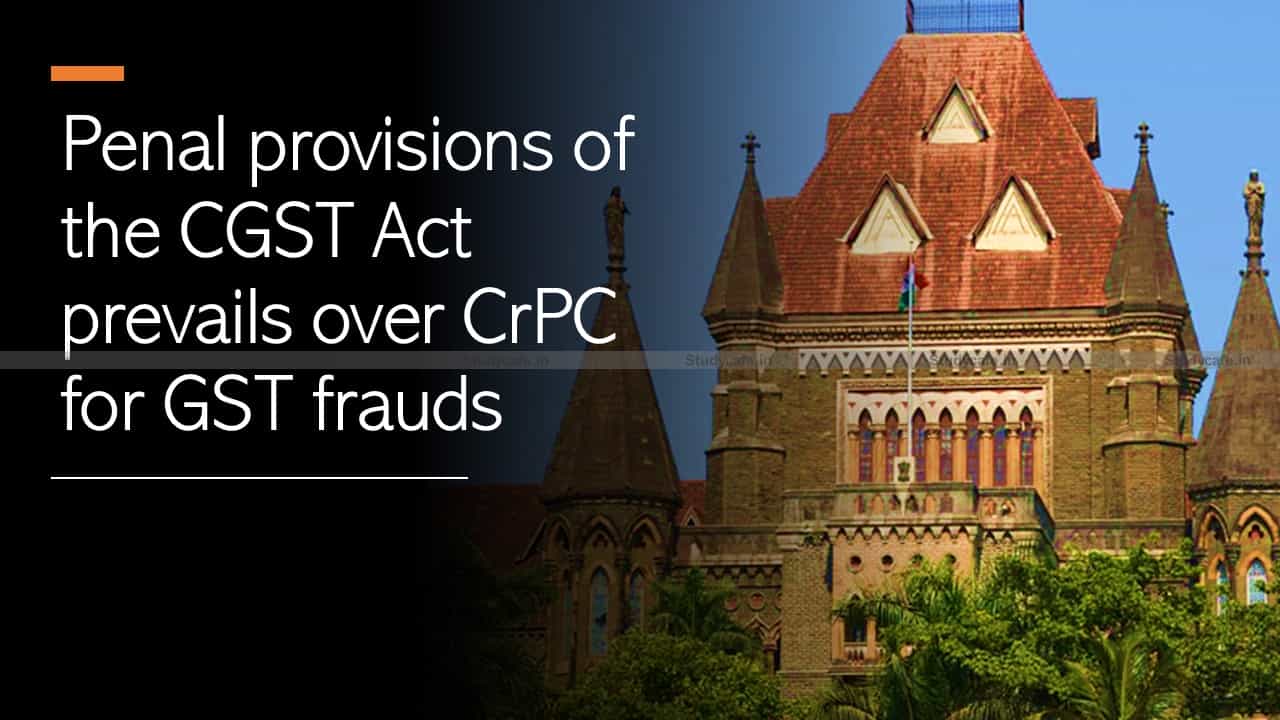
Penal provisions of the CGST Act prevails over Cr.PC for GST frauds The Hon’ble Bombay High Court in Tejas Pravin Dugad v. Union of India [Order No. …
 A2ZBimal Jain
 Feb 5, 2021
- Observed that, Section 67(10) of the CGST Act shows that the provision of Section 165(5) of the Cr.PC will not be applicable to such search and seizure and the report needs to be given to the Commissioner instead of Magistrate. Further, noted that this provision is special in nature and so, it need to be followed.
- Analyzed and considered Section 69 of the CGST Act as it gives procedure which needs to be followed when arrested accused is not released on bail by officer mentioned in this section.
- Observed that, Section 69(3)(b) of the CGST Act shows that when bailable offence is committed, the Deputy Commissioner or the Assistant Commissioner needs to exercise the power, which is given to the officer in-charge of the police station in the Cr.PC and that satisfaction of Commissioner is sufficient for effecting arrest of a person, who has committed the non bailable offences, as specified under Section 132 of the CGST Act. The allegations against the Petitioners shows that there is material for the offences punishable under Sections 132(1)(b) and (c) of the CGST Act.
- Observed that, Section 138 of the CGST Act shows that compounding of the offence is possible either before or after institution of prosecution and that such compounding shall not affect the proceeding, if any, instituted under any other law and the compounding can be done only after making payment of tax, interest and penalty involved in such offences.
- Stated that, the specific provisions and scheme of the CGST Act show that separate Chapters are given in the CGST Act for determination of tax not paid or erroneously refunded or ITC wrongly availed for offences and penalties.
- Held that, in view of the scheme of the CGST Act, the Court has no hesitation to hold that, both adjudication and prosecution can be started simultaneously. Further, the aforesaid special provisions of the CGST Act shall prevail over the provisions of the Cr.PC and it cannot be said that all the provisions like Sections 154 and 173 of the Cr.PC need to be followed for prosecution under the CGST Act.
- The Court is limiting the scope of discussion only to the extent of the offences committed under the CGST Act and the observations are made only from that angle. If offences under the Indian Penal Code, 1860 also are committed then different and more serious view can be taken.
- Noted that no summons were issued to the Petitioners in the present case as interim relief was granted to the Petitioners that prevented the Respondent to issue summons. By such order, the Petitioners indirectly got relief of anticipatory bail, which is also not ordinarily permissible in proceeding of present nature. White collar offences are more serious than offences like murder, dacoity etc. Such offences are committed after hatching conspiracy. This circumstance needs to be kept in mind by Court as the granting of relief of anticipatory bail hampers investigation and such approach causes damage to the image of judiciary.
- Noted that, even when the matter could have been filed before the regular Court as search and seizure took place in November 2020, the matter came to be filed before the Vacation Court. This circumstance also cannot be ignored. Attempt is made to give explanation that the consultant of the company was infected due to Covid-19 virus. Such submission ordinarily cannot be accepted by the Court. On January 11, 2021, there was insistence to grant interim relief and adjournment was sought. The interim relief was vacated by this Court by order dated January 11, 2021. On January 14, 2021 also, initially an attempt was made by the Petitioner that only the Petitioner from Criminal Writ Petition No. 1716 of 2020 had instructed him to argue the matter. When the Court expressed that the Court will dispose of all the matters on merits if the Court finds that admission is not possible, then only argument was advanced in all the matters. Due to all these circumstances, this Court holds that some costs needs to be imposed on the Petitioners.
- Dismissed the petition and directed the Petitioners to deposit Rs. 25,000/- in the court, as costs of the petition for Respondents, within four weeks.
“Power of inspection, search and seizure-
(10) The provisions of the Code of Criminal Procedure, 1973 (2 of 1974), relating to search and seizure, shall, so far as may be, apply to search and seizure under this section subject to the modification that sub-section (5) of section 165 of the said Code shall have effect as if for the word “Magistrate”, wherever it occurs, the word “Commissioner” were substituted.”
Section 69 of the CGST Act:“Power to arrest-

69. (1) Where the Commissioner has reasons to believe that a person has committed any offence specified in clause (a) or clause (b) or clause (c) or clause (d) of sub-section (1) of section 132 which is punishable under clause (i) or (ii) of sub-section (1), or sub-section (2) of the said section, he may, by order, authorise any officer of central tax to arrest such person.
(2) Where a person is arrested under sub-section (1) for an offence specified under sub-section (5) of section 132, the officer authorised to arrest the person shall inform such person of the grounds of arrest and produce him before a Magistrate within twenty-four hours.
(3) Subject to the provisions of the Code of Criminal Procedure, 1973 (2 of 1974),––

(a) where a person is arrested under sub-section (1) for any offence specified under sub-section (4) of section 132, he shall be admitted to bail or in default of bail, forwarded to the custody of the Magistrate;
(b) in the case of a non-cognizable and bailable offence, the Deputy Commissioner or the Assistant Commissioner shall, for the purpose of releasing an arrested person on bail or otherwise, have the same powers and be subject to the same provisions as an officer-in-charge of a police station.”
Section 70(1) of the CGST Act:“Power to summon persons to give evidence and produce documents-
70. (1) The proper officer under this Act shall have power to summon any person whose attendance he considers necessary either to give evidence or to produce a document or any other thing in any inquiry in the same manner, as provided in the case of a civil court under the provisions of the Code of Civil Procedure, 1908 (5 of 1908).”
Section 132(4) of the CGST Act:“Punishment for certain offences-
(4) Notwithstanding anything contained in the Code of Criminal Procedure, 1973, (2 of 1974) all offences under this Act, except the offences referred to in sub-section (5) shall be non-cognizable and bailable.
(5) The offences specified in clause (a) or clause (b) or clause (c) or clause (d) of sub-section (1) and punishable under clause (i) of that sub-section shall be cognizable and non-bailable.
(6) A person shall not be prosecuted for any offence under this section except with the previous sanction of the Commissioner.
Explanation.- For the purposes of this section, the term “tax” shall include the amount of tax evaded or the amount of input tax credit wrongly availed or utilised or refund wrongly taken under the provisions of this Act, the State Goods and Services Tax Act, the Integrated Goods and Services Tax Act or the Union Territory Goods and Services Tax Act and cess levied under the Goods and Services Tax (Compensation to States) Act.”
DISCLAIMER: The views expressed are strictly of the author and A2Z Taxcorp LLP. The contents of this article are solely for informational purpose. It does not constitute professional advice or recommendation of firm. Neither the author nor firm and its affiliates accepts any liabilities for any loss or damage of any kind arising out of any information in this article nor for any actions taken in reliance thereon.About Author


A2ZBimal Jain
Chartered Accountant
 A2Z Taxcorp LLP
 Delhi, Delhi, India
 468
468My Recent Articles
- Actions taken by the department during enquiry need not necessarily be termed as harassment
- Who are liable to generate e-invoice w.e.f October 1, 2022
- Personal penalty cannot be imposed on the Chairman of the Company for failure in ensuring proper accounting of the goods
- Stayed the order of cancellation of GST Registration of the assessee for continuing the trading activities
- Can CA be arrested- Section 69 vs Section 132 of the CGST Act
Loading suggestions…


Recent Posts


All Posts


Recent Posts
All Posts